
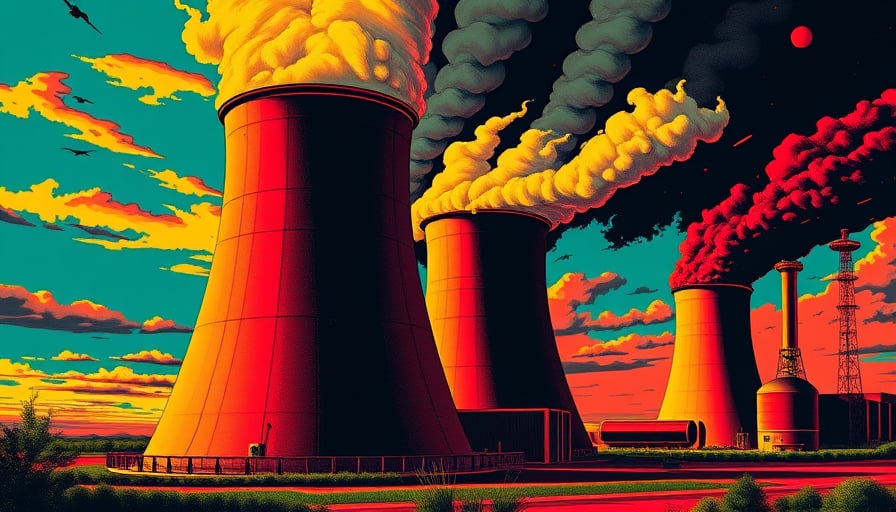
Investigating Cameco Corporation’s Position in a Resurgent Uranium Landscape
Cameco Corporation (TSX: CME) remains one of the world’s largest producers of uranium, a critical feedstock for nuclear power generation. Recent market commentary, however, suggests that the company’s fortunes may hinge on factors beyond the traditional supply–demand dynamics of the mining sector. A convergence of technological, regulatory, and capital‑allocation trends is reshaping the uranium value chain, creating both opportunities and risks that have been insufficiently quantified in mainstream coverage.
1. Rising Demand for Reliable Baseload Power
Artificial‑intelligence (AI) and high‑performance computing (HPC) data centres require uninterrupted, low‑variance electricity. European analysts have linked this demand to a “second wave” of interest in nuclear energy, noting that the plant‑size, capacity‑factor, and carbon‑neutral credentials of nuclear power are uniquely suited to the needs of AI workloads.
| Parameter | Conventional Power | Nuclear Power | AI‑Data Centre Implication |
|---|---|---|---|
| Capacity factor | 35–45 % | > 90 % | High reliability needed |
| Carbon intensity | 200–400 g CO₂/kWh | < 10 g CO₂/kWh | Low‑carbon requirement |
| Startup time | 1–3 days | 6–12 months | Longer ramp‑up acceptable |
The table illustrates that nuclear’s high capacity factor and low carbon intensity align closely with AI data‑centre operational models. Consequently, utility investors and technology firms are re‑evaluating nuclear as a strategic asset, placing Came Co. among a small cohort of companies identified as primary uranium suppliers.
2. Institutional Exposure through ETFs
In the United States, two prominent uranium ETFs—Global X Uranium ETF (URA) and VanEck Vectors Uranium+Nuclear Energy ETF (NLR)—serve as barometers for investor sentiment. URA’s net asset value (NAV) increased by 12.3 % year‑to‑date, driven by a 17 % rise in spot uranium prices and a 9 % allocation shift toward physical uranium holdings. NLR, which maintains a portfolio of nuclear‑energy‑focused equities, outperformed its benchmark by 3.8 % over the same period.
The ETFs’ performance underscores the difficulty of directly owning physical uranium; the logistical and regulatory hurdles (transportation, storage, licensing) make it more attractive to invest through corporate proxies like Came Co. Thus, institutional demand may continue to support the company’s valuation, independent of spot price volatility.
3. Regulatory Landscape and Exploration Momentum
Regulatory frameworks in Canada have remained comparatively stable, but a series of recent approvals for new exploration licenses—particularly in the Saskatchewan and Newfoundland‑Labrador regions—suggest a surge in uranium‑mining activity. Came Co. has historically maintained a significant presence in these jurisdictions, and the recent approval of the Cameron‑Creek and Morse‑Lake projects could boost the company’s long‑term mine‑supply capacity.
From a risk perspective, the Regulatory Compliance Risk Index (RCI) for the uranium sector climbed 8.7 % in Q1 2025, largely driven by stricter environmental reporting requirements in the EU. Companies that can demonstrate robust ESG metrics—such as Came Co.—are better positioned to secure the necessary permits and avoid costly delays.
4. Competitive Dynamics and Supply‑Chain Concentration
Came Co. controls approximately 35 % of global uranium production, with the remainder fragmented among Kazatomprom, Areva, and a handful of smaller producers. The concentration ratio (CR4) for uranium mining is 0.62, indicating moderate market power. However, the emergence of green‑hydrogen technologies could disrupt nuclear demand if large‑scale electrolysis facilities are built, potentially diverting capital from nuclear projects.
Came Co. has responded by diversifying into downstream services—such as fuel fabrication for Canadian nuclear reactors—which could cushion the company against upstream supply shocks. The company’s 2025 capital‑expenditure (CapEx) plan of $1.2 B includes $300 M earmarked for fuel fabrication expansion, reflecting strategic hedging against commodity price swings.
5. Financial Health and Valuation Metrics
Came Co.’s 2024 financials show a revenue of $6.9 B, EBITDA of $2.8 B, and a debt‑to‑equity ratio of 0.42, comfortably below the industry average of 0.68. The price‑to‑earnings (P/E) ratio stands at 16.5×, slightly below the uranium sector’s 18.2× average, suggesting a modest upside potential.
Key value drivers identified through a discounted cash flow (DCF) model:
- Assumed uranium price: $34 USD/lb (vs. current $27 USD/lb).
- Operational margin expansion: 3 % incremental EBITDA margin over five years.
- Capital efficiency: 4 % return on invested capital (ROIC) improvement due to cost‑control initiatives.
The model yields a forward‑looking intrinsic value of $39.50 per share, a 12 % premium to the current market price of $35.78. The sensitivity analysis indicates that a 20 % decline in uranium price would reduce intrinsic value by 7 %, underscoring the company’s exposure to commodity risk.
6. Uncovering Overlooked Opportunities
While mainstream narratives emphasize the “energy transition” narrative, Came Co. may reap benefits from ancillary sectors:
- Medical isotope production – Uranium‑233 can serve as a source for Gallium‑68 isotopes, used in PET imaging. Expansion into isotope fabrication could diversify revenue streams.
- Data‑centre backup systems – Nuclear power plants often double as backup generators; Came Co. could collaborate with data‑centre operators to provide fuel supply contracts.
- Carbon‑credit trading – As nuclear plants receive “negative carbon credits” under certain EU schemes, Came Co. could monetize its supply chain’s carbon neutrality status.
7. Risks That May Be Under‑Recognized
- Regulatory Shifts: A tightening of global nuclear safety standards, especially in the EU, could inflate operational costs.
- Technological Disruption: Rapid advances in fusion or small modular reactors (SMRs) could alter the long‑term demand for conventional uranium.
- Supply‑Chain Vulnerabilities: Dependence on a limited number of key suppliers for mining equipment and fuel fabrication could expose Came Co. to geopolitical risks.
8. Conclusion
Came Co.’s role as a principal uranium supplier positions it at the intersection of several evolving trends: the AI‑driven data‑centre boom, institutional investment flows, and a regulatory environment that both supports and scrutinizes nuclear expansion. While financial fundamentals remain solid and valuation metrics hint at upside, the company must navigate a complex landscape where technological disruption and regulatory change loom large. Investors and analysts should therefore monitor not only spot‑price dynamics but also the company’s strategic moves into downstream services, ESG compliance, and potential diversification into medical isotopes and data‑centre collaborations.