
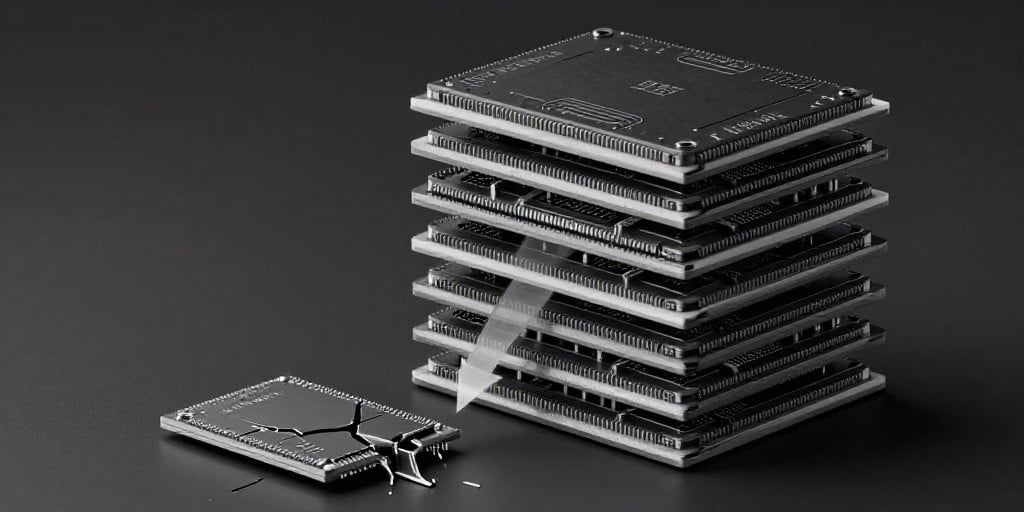
Western Digital’s Slide Amid an AI‑Driven Re‑evaluation of the Semiconductor Landscape
Western Digital Corp. (WDC) experienced a pronounced decline in trading on Tuesday, falling in the low‑single‑digit range alongside a broader slide across memory and semiconductor stocks. The company’s share price moved in tandem with peers such as Seagate and Micron, reflecting a wider correction that has impacted the Nasdaq 100, which has shed a noticeable portion of its recent gains.
The Anatomy of a Sector‑Wide Pullback
At the heart of this downturn lies investor skepticism about the sustainability of the artificial‑intelligence (AI) spending boom. The cost of AI development has ballooned—cloud‑service providers, hardware vendors, and enterprise customers alike are committing significant capital to training, inference, and data‑storage pipelines. Concurrently, heightened competition from Chinese chip manufacturers has forced Western firms to re‑evaluate their pricing power and market share.
Analysts argue that the rapid rally in AI‑related names may have outstripped the underlying fundamentals that support such high growth expectations. The valuation multiples of companies like NVIDIA, AMD, and even traditional storage leaders were, in many cases, driven by forward‑looking projections rather than current earnings. When those projections faltered—whether due to slowing demand for high‑performance GPUs or the emergence of more cost‑effective Chinese competitors—investors began to pull back.
Debt, Infrastructure, and the Perception of Overreach
The market’s reaction has been amplified by concerns over high debt levels tied to large AI infrastructure deals. Companies that financed AI‑centric expansions with leverage now face a tougher environment: their balance sheets reveal significant interest obligations that may strain cash flows if growth does not materialize as projected. Traders, in turn, are demanding clearer evidence that future demand will support current valuations.
This scrutiny is not limited to the United States. The decline in global semiconductor indices underscores a broader loss of confidence that extends beyond domestic markets. Emerging economies that depend on semiconductor imports for technology development are also reassessing their supply‑chain strategies, potentially reshaping the industry’s geographic distribution of production and R&D.
Western Digital’s Position in the New Landscape
Western Digital’s performance mirrors this trend. The company’s share price has been squeezed in line with the broader memory‑chip sector’s downturn. Its valuation has come under pressure as investors reassess the balance between projected growth and the risk of overinvestment in AI‑related hardware.
Despite these challenges, analysts remain divided on the long‑term outlook. Some maintain a cautious bullish stance based on WDC’s established market position and the potential for future demand in high‑capacity storage. The company’s 3D NAND and high‑density SSD technologies, for instance, are well‑suited to the needs of large‑scale AI data centers that require efficient, scalable storage solutions.
Case Study: The 3D NAND Advantage
One illustrative example is Western Digital’s recent deployment of 3D NAND technology across its storage portfolio. By stacking memory layers vertically, the company can achieve higher densities while maintaining or reducing costs per gigabyte. This directly addresses the bandwidth and capacity requirements of AI workloads, which often involve processing terabytes of data daily.
However, the transition to 3D NAND also entails significant capital expenditure and manufacturing lead times. If demand for AI‑driven storage does not accelerate as forecasted—due to competition, shifting AI paradigms, or macroeconomic headwinds—Western Digital could face excess inventory or underutilized production capacity.
Broader Societal, Privacy, and Security Implications
Beyond the boardroom, the sector’s pivot toward AI infrastructure raises broader questions. As storage capacities expand to meet AI demands, so too does the volume of personal and sensitive data that must be safeguarded. The concentration of data in a few large cloud providers amplifies the risk of privacy breaches, prompting regulators to consider stricter data‑protection frameworks.
Security concerns also loom large. The proliferation of AI‑powered malware—capable of autonomously learning and evading traditional defenses—means that storage vendors must integrate robust security features into their hardware and firmware. Failure to do so could expose enterprises to costly breaches, eroding trust in the very technology that fuels AI innovation.
Looking Ahead
The current correction presents both a cautionary tale and an opportunity. Companies that can navigate the delicate balance between innovation, debt management, and ethical responsibility will be best positioned to thrive. Western Digital’s experience illustrates the broader challenge facing the semiconductor industry: delivering cutting‑edge technology while maintaining financial prudence and societal trust.
In the months ahead, investors will continue to scrutinize earnings reports, debt levels, and supply‑chain resilience. Those who can convincingly demonstrate that their products are indispensable to the next wave of AI adoption—and that they can do so without compromising security or privacy—may find that the market’s skepticism is a short‑lived hurdle rather than an enduring barrier.