
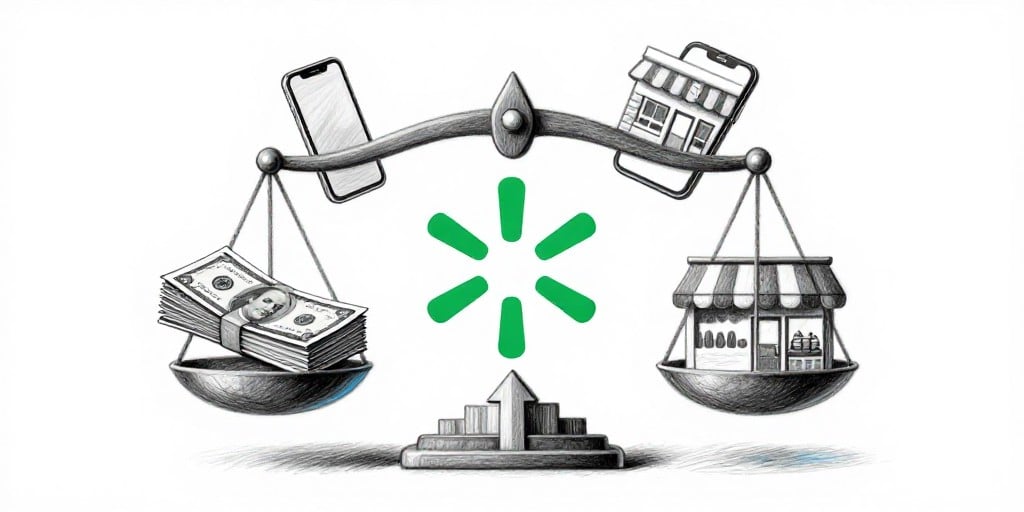
Walmart Inc. Sustains Momentum Amid a Shift Toward Value‑Focused Investment
In a market that has recently tilted away from high‑growth technology names toward more stable, consumer‑oriented companies, Walmart Inc. has continued to demonstrate resilience. The retailer’s stock performance reflects a broader rotation by investors seeking steadier earnings profiles and less capital intensity.
Market Dynamics and Investor Sentiment
The recent shift in investor sentiment has favored firms with predictable cash flows over those that rely heavily on rapid expansion and significant capital outlays. Walmart’s robust store‑traffic numbers, coupled with ongoing supply‑chain efficiencies, reinforce the company’s revenue outlook even as macro‑economic data indicate a cautious stance on discretionary spending. This environment has amplified demand for retail businesses that can balance growth with disciplined cost control.
Earnings Outlook and Cost Discipline
Market participants are closely monitoring upcoming quarterly earnings reports to assess Walmart’s cost structure and inventory management. The retailer’s capacity to sustain profit margins in the face of rising commodity prices remains a critical metric for investors. Analysts emphasize that Walmart’s extensive distribution network and economies of scale provide a cushion against volatile input costs, which is essential in an environment marked by fluctuating commodity prices and potential supply‑chain disruptions.
Institutional Appeal and Dividend Policy
Walmart’s dividend policy offers a yield that contrasts sharply with the growth‑focusing strategies of many peers. This attribute has attracted income‑seeking investors, contributing to a more balanced valuation relative to the broader index. Institutional investors are particularly drawn to the retailer’s ability to generate reliable cash flows, enabling consistent dividend payouts while maintaining reinvestment capacity for future growth initiatives.
Omnichannel Strategy and Consumer Trends
The retailer’s integrated omnichannel approach—combining brick‑and‑mortar operations with e‑commerce capabilities—positions Walmart favorably as consumer habits evolve. Analysts project that the company’s omnichannel strategy will continue to underpin its competitive advantage, especially in regions where digital adoption is accelerating. The expansion of same‑day delivery, curbside pickup, and in‑store pickup options reflects Walmart’s responsiveness to changing consumer preferences, thereby enhancing customer loyalty and driving incremental sales.
Broader Sector Implications
The retail sector as a whole has garnered interest from institutional investors seeking exposure to companies capable of weathering volatility in consumer demand. Walmart’s performance provides a benchmark for assessing resilience in the face of macro‑economic uncertainty. Its operational fundamentals—strong logistics, diversified product mix, and cost‑effective supply‑chain practices—offer a template for peers navigating similar challenges.
Conclusion
Walmart Inc.’s continued focus on operational excellence, coupled with a prudent dividend strategy and a forward‑looking omnichannel model, positions the retailer as a compelling option for investors seeking a blend of growth potential and risk mitigation. As the market continues to prioritize value and stability, Walmart’s solid fundamentals are likely to sustain investor confidence and contribute to its resilience amid evolving economic conditions.