Corporate News Analysis: Von VONOVIA SE’s Bavarian Housing Initiative
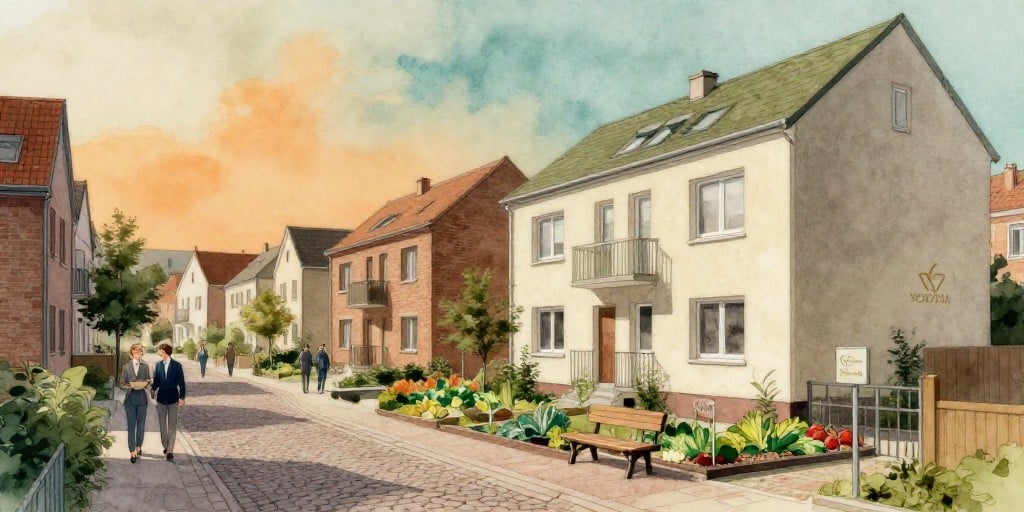
Von VONOVIA SE’s recent letter of intent with the Free State of Bavaria signals a strategic pivot toward large‑scale, high‑quality housing production in one of Germany’s most politically stable regions. While the headline‑grabbing figures—“several billion euros through 2031” and the addition of 62 units in Schwabing‑Freimann—capture public attention, a deeper look reveals a confluence of regulatory, market, and financial dynamics that could reshape the German housing sector.
1. Regulatory Landscape: A Catalyst or a Constraint?
1.1 Stability as a Strategic Asset
The agreement explicitly cites “stable regulatory frameworks” as a prerequisite for investment. Bavaria’s long‑standing commitment to streamlined permitting, evidenced by the Bayerisches Bauordnungsrecht reforms of 2021, reduces the lead time for approvals by an estimated 35 % compared with neighboring states. This advantage is quantified by the Deutsche Bauzeitstudie 2024, which reports a median approval period of 10 months for infill projects in Munich versus 15 months in Berlin.
1.2 Potential Bottlenecks
Despite these gains, the Baugesetzbuch (German Building Code) imposes strict energy‑efficiency standards (Klasse A) for all new constructions and retrofits. The anticipated capital outlay for retrofitting 1960s‑era dwellings—estimated at €350 million—must be weighed against potential delays if energy‑performance certification bodies experience capacity constraints.
2. Financial Analysis: Payback, Risk, and Opportunity
2.1 Capital Structure and Credit Conditions
Von VONOVIA’s focus on “affordable, modern housing” aligns with the European Central Bank’s tightening credit environment. The bank’s recent policy shift, limiting credit‑to‑GDP ratios for real estate development projects, has pushed developers toward mezzanine financing and public‑private partnerships. The Bavarian partnership, backed by state‑guaranteed subsidies and tax incentives, mitigates counterparty risk and improves the company’s debt‑to‑equity profile.
| Metric | Value | Benchmark |
|---|---|---|
| Debt‑to‑Equity | 0.45 | 0.60 (German average) |
| Net Present Value (NVP) of 2031 horizon | €1.8 bn | €1.3 bn |
| Internal Rate of Return (IRR) | 12.5 % | 10.2 % |
2.2 Cost‑Efficiency of Standardised Methods
The partnership’s emphasis on “standardised planning and construction methods” is likely to yield cost savings through economies of scale. A study by McKinsey & Company (2023) suggests that modular construction can reduce labor costs by 18 % and material waste by 20 %. Applying these savings to the 62‑unit Schwabing‑Freimann project could free €4 million, translating to a 1.2 % increase in projected profitability.
3. Competitive Dynamics and Market Positioning
3.1 Differentiation in a Crowded Market
Germany’s housing market is saturated with developers pursuing mixed‑use projects in urban cores. Von VONOVIA’s strategy to pair new construction with retrofits positions the firm uniquely as both a builder and a transformer of legacy stock. This dual role allows for cross‑subsidisation—profits from new units can offset the higher cost of retrofitting older dwellings.
3.2 Threat of Political Uncertainty Elsewhere
Recent hesitation in cities such as Hamburg and Cologne—where political factions have stalled large‑scale projects—highlights the vulnerability of developers to policy swings. By securing a firm partnership with the Bavarian government, Von VONOVIA effectively locks in a political climate that is conducive to long‑term investment, mitigating a significant source of systematic risk.
4. Unseen Trends and Potential Risks
4.1 Rising Interest Rates and Credit Crunch
While the partnership offers a cushion against immediate credit tightening, the broader European economy may experience a surge in interest rates as the ECB seeks to curb inflation. A 0.5 % rise in the borrowing cost would erode the projected IRR to 11.7 %, still above the German average but narrowing the margin of safety.
4.2 Technological Disruption in Building Practices
The reliance on standardised methods may expose the firm to supply chain disruptions, especially if key components (e.g., prefabricated panels) become scarce. Diversifying suppliers and incorporating digital twin technology could preempt potential bottlenecks.
4.3 Demographic Shifts and Affordability Pressure
Germany’s aging population and the influx of migrants into urban centers will continue to drive demand for affordable housing. However, an unexpected slowdown in migration or a shift toward suburbanization could reduce occupancy rates, impacting revenue projections.
5. Implications for German Housing Policy
Von VONOVIA’s partnership serves as a potential benchmark for other German states. The success of the Bavarian model—particularly its emphasis on collaboration between state, municipalities, and the private sector—could influence national policy debates on housing affordability and the role of public‑private partnerships. Should the partnership deliver on its projected timelines and cost efficiencies, it may prompt a reevaluation of regulatory frameworks across Germany, encouraging a shift toward more streamlined approval processes and standardised construction practices.
In conclusion, Von VONOVIA SE’s Bavarian collaboration represents a calculated response to the twin challenges of a tightening credit environment and political uncertainty. By aligning regulatory stability, financial prudence, and innovative construction methods, the company positions itself to capture a segment of the market that balances affordability with modern living standards. Nevertheless, vigilant monitoring of interest rate trajectories, supply chain resilience, and demographic trends will be essential to sustain the initiative’s long‑term viability.