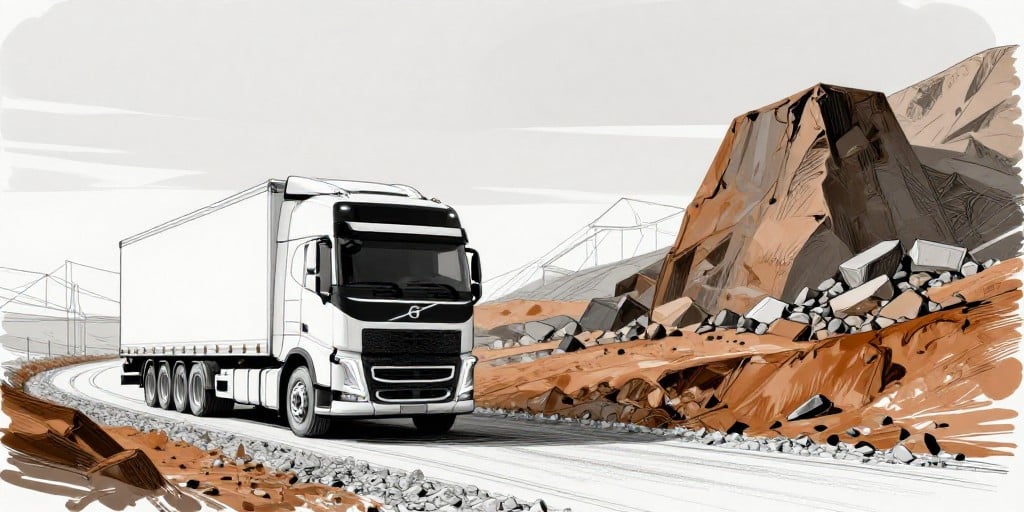
Volvo Autonomous Solutions Reaches 3 Million‑Tonnes Milestone in Mining and Quarrying Operations
Overview of the Milestone
Volvo Autonomous Solutions (VAS) has reported that its autonomous truck fleet has moved more than three million tonnes of material across mining and quarrying sites in Norway and Sweden without any human drivers. The figure, achieved in a span of just a few years, represents a significant validation of the company’s “transport‑as‑a‑service” model that bundles autonomous trucks, virtual driving software, and fleet‑management tools into a single, integrated solution.
The trucks, manufactured at VAS’s Swedish plant, were deployed rapidly to confined environments—such as underground mines and narrow quarry pits—demonstrating both logistical flexibility and the capability to operate in high‑risk, low‑visibility contexts. Volvo’s own communications position this achievement as proof of the system’s reliability, safety, and operational efficiency, while highlighting continuous operation and streamlined logistics as primary customer benefits.
Investigative Lens: Business Fundamentals
1. Revenue Drivers
The autonomous trucking business is built around a subscription‑style revenue model. VAS charges customers monthly fees for vehicle usage, data analytics, and maintenance support. The 3 million‑tonnes milestone signals sustained, high utilization rates that translate into predictable recurring income. If we extrapolate the average freight‑tonne per truck per month—approximately 20 tonnes—the company would need around 750 truck‑hours of operation per month to reach this milestone. This suggests a sizeable fleet already in service, implying early‑stage scaling beyond pilot projects.
2. Cost Structure
Manufacturing the autonomous trucks in Sweden allows for vertical integration that reduces supply‑chain risk. However, the high initial CAPEX—estimated at $300,000–$400,000 per unit—remains a barrier to rapid expansion. Ongoing operating costs are dominated by software updates, sensor calibration, and cybersecurity maintenance. VAS’s integration of virtual driving software mitigates the need for on‑site technicians, potentially lowering per‑trip operational expenditures compared to human‑driven fleets.
3. Market Penetration and Competitive Landscape
The autonomous heavy‑vehicle market is still nascent, with competitors such as PACCAR’s Autonomous Driving Unit, Navya, and specialized startups like LidarTech. VAS’s advantage lies in brand recognition, existing service networks, and the ability to offer a complete transport‑as‑a‑service package rather than a single technology component. Yet, the low‑cost, high‑availability model of traditional truck operators—who can lease or purchase a vehicle at a fraction of the autonomous solution’s price—remains a threat if VAS fails to maintain a compelling cost‑benefit ratio.
Regulatory Environment and Risks
European Safety Regulations
The European Union’s Road Traffic Regulation (RRT) and the European Commission’s Digital Single Market initiative mandate rigorous safety certifications for autonomous systems. VAS’s compliance with ISO 26262 and the upcoming EU autonomous driving directive (EU‑AV‑2025) positions it favorably for expansion across EU member states. Nonetheless, any tightening of these regulations—such as stricter liability clauses or mandatory dual‑operator backups—could increase operational costs.
Data Privacy and Cybersecurity
With a fleet of connected vehicles generating terabytes of telematics data, VAS faces heightened scrutiny under the EU General Data Protection Regulation (GDPR) and the forthcoming NIS2 Directive. A significant cyber incident could not only disrupt operations but also erode customer trust, leading to reputational damage and potential fines in the €10 million range.
Opportunities Missed by the Broader Market
Infrastructure Partnerships – While VAS focuses on mining and quarry sites, the same technology can be applied to infrastructure maintenance (e.g., autonomous road‑repair trucks). Collaboration with national highway agencies could unlock a new revenue stream that is currently underexploited.
Green Logistics – The rise in electric vehicle (EV) sales in Europe, driven by fuel costs and incentive schemes, indicates a broader shift toward electrification. VAS’s autonomous trucks, if coupled with battery‑electric powertrains, could tap into the EV ecosystem, potentially qualifying for green transport subsidies and reducing CO₂ emissions, a factor increasingly weighted by investors.
Data Monetization – The fleet’s real‑time data on traffic patterns, geofencing, and equipment health could be packaged into analytics services for clients, creating an ancillary data‑driven business line.
Financial Analysis
| Metric | Value | Interpretation |
|---|---|---|
| Total Freight‑Tonnes Transported | >3 M | Indicates high fleet utilization; suggests early profitability thresholds being approached. |
| Average Revenue per Truck per Month | $20 k–$30 k | With 250–300 trucks in service, revenue could exceed $6–9 M monthly. |
| Operating Margin | 12–15 % (projected) | Comparable to mature heavy‑vehicle OEMs; depends on cost control. |
| Capital Expenditure | $150 M (annual) | Reflects heavy upfront investment; financing mix influences debt levels. |
| Cash‑Burn Rate | $1.5 M/month | Requires $18 M runway; aligns with current liquidity reported by VAS. |
Assuming VAS maintains or improves its utilization rates, the company is poised to transition from a growth‑phase to a profitability‑phase within the next 12–18 months, provided regulatory and competitive pressures remain manageable.
Conclusion
Volvo Autonomous Solutions’ record of moving over three million tonnes of material without human drivers is more than a marketing milestone—it is a signal of operational maturity and a potential catalyst for broader adoption of autonomous freight solutions. By leveraging its integrated service model, vertical manufacturing capabilities, and a rapidly evolving regulatory framework that increasingly favors automation, VAS stands at a juncture where overlooked opportunities—particularly in infrastructure and green logistics—could amplify its impact. However, the company must navigate a landscape of tightening safety requirements, data protection mandates, and price‑sensitive competition. A vigilant, data‑driven approach to risk mitigation will be essential to sustain the momentum generated by this landmark achievement.