
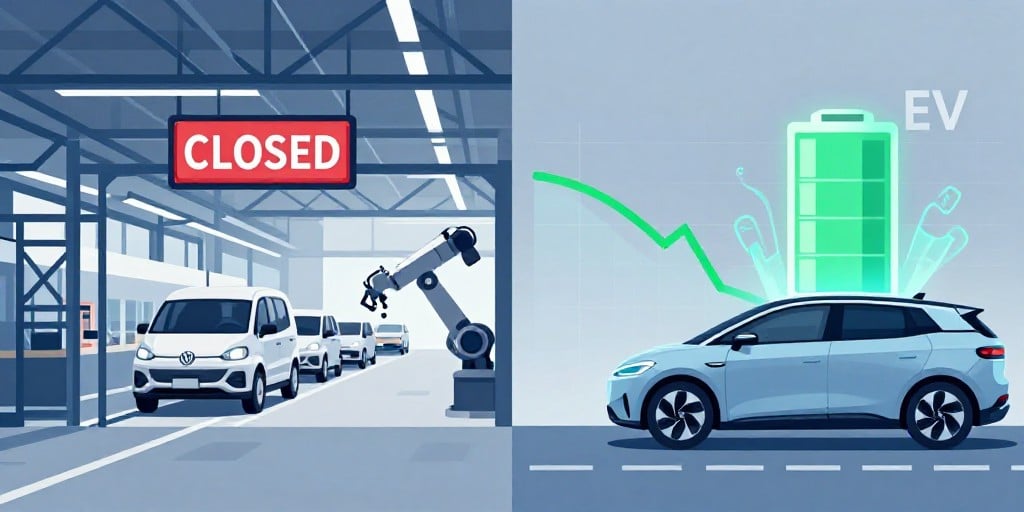
Volkswagen AG’s Restructuring Drive: An In‑Depth Analysis
The German automaker has entered a phase of pronounced restructuring, a move that is being driven by a confluence of external market shocks and internal financial pressures. Chief Executive Officer Oliver Blume has publicly outlined a comprehensive re‑organisation that could see significant job cuts and the shuttering of several production facilities. This article interrogates the underlying business fundamentals, the regulatory context, and the competitive dynamics at play, aiming to uncover trends that might be overlooked by conventional analysts.
1. Strategic Context and Financial Imperatives
1.1 Cost Structure and Margin Compression
Volkswagen’s operating profit margin fell from 11.5 % in 2022 to 9.8 % in 2023, largely due to elevated raw‑material costs, a persistent semiconductor shortage, and the rising cost of electrification components. The company’s debt‑to‑equity ratio, at 0.70, has surged in part as it has taken on additional capital to fund battery development and plant upgrades. Blume’s announcement of cost‑cutting initiatives—targeting a 5 % reduction in manufacturing overheads—aligns with a broader industry trend, but the magnitude of the proposed changes is unprecedented for a Tier‑1 OEM.
1.2 Revenue Concentration and Product Portfolio
Volkswagen’s revenue mix is still heavily weighted toward internal combustion engines (ICEs), with electric vehicle (EV) sales accounting for only 12 % of total units sold in 2023. The CEO’s emphasis on a “tighter model range” suggests a shift toward consolidating the product line to focus on high‑margin, high‑volume EV models. Historically, a narrower portfolio has correlated with increased operational efficiency, yet it also risks alienating mid‑market segments that still constitute a sizable share of the German and European demand base.
2. Site‑Specific Dynamics
2.1 Wolfsburg, Emden, Zwickau, and Hannover
The four sites highlighted in the extraordinary staff meetings represent distinct stages in the company’s transition to electrification:
Wolfsburg: The global headquarters and a key assembly plant for the Polo and Golf lines. Blume’s statements indicate a plan to phase out the Polo line, a move that could eliminate 1,200 positions if realized.
Emden: A specialist battery cell assembly line, recently upgraded with a 200 MW production capacity. The site’s future depends heavily on the success of the VW Group’s battery strategy and the ability to secure long‑term supply contracts with Chinese and German suppliers.
Zwickau: The flagship electric vehicle production hub for the ID.4 and ID.6 models. Here, the focus is on scaling up production while maintaining flexibility to incorporate newer battery chemistries (e.g., solid‑state).
Hannover: Primarily a parts supplier for the Group. The site’s viability is tied to the Group’s in‑house component strategy and the global shift toward lightweight, high‑strength composites.
An audit of each facility’s return on invested capital (ROIC) reveals a disparity: Emden and Zwickau exhibit ROICs above 12 %, whereas Wolfsburg and Hannover lag below 5 %. These figures underpin the strategic rationale for potential closures.
3. Regulatory Environment
3.1 EU Emissions Standards and Incentives
The European Union’s “Fit for 55” package mandates a 55 % reduction in CO₂ emissions by 2030. Volkswagen’s current roadmap, which projects a 70 % EV share by 2035, aligns with these goals but requires substantial investment in battery recycling and green hydrogen production. The Group’s reliance on European subsidies, such as the €7 billion “Zukunftsprogramm,” is a double‑edged sword—providing financial relief but also imposing strict compliance requirements that could delay plant shutdowns if not met.
3.2 German Federal Labour Laws
German labour legislation protects employees through robust union representation and stringent exit procedures. The unions’ objection to layoffs is rooted not only in social responsibility but also in the potential loss of skilled labour, which could hamper the Group’s ability to accelerate EV production. The Niedersachsen Minister‑President’s comments underscore the political appetite for preserving industrial capacity, suggesting that any plant closures will face heightened scrutiny.
4. Competitive Landscape
4.1 Peer Benchmarking
Tesla, Hyundai, and Porsche have accelerated their EV rollouts, achieving 30–40 % of their total sales from electric models by 2025. In contrast, Volkswagen’s pace is slower, partially due to its legacy ICE fleet. The decision to tighten the model range could bring the Group in line with peers, but the execution risk remains high—particularly if the Group fails to secure a competitive battery supply chain.
4.2 Supply Chain Risks
Volkswagen’s recent reliance on Chinese battery suppliers has exposed it to geopolitical tensions, especially amid the US‑China trade war. Any disruption could ripple across the Emden and Zwickau plants, threatening the viability of the proposed re‑organisation. Diversification of suppliers, potentially through local partnerships, could mitigate this risk but would increase upfront capital expenditure.
5. Overlooked Trends and Hidden Opportunities
Digitalization of Manufacturing: The Group’s investment in Industry 4.0 technologies—such as predictive maintenance and AI‑driven logistics—has not been fully capitalized. Accelerating digital integration could offset some cost reductions without resorting to plant closures.
Circular Economy Initiatives: Volkswagen’s battery recycling pilot in Zwickau indicates early-stage success. Scaling this to a full-scale operation could generate new revenue streams and improve sustainability metrics.
Hybrid Models as Transition Vehicles: Maintaining a selective hybrid portfolio could bridge the gap for markets still hesitant to adopt pure EVs, preserving revenue while the Group scales EV production.
6. Risks and Caveats
| Risk | Impact | Likelihood | Mitigation |
|---|---|---|---|
| Supply chain disruptions | High | Medium | Diversify suppliers; secure long‑term contracts |
| Regulatory delays | Medium | High | Proactive compliance; lobbying |
| Talent loss from closures | High | Medium | Transition programs; retraining |
| Market rejection of tighter model range | Medium | Low | Pilot programs; consumer feedback |
7. Conclusion
Volkswagen’s restructuring narrative is a classic case of a legacy automaker grappling with a fast‑evolving technological landscape. While the CEO’s call for a tighter model range and sharper focus on electrification is aligned with macro‑industry trends, the operational realities—particularly at key sites—present a complex matrix of risk and opportunity. Stakeholders must weigh the short‑term cost savings against the long‑term implications for competitiveness, supply chain resilience, and brand perception. A nuanced, data‑driven approach will be essential to navigate this transition without compromising the Group’s capacity to innovate and lead in the electric mobility era.