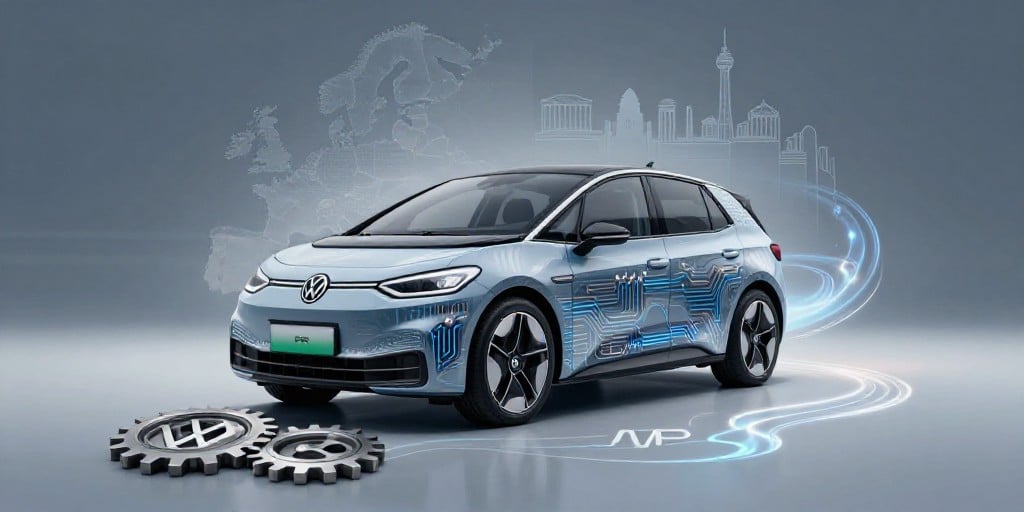
Volkswagen Contemplates Cross‑Regional Software Architecture for European EVs
Volkswagen AG has reportedly been exploring the possibility of integrating the China Electronic Architecture—a software and electronic platform jointly developed with Chinese electric‑vehicle maker Xpeng—into its European mass‑market line‑up. According to a German trade publication, the proposal would see the architecture deployed across a significant portion of forthcoming models in the VW, Skoda, and Cupra brands, with the stated objective of streamlining development cycles and accelerating time‑to‑market for new electric vehicles in Europe.
Strategic Rationale
Volkswagen’s current strategy in China has involved a dedicated software stack tailored to local market requirements, regulatory constraints, and customer preferences. By contrast, the Western division has largely relied on a separate platform that it has co‑developed with Rivian. The move to adopt the China‑derived architecture in Europe would represent a strategic realignment aimed at consolidating software development efforts, reducing duplication of engineering resources, and leveraging economies of scale. Such a shift also aligns with the broader automotive trend toward software‑centric, modular platforms that can be rapidly adapted to a range of vehicle types and market segments.
Implications for the Rivian Partnership
Rivian has been a key partner for Volkswagen in the development of a distinct technology platform intended for the North‑American market. The company has invested heavily in the joint venture, which has produced a separate set of vehicle‑control software and hardware components that differ from those used in China. The proposal to introduce the China Electronic Architecture in Europe raises questions about the future role of the Rivian‑derived platform in Volkswagen’s volume production. However, no official statement has indicated that the partnership will be altered or reduced. It is plausible that Volkswagen may pursue a dual‑architecture strategy—using the Rivian platform in the United States while adopting the China‑derived stack in Europe—thereby preserving its commitments to both partners.
Role of NXP Semiconductors
In parallel with the software‑architecture debate, Volkswagen has entered into an agreement with NXP Semiconductors to supply microcontrollers that will underpin its emerging software‑defined vehicle architecture. The microcontrollers are intended to consolidate multiple vehicle functions within zonal controllers, thereby reducing hardware complexity and enabling tighter integration across the platform. NXP’s experience in automotive electronics, combined with Volkswagen’s ambition to create a unified software stack, positions the partnership as a potential catalyst for faster, more efficient vehicle development.
Industry Context
The automotive industry is undergoing a decisive shift toward integrated, software‑centric electric‑vehicle platforms. Manufacturers are increasingly seeking to balance global software strategies with local market adaptations, a challenge that becomes more pronounced as companies pursue partnerships across geographic boundaries. Volkswagen’s exploratory move to import a Chinese‑developed architecture for use in Europe illustrates the company’s willingness to adopt a more flexible, cross‑regional approach to software development. It also underscores the importance of securing reliable semiconductor supply chains—exemplified by the partnership with NXP—to support the complex, software‑defined architectures of next‑generation electric vehicles.
In summary, Volkswagen’s potential adoption of the China Electronic Architecture for European models and its continued collaboration with Rivian and NXP indicate a strategic focus on achieving greater software efficiency and platform convergence. This approach is likely to influence the company’s competitive positioning, operational cost structure, and long‑term market responsiveness, while reflecting broader economic trends that favor integrated, agile automotive technologies.