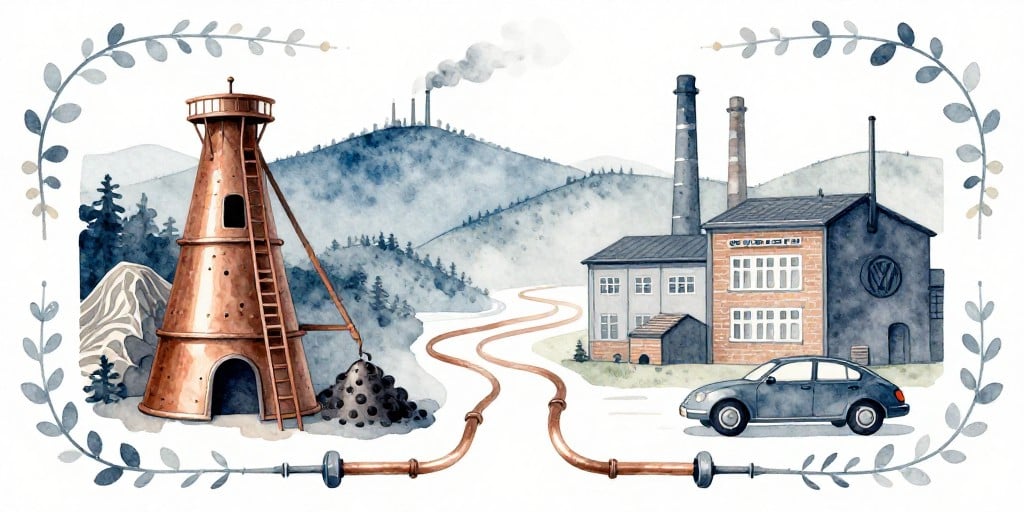
Volkswagen AG Announces Strategic Diversification into Copper Mining
Volkswagen AG has unveiled a bold expansion strategy that will see the automotive giant step into the mining and metals sector. The move, announced by the group’s finance team, involves a planned asset reorganisation aimed at acquiring significant stakes in several copper‑mining operations. Under the proposal, Volkswagen will issue shares to purchase a majority interest in a copper‑mining venture and acquire a full stake in an additional mining operation. The intent is to integrate profitable mineral exploration and production assets into its portfolio, thereby diversifying revenue streams beyond the traditional automotive manufacturing and services model.
Rationale Behind the Diversification
The decision to enter the mining sector aligns with broader industry trends where traditional manufacturers seek to mitigate exposure to volatile commodity markets and supply‑chain disruptions. Copper, a critical component in electric vehicles and renewable energy infrastructure, offers a strategic alignment with Volkswagen’s long‑term electrification roadmap. By securing direct access to copper resources, the company positions itself to hedge against price spikes and supply constraints that could affect its automotive production.
From a financial perspective, the acquisition strategy leverages Volkswagen’s strong balance sheet and access to capital markets. Share issuance to fund the purchases is expected to be diluted but is offset by the anticipated upside in mineral production margins and the potential for value creation through vertical integration. Analysts note that the proposed reorganisation may also unlock synergies between the company’s existing explosive‑manufacturing arm and the mining operations, particularly in logistics, safety, and regulatory compliance.
Market Dynamics and Competitive Positioning
The mining and metals sector is characterised by high capital intensity, long development cycles, and significant regulatory oversight. However, it also offers attractive profit margins, especially for companies that can achieve economies of scale and efficient exploration-to-production pipelines. Volkswagen’s entry into this space signals a shift toward a dual‑business model: combining its established automotive production‑sales services with commodity extraction and processing.
Competitors in the automotive space have largely remained focused on internal combustion engine (ICE) transition or electrification, with limited direct exposure to raw material extraction. In contrast, firms such as General Motors and Stellantis have pursued strategic partnerships and joint ventures with mining companies, but none have taken the step of acquiring operational assets. Volkswagen’s move therefore establishes a new benchmark for vertical integration in the industry.
Economic Context and Labor Pressures
The announcement comes against a backdrop of escalating labour tensions across the German automotive sector. A separate report highlighted widespread walkouts by metalworkers in German factories, affecting key automaker units including Audi and Mercedes‑Benz. The unions demanded wage increases and job‑protective measures, leading to ongoing negotiations with Volkswagen’s parent companies and suppliers.
While these labour disputes are creating short‑term cost pressures for Volkswagen’s German operations, they do not directly influence the planned mining investments. Nonetheless, the company’s leadership must manage the dual challenge of maintaining operational stability in its core manufacturing plants while expanding into a new commodity‑based business. The potential for cost synergies—such as reduced reliance on third‑party copper suppliers—could alleviate some of the financial strain imposed by labour negotiations.
Broader Economic Implications
Volkswagen’s expansion into copper mining reflects a larger trend of diversification among industrial conglomerates seeking resilience against macroeconomic volatility. By securing access to a key raw material, the company can better navigate fluctuations in global supply chains and commodity price cycles. Moreover, the integration of mining operations may enhance the firm’s sustainability profile by allowing tighter control over the entire supply chain, from extraction to vehicle assembly.
In terms of economic impact, the move is likely to attract investment into the mining sector, create new jobs in exploration and production, and stimulate ancillary industries such as logistics, engineering, and safety services. For the German economy, the development of domestic mining assets could reduce import dependence for critical materials, supporting broader industrial policy objectives.
Conclusion
Volkswagen AG’s planned entry into the copper mining and metals sector marks a strategic diversification that transcends traditional automotive boundaries. By acquiring stakes in mining operations, the company seeks to secure a stable supply of a pivotal commodity, enhance its competitive positioning, and create new revenue streams. While labour disputes in Germany pose short‑term cost challenges, the company’s focus on operational stability and strategic asset acquisitions positions it to navigate an increasingly complex industrial landscape.