
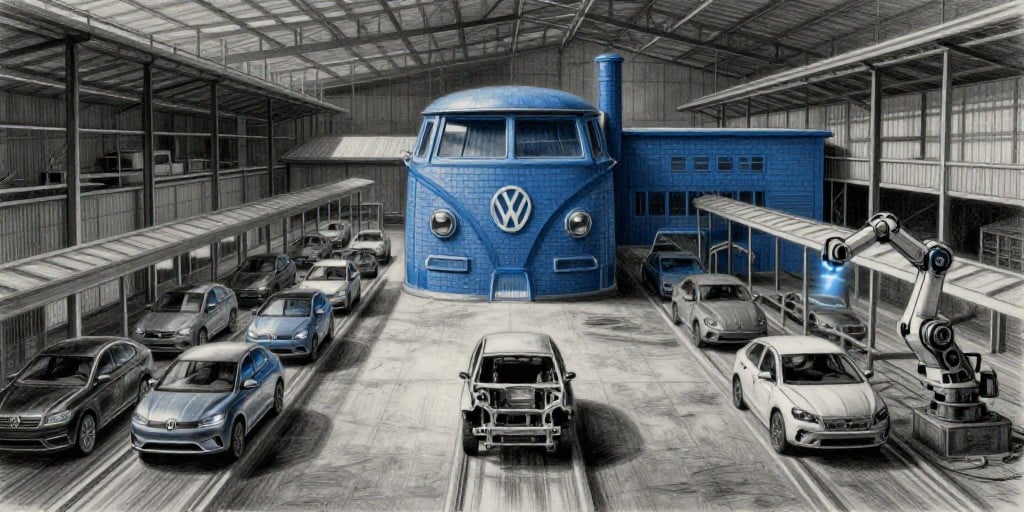
Volkswagen AG Announces Strategic Restructuring to Concentrate on Core Segments
Volkswagen AG (VW) announced a sweeping restructuring strategy designed to sharpen its focus on the most attractive market segments. The board disclosed that the group intends to reduce its model range by up to 50 % and cut the number of optional features by roughly 75 %. In line with this, global production capacity is projected to decline from 12 million to 9 million vehicles per year.
Rationale and Strategic Focus
The company’s leadership has emphasized that investments and development resources will be directed toward products and technologies that generate the greatest value for both customers and the firm. By concentrating on a narrower portfolio, VW seeks to achieve higher economies of scale, streamline supply‑chain operations, and accelerate innovation in high‑growth areas such as electrification and autonomous driving.
The restructuring plan is part of a broader “Target 2030” framework that the board is currently developing. While no specific decisions regarding plant closures or workforce reductions were made at the supervisory‑board meeting, VW confirmed that cost‑cutting measures will be intensified under the new framework.
Implications for Production and Employment
Reports in the media suggest that up to 100 000 jobs could be lost worldwide if the restructuring reaches its full scale. Four German plants—Hannover, Emden, Zwickau and Neckarsulm—may be closed, with production potentially ending at those sites by the end of 2034. The supervisory board confirmed that the exact content of the future plan would be discussed between board and management, but no resolutions were adopted at the meeting.
Employees and trade‑union representatives have voiced significant concerns over the announced changes. IG Metall has called for a clear plan and warned that the company’s approach could trigger substantial conflict. Local workers at several sites, including Wolfsburg, have staged protests, while regional governments—particularly in Lower Saxony—have expressed opposition to plant closures and workforce cuts.
Industry and Economic Context
Automotive industry analysts note that VW’s move reflects a broader trend of consolidation and portfolio rationalization among major manufacturers. With the shift toward electrification, companies are reallocating resources to high‑margin battery and drivetrain technologies while shedding legacy models that no longer align with consumer demand.
The restructuring also intersects with macroeconomic factors such as supply‑chain constraints, fluctuating raw‑material prices, and tightening regulatory standards for emissions. By narrowing its product range, VW aims to mitigate these risks and position itself more competitively against rivals that are pursuing similar strategies, including Stellantis, Toyota, and Ford.
Outlook
The supervisory board’s session ended without reaching a consensus on the proposed savings, leaving the future of the restructuring plan uncertain. Stakeholders—including employees, unions, regional authorities, and investors—await further clarification on the timeline and scope of the changes. If the plan proceeds as outlined, VW will likely see a more streamlined and technology‑centric portfolio, potentially improving profitability and shareholder value, but at the cost of significant workforce and plant realignment.