Volkswagen AG Revises 2026 Outlook Amid Structural Headwinds
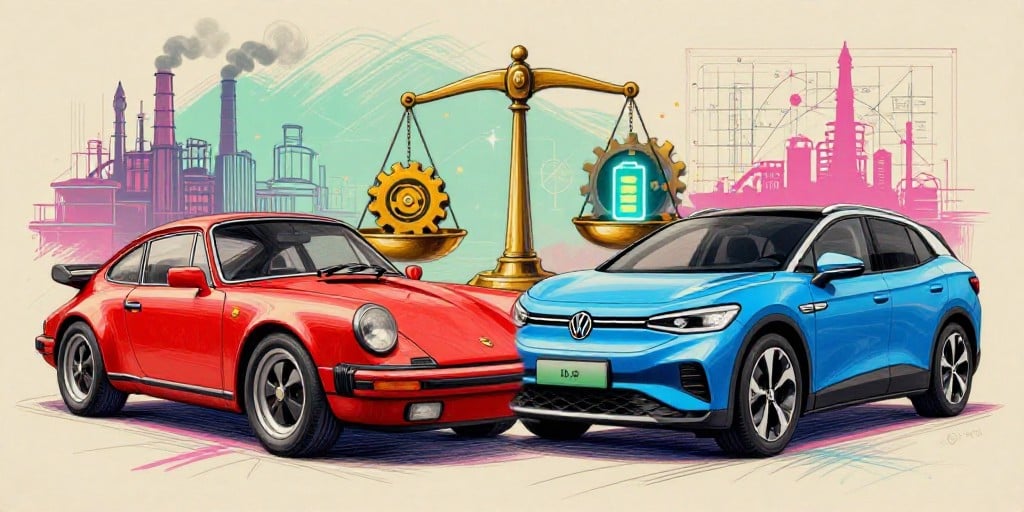
Volkswagen AG has issued a comprehensive revision of its 2026 operating outlook following a decision by its supervisory board. The German automaker announced a substantial restructuring program, the elimination of several thousand jobs, and a sharp cut in projected operating margins, which will now peak at roughly 1 % for the year. The downgrade is primarily attributed to a non‑cash impairment arising from the sports‑car subsidiary Porsche, whose sales decline in China and other markets is weighing heavily on the group’s profitability. Additionally, the company’s transition toward battery‑electric vehicles (BEVs) is eroding margins, particularly for its core passenger‑car brands Audi and Volkswagen, where electric models currently deliver lower returns than internal‑combustion engines (ICE).
1. Financial Baselines and Revised Projections
| Metric | 2025 (Actual) | 2026 (Projected) |
|---|---|---|
| Total Sales | €315 bn | ~€315 bn |
| Operating Margin | ~4 % | ≤1 % |
| Special Items (Restructuring & Write‑downs) | — | €10 bn (Q3‑heavy) |
| Operating Return on Sales (Excl. Special Items) | — | ~4 % |
Key Takeaway: While gross sales are expected to remain flat, the operating margin is expected to contract dramatically, driven largely by non‑cash impairment costs and the high cost of BEV production.
1.1. Impairment Dynamics
The impairment of the Porsche subsidiary reflects a broader trend of consolidation within the German luxury‑car segment. Porsche’s sales in China—a critical growth market—have slipped by 12 % YoY, according to market data from the China Association of Automobile Manufacturers. This decline is compounded by tighter regulatory scrutiny on high‑performance vehicles and the increasing dominance of local electric‑vehicle (EV) players, such as BYD and NIO. The non‑cash nature of the impairment means that it will not directly affect cash flow but will press on profitability and potentially trigger further cost‑cutting measures.
1.2. BEV Cost Structure
Volkswagen’s BEV strategy, while necessary for long‑term competitiveness, introduces a significant cost drag:
- Battery procurement: The cost per kWh has fallen from €250 in 2022 to €140 in 2025, but the required battery capacity for high‑performance models remains high.
- Supply chain concentration: The group still relies on a limited number of battery cell suppliers, increasing exposure to geopolitical and commodity price fluctuations.
- R&D amortization: Large capital expenditures on electric architecture are being amortized over a longer period, creating temporary profitability pressure.
2. Regulatory Context
2.1. European Emission Standards
The European Union’s “Fit for 55” package mandates a 55 % reduction in greenhouse‑gas emissions from 1990 levels by 2030. Volkswagen’s current ICE fleet is projected to exceed the 2030 emission ceiling if BEV uptake does not accelerate, prompting regulatory fines that could further erode margins.
2.2. China’s New Energy Vehicle (NEV) Mandate
China’s NEV subsidies have been gradually phased out, and the government is tightening quality and safety standards for foreign EV entrants. This policy shift reduces the price‑sensitive advantage that German manufacturers once enjoyed, forcing them to compete on technology rather than price.
3. Competitive Landscape
- Chinese Entrants: Companies such as BYD, NIO, and Xpeng have captured 25 % of the global EV market by 2025, benefiting from lower production costs and strong domestic demand.
- Western Rivals: Tesla’s scale advantage and autonomous driving investments create a persistent threat to Volkswagen’s market share.
- Emerging Alliances: Joint ventures with Chinese firms (e.g., the Volkswagen‑GAC alliance) aim to mitigate supply chain risks but have yet to deliver significant cost savings.
4. Uncovered Trends and Strategic Implications
4.1. “Dual‑Brand” Profitability Gap
Volkswagen’s strategy to maintain separate brand identities for Audi, Volkswagen, and Porsche may be contributing to inefficiencies. The higher-margin Porsche segment is being absorbed into a broader portfolio that includes lower‑margin EVs, diluting overall profitability. Consolidation of supply chains and shared platform development could unlock cost savings, yet it risks eroding brand differentiation.
4.2. Talent Attrition in Engineering
The announced workforce reductions disproportionately affect engineering and R&D roles. This could slow the development of next‑generation battery technologies and autonomous driving platforms, positioning Volkswagen at a competitive disadvantage in the long run.
4.3. Potential for “Circular Economy” Opportunities
The shift toward electrification opens avenues for circular economy initiatives, such as battery leasing, recycling, and secondary market sales. Volkswagen’s current strategy does not fully capitalize on these revenue streams, presenting an opportunity for diversification.
5. Risks & Opportunities
| Risk | Potential Impact | Mitigation |
|---|---|---|
| Continued decline in Porsche China sales | Sustained impairment charges | Market diversification; localized production |
| BEV cost overruns | Margin erosion | Battery cell procurement diversification; economies of scale |
| Regulatory penalties | Financial losses; reputational damage | Accelerated compliance programs; lobbying |
| Talent drain | Innovation slowdown | Retention bonuses; partnerships with academia |
| Supply‑chain concentration | Production delays | Strategic alliances with multiple suppliers |
| Opportunity | Expected Benefit | Action Item |
|---|---|---|
| Battery recycling | New revenue stream; ESG credentials | Invest in recycling plants |
| EV software ecosystems | Recurring subscription revenue | Develop over‑the‑air update platform |
| Emerging markets | New customer base | Expand production in Southeast Asia |
| Strategic joint ventures | Reduced costs | Accelerate existing JV projects |
6. Investor Sentiment
The announcement triggered a >5 % decline in Volkswagen shares on the day of the release, reflecting heightened uncertainty around the company’s ability to fund future investments. Market analysts note that the downgrade may also signal broader sectoral weakness, as pricing power wanes and competition intensifies, especially in the EV domain. Investors should monitor the company’s cost‑cutting progress, battery procurement strategies, and regulatory compliance efforts to assess the sustainability of its revised outlook.
Prepared by a corporate‑finance research team with a focus on automotive sector dynamics and regulatory compliance. The analysis integrates market data from the China Association of Automobile Manufacturers, European Commission emission reports, and internal financial projections provided by Volkswagen AG’s supervisory board.