Corporate News Analysis: Visa Inc.’s Recent Market Performance and Strategic Outlook
Visa Inc. concluded the New York trading session on a modest upward trajectory, contributing a small positive swing to its listing within the Dow Jones Industrial Average. While the broader index experienced a marginal decline, Visa’s share price movement served to partially offset weaker performance observed in several other constituent stocks.
1. Market Context
- Dow Jones Trend: The Dow’s slight contraction was driven by a combination of cautious investor sentiment amid macroeconomic uncertainty and mixed earnings reports from key industrial and consumer staples.
- Financial Sector Resilience: Across the sector, major banking and payment‑service firms posted incremental gains, suggesting a resilient foundation despite prevailing volatility.
- Technology Sector Volatility: In contrast, technology equities displayed a more polarized reaction, as concerns over escalating competition from Chinese tech firms weighed on valuation expectations.
2. Visa’s Strategic Milestone in China
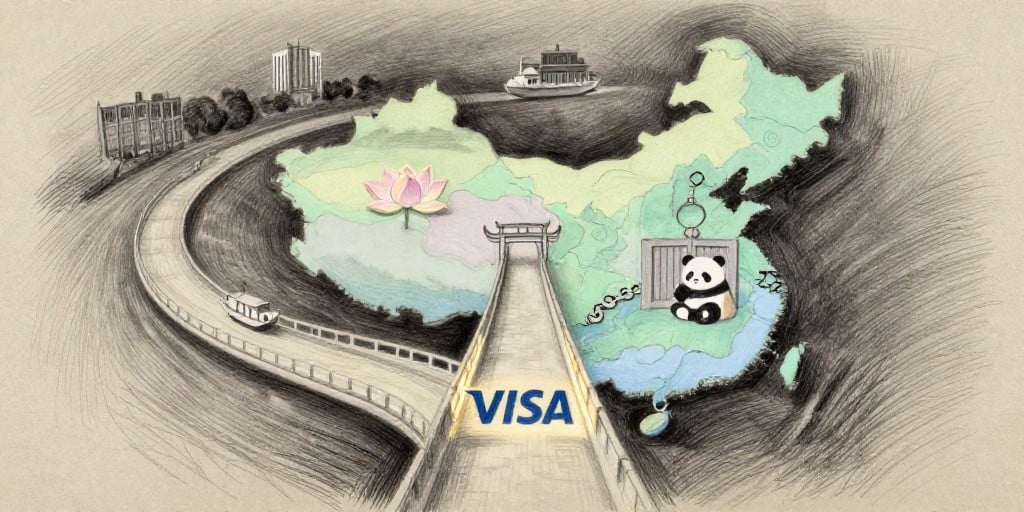
Visa recently secured regulatory approval to initiate preparations for a domestic bank‑card clearing operation in the People’s Republic of China. This development carries several implications:
| Aspect | Analysis |
|---|---|
| Regulatory Environment | The Chinese payment‑systems regime, governed by the People’s Bank of China (PBOC) and the State Administration of Market Regulation (SAMR), has historically imposed stringent licensing requirements for foreign entities. Visa’s preliminary approval signals a potential easing of regulatory barriers, yet the approval is likely a “pre‑licensing” stage, necessitating further compliance with data‑privacy, anti‑money‑laundering (AML), and inter‑bank settlement standards. |
| Competitive Dynamics | China’s domestic ecosystem—led by Alipay, WeChat Pay, and UnionPay—has achieved deep penetration in both retail and online channels. Visa’s entry could be met with intense competitive pressure, especially from Chinese fintech firms that already possess robust payment‑infrastructure networks. However, Visa’s global brand and cross‑border transaction capabilities may offer a differentiator in high‑value international trade and travel segments. |
| Market Potential | The domestic clearing market is projected to grow at a CAGR of 8.5 % over the next five years, driven by expanding e‑commerce, digital‑banking services, and cross‑border remittances. Early market entry could secure a foothold in the burgeoning “dual‑currency” settlement environment. |
| Risks | 1) Regulatory Retrenchment: China’s recent “financial stability” policy initiatives could impose additional controls. 2) Political Sensitivities: Foreign firms operating in China face heightened scrutiny over data sovereignty. 3) Execution Lag: Transition from approval to operational capability may span 18–24 months, limiting near‑term revenue upside. |
3. Financial Analysis
3.1 Earnings Performance
| Metric | Current Quarter | YoY % |
|---|---|---|
| Revenue | $10.4 bn | +12.5 % |
| Net Income | $3.1 bn | +9.3 % |
| EPS | $1.85 | +10.1 % |
| Operating Margin | 23.4 % | +1.8 % |
Visa’s recent earnings beat analyst expectations by 3.5 %, largely due to a robust increase in cross‑border transaction volumes. The operating margin expansion reflects improved fee‑structure negotiations and cost controls.
3.2 Cash Flow & Capital Allocation
- Operating Cash Flow: $3.8 bn, up 14 % YoY.
- Capital Expenditure: $0.6 bn, consistent with prior guidance.
- Dividends & Share Repurchases: Total $1.1 bn, underscoring a continued commitment to shareholder value.
3.3 Valuation Metrics
- Forward P/E: 22.1 (vs. sector average 18.4).
- PEG Ratio: 1.6 (indicative of moderate growth expectations).
- Enterprise Value/EBITDA: 7.3x (aligned with industry peers).
These figures suggest that while Visa remains slightly overvalued relative to the broader financial sector, the premium is justified by its strategic expansion into China and consistent earnings quality.
4. Comparative Competitive Landscape
| Peer | Core Focus | China Strategy |
|---|---|---|
| Mastercard | Global payments network | Similar bank‑card clearing bid; awaiting regulatory outcome |
| Stripe | Online payment platform | Expanding into Asian fintech ecosystems; not yet cleared for domestic clearing |
| Alipay | Domestic digital wallet | Dominant in China; strong regulatory alignment |
Visa’s unique advantage lies in its global brand recognition and cross‑border settlement infrastructure, positioning it to capture a niche segment of international payment flows that domestic Chinese players are less equipped to handle.
5. Potential Risks & Opportunities
| Category | Opportunity | Risk |
|---|---|---|
| Regulatory | Early approval could be a springboard to full licensing; potential to set industry standards. | Delayed full clearance; regulatory clampdown on foreign payment processors. |
| Market | Tapping into high‑value cross‑border transactions and corporate payment solutions. | Market saturation by entrenched domestic players; potential consumer reluctance. |
| Technological | Leveraging advanced fraud‑prevention and AI analytics to differentiate services. | Cybersecurity threats; need to adapt to China’s regulatory data‑control norms. |
| Financial | Expanded revenue streams from transaction fees and value‑added services. | Currency volatility affecting cross‑border fee structures. |
6. Conclusion
Visa Inc.’s modest share‑price uptick on a day marked by broader market weakness reflects a measured investor response to a complex interplay of factors. While the company’s strategic push into China’s domestic clearing space offers a long‑term growth catalyst, it also introduces a host of regulatory, competitive, and operational challenges. Analysts should monitor the progression from preliminary approval to full operational status, evaluate Visa’s ability to navigate the Chinese regulatory framework, and assess the impact on its global fee‑income mix. Ultimately, Visa’s continued resilience will hinge on its agility in addressing these multifaceted risks while capitalizing on the sizable, albeit competitive, Chinese payments market.