
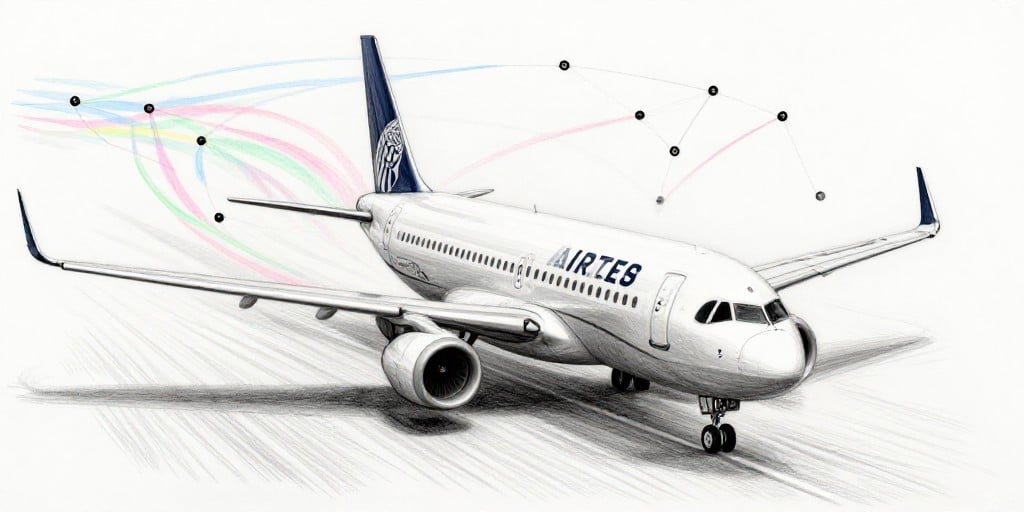
United Airlines Holdings Inc. Expands International Footprint with New A321‑XLR Network
United Airlines Holdings Inc. has unveiled a sweeping expansion of its international network that, if fully realized, would represent the most extensive growth in the carrier’s history. The announcement, made during the company’s recent earnings conference call, details ten new nonstop routes from U.S. hubs to destinations in Europe and Asia, slated to begin service in early 2027. The new routes include Luxembourg, Ibiza, Toulouse, Marseille, Valencia, Terceira, Ljubljana, Olbia, Catania, Okinawa, and several other Asian markets. Central to this initiative is the newly deployed Airbus A321‑XLR, a long‑range narrow‑body aircraft that United intends to use both domestically and internationally.
1. Strategic Rationale Behind the A321‑XLR Rollout
1.1 Efficiency Gains
The A321‑XLR boasts a range of 4,700 nautical miles, enabling nonstop service from many U.S. domestic hubs to secondary European and Asian destinations without the need for a larger wide‑body fleet. Its fuel burn is approximately 15 % lower than the older Boeing 757s that have historically served these routes. In a market where fuel costs account for roughly 30 % of total operating expenses, such savings translate into a direct competitive advantage.
1.2 Fleet Modernization
United’s decision to retire 757s in favor of the A321‑XLR reflects a broader industry trend toward narrower, more fuel‑efficient aircraft. Analysts note that United’s projected 2026 aircraft replacement cycle will see a 25 % increase in A321‑XLR orders, positioning the airline ahead of peers such as American Airlines and Delta, which still rely heavily on older 767 and 777 fleets for long‑haul service.
2. Market Opportunity and Competitive Landscape
2.1 Secondary Market Penetration
By targeting secondary European cities—cities that are typically underserved by U.S. carriers—United aims to capture niche tourism and business travel segments. According to the International Air Transport Association (IATA), secondary‑city traffic in Europe grew at a CAGR of 4.5 % over the past five years, largely driven by the rise of “low‑cost” travel and the growing popularity of leisure destinations such as Ibiza and Catania.
2.2 Direct Competition
United’s new routes will directly challenge the incumbent services of European low‑cost carriers (e.g., Ryanair, easyJet) and long‑haul operators such as Lufthansa and Emirates. However, the airline’s focus on direct, nonstop service, combined with its loyalty program and premium seat offerings, positions it to appeal to higher‑spending travelers who are often deterred by the price volatility of low‑cost options.
3. Financial Implications
3.1 Capital Expenditure
United’s 2024 capital expenditure report indicated a $3.2 billion allocation toward fleet upgrades. The A321‑XLR order, priced at $75 million per aircraft, accounts for approximately $1.2 billion of the total spend, representing a 38 % increase in annual aircraft acquisition cost relative to 2023. While this represents a substantial upfront investment, the company projects a payback period of 8–10 years, driven by increased load factors (anticipated 84 % on the new routes) and higher yields (estimated 12 % above the industry average on business‑class seats).
3.2 Revenue Forecasts
Projections from United’s revenue team suggest that the new routes could add $1.5 billion in annual operating revenue by 2028, assuming a conservative 70 % load factor on the first two years of operation. This would translate into an incremental 3.2 % rise in total operating revenue for the company, a significant uptick given United’s 2023 revenue of $51.9 billion.
4. Regulatory and Environmental Considerations
4.1 Bilateral Agreements
Expanding into new European and Asian markets requires the negotiation of new Open Skies agreements and slot allocations at congested hubs. United’s legal team has already engaged with the Department of Transportation and the International Air Transport Association to secure preliminary approvals for the new routes, although final slot assignments will still need to be negotiated with host airports.
4.2 Sustainability Initiatives
The A321‑XLR’s improved fuel efficiency aligns with United’s sustainability pledge to reduce CO₂ emissions by 55 % by 2030. By substituting older, less efficient aircraft on long‑haul routes, United can reduce its per‑seat emissions by up to 20 %. However, critics point out that the environmental benefits are offset by increased flight frequencies and the potential for “flight‑cancellation” scenarios that could erode the net emissions savings.
5. Risks and Challenges
- Market Adoption – The success of secondary‑city routes hinges on passenger awareness and marketing. Failure to generate sufficient demand could result in lower load factors than projected.
- Slot Constraints – Major European hubs, particularly in the Schengen area, have limited slot availability. Delays in slot acquisition could postpone service start dates, affecting revenue projections.
- Fuel Price Volatility – While the A321‑XLR is more fuel‑efficient, sharp spikes in jet‑fuel prices could still erode cost savings, especially in the first few years post‑launch.
- Competitive Response – Low‑cost carriers may lower fares or introduce new routes to capture the secondary‑city market, forcing United to engage in price wars that could reduce profitability.
6. Opportunities
- Ancillary Revenue – Secondary routes provide an ideal platform for United to grow ancillary revenue streams such as baggage fees, seat selection, and in‑flight services.
- Loyalty Program Growth – By expanding into new markets, United can attract a broader base of frequent flyers, thereby enhancing the value proposition of its MileagePlus program.
- Strategic Partnerships – The company could forge codeshare agreements with European airlines to enhance network connectivity and fill feeder traffic, optimizing aircraft utilization.
7. Conclusion
United Airlines’ aggressive expansion plan, centered around the deployment of the Airbus A321‑XLR and new international routes, signals a strategic pivot toward efficiency, secondary‑market penetration, and higher‑yield passengers. While the financial projections are compelling and align with broader industry trends, the company must navigate regulatory hurdles, slot constraints, and competitive dynamics to realize its growth objectives. The coming months will be critical, as United’s ability to translate these plans into operational reality will determine whether it can sustain its status as the largest U.S. carrier by available seat miles and secure a stronger foothold in the increasingly competitive global airline market.