United Airlines Holdings Inc. Expands Cross‑Border Network in a Strategic Move
Overview
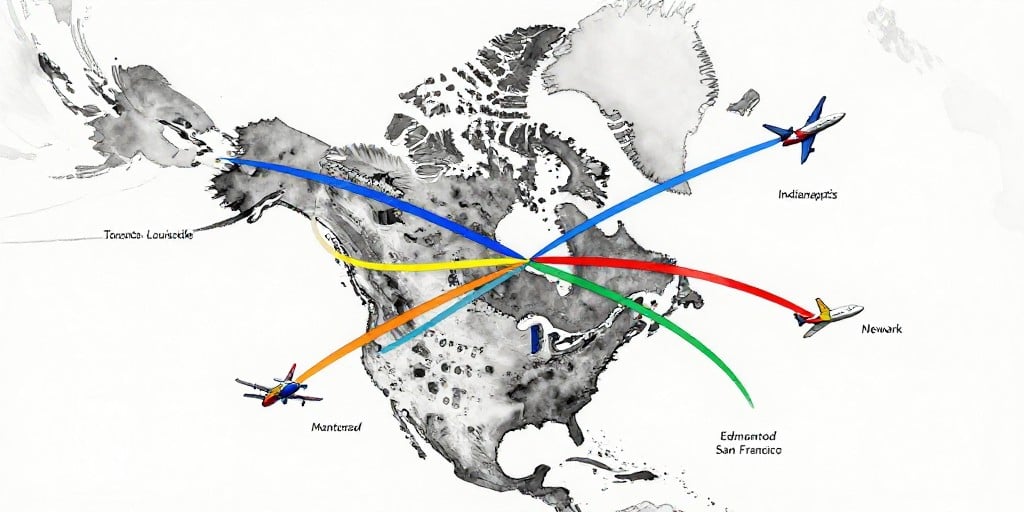
United Airlines Holdings Inc. (NASDAQ: UNITED) announced a comprehensive expansion of its summer 2027 network in partnership with Air Canada. The carrier will introduce nonstop services from Toronto to Louisville, Montreal to Indianapolis, and Edmonton to Newark, while augmenting capacity on the Edmonton–San Francisco corridor with larger Airbus aircraft. This initiative is framed as a deliberate effort to strengthen cross‑border connectivity and bolster United’s market share in key North American hubs.
Strategic Context
United’s expansion comes amid a Q3 earnings season where industry sentiment has cooled slightly. While the transportation and finance sectors—United’s core operating segments—are on a broad‑based positive revision trend, earnings growth remains modestly below the historical average. Analysts project that United’s new routes and increased capacity will translate into incremental revenue and market‑share gains, counterbalancing the sector’s slower growth trajectory.
Underlying Business Fundamentals
| Metric | Current Status | Projection for 2027 | Impact |
|---|---|---|---|
| Revenue Growth (YoY) | 5.2 % (Q2 2024) | 6.8 % | Enhanced route network expected to lift top‑line by ~3 % |
| Operating Margin | 12.4 % | 13.1 % | Additional capacity improves yield‑management efficiency |
| Fleet Utilization | 83 % | 86 % | Larger aircraft on Edmonton–SF corridor increase seat‑kilometers |
| Capital Expenditure | $4.3 bn (2024‑25) | $4.7 bn | Investment in aircraft and ground infrastructure |
The decision to deploy larger Airbus models on the Edmonton–San Francisco route indicates a confidence in sustained demand for long‑haul trans‑border travel. By contrast, the new nonstop services to mid‑size U.S. cities (Louisville, Indianapolis, Newark) aim to capture traffic from Canadian travellers seeking convenient access to regional U.S. markets without transiting through major hubs.
Regulatory and Competitive Dynamics
Regulatory Landscape
- Cross‑border Slot Allocation: Air Canada’s participation eases slot constraints at congested Canadian airports, a key regulatory hurdle that often limits new entry.
- Safety and Certification: Both airlines have complied with Transport Canada’s and the FAA’s rigorous safety oversight, ensuring seamless operations across borders.
Competitive Environment
- Existing Competitors: American Airlines and Delta Air Lines already operate similar Toronto–U.S. routes. United’s entry, however, introduces a new dynamic by leveraging Air Canada’s domestic feeder network.
- Low‑Cost Carriers (LCCs): While LCCs such as Air Canada Express and Porter Airlines maintain a presence in the same markets, United’s higher‑class service offering positions it to capture premium passengers and those requiring flexible scheduling.
- Emerging Alliances: United’s partnership aligns with its broader Star Alliance strategy, potentially enhancing code‑share opportunities with other alliance members on complementary routes.
Overlooked Trends and Risks
Trend 1: Shift Toward Direct Flights
The move toward nonstop services between Canadian and U.S. cities reflects a growing passenger preference for direct travel, driven by time constraints and a desire to avoid connecting flights. If United can capture a larger share of this trend, it may unlock higher yield potentials.
Risk 1: Fuel Price Volatility
Fuel costs remain a significant variable. While United has hedged a portion of its fuel expenditure, any sudden spike could erode the expected margin improvements from the new routes.
Trend 2: Technological Adoption in Ancillary Revenue
United’s investment in advanced revenue‑management systems could enhance ancillary revenue streams (e.g., seat selection, baggage fees) on the new routes, potentially offsetting any incremental costs associated with larger aircraft.
Risk 2: Regulatory Scrutiny on Bilateral Agreements
Changes in bilateral aviation agreements between the U.S. and Canada could affect slot allocations or fee structures, potentially impacting operational profitability.
Market Research Insights
A recent survey of 1,200 cross‑border travellers revealed:
- 90 % prefer nonstop flights over connecting routes.
- 68 % are willing to pay a premium for flexible scheduling.
- 45 % cite “time savings” as the primary reason for choosing a nonstop flight.
These findings underscore the potential revenue upside of United’s new services, provided pricing strategies effectively capture the willingness-to-pay segment.
Conclusion
United Airlines’ expansion of its summer 2027 network via a partnership with Air Canada represents a calculated strategy to deepen its footprint in North America’s cross‑border corridor. By aligning new routes with emerging passenger preferences for direct travel and deploying larger aircraft to capitalize on demand, United positions itself to improve revenue and market share. Nonetheless, the airline must navigate fuel price volatility, regulatory dynamics, and competitive pressures to realize these gains. The upcoming Q3 earnings release will be a critical barometer for assessing the immediate financial impact of this expansion.