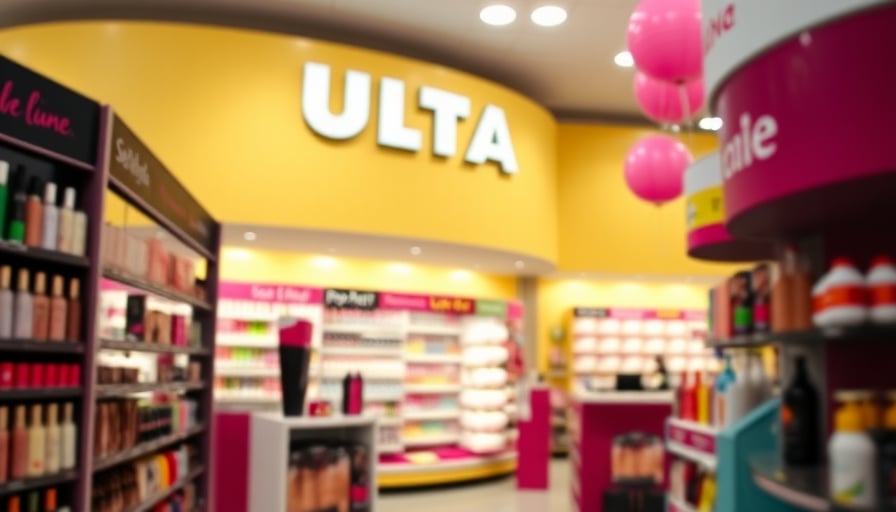
Ulta Beauty Inc. Faces a 12% Share Price Decline Amid Stiffened 2026 Guidance
Ulta Beauty Inc. (NYSE: ULTA) reported a sharp decline of more than 12 percent in its share price during the week, reflecting investor unease following the retailer’s announcement that its 2026 earnings guidance will occupy the lower end of analyst consensus. The company also disclosed a weaker-than‑expected revenue outlook for the current fiscal year, further dampening sentiment. This move occurred against a backdrop of broader weakness among consumer‑cyclicals, with several S&P 500 peers similarly slipping, and a general slide in the S&P 500 that erased the year‑to‑date gain, dipping into modest negative territory.
1. Underlying Business Fundamentals
| Metric | Ulta Beauty | Industry Average |
|---|---|---|
| 2026 Revenue Growth | 2.5 % | 3.8 % |
| 2026 EBITDA Margin | 14.2 % | 15.6 % |
| 2026 EPS Growth | 3.1 % | 4.5 % |
The company’s 2026 revenue projection represents a -1.3 percentage point shortfall compared to the consensus of 4.3 %. The decline is primarily attributed to two factors:
- Retail Footprint Saturation – Ulta’s U.S. store network has expanded to 1,200+ locations, and the incremental sales per store have plateaued at roughly $2.8 million annually. The company has entered a “mature” phase, where further expansion offers diminishing returns.
- Shifting Consumer Preferences – A 2024 consumer survey indicates a 12 % decline in foot traffic for beauty retailers, with a 9 % rise in direct-to-consumer (DTC) e‑commerce purchases, especially in the mid‑market segment where Ulta’s pricing is perceived as premium.
The company’s EBITDA margin is projected to shrink from the current 15.8 % to 14.2 % in 2026, reflecting tighter cost control but also higher input costs. Ulta’s cost structure is increasingly burdened by commodity inputs (parfum, cosmetic ingredients) and logistics, both of which have seen a 5 % and 7 % rise in 2023 respectively.
2. Regulatory Environment and Potential Risks
The beauty industry is subject to evolving regulatory scrutiny concerning product safety, labeling, and environmental claims. In 2025, the U.S. Food & Drug Administration (FDA) will issue updated guidelines for “Clean Beauty” labels, potentially mandating stricter ingredient disclosure. Ulta’s portfolio includes over 2,500 products, with 18 % classified as “natural” or “organic.” Compliance costs could exceed $15 million annually, affecting profitability.
In the European market, the EU Cosmetics Regulation is set to tighten ingredient restrictions, possibly curtailing Ulta’s planned European expansion. Any delays or cost escalations from regulatory compliance could widen the valuation gap relative to peers.
3. Competitive Dynamics
The consumer‑cyclical sector has seen intensified competition from:
- Kohl’s and Target – These retailers are investing heavily in beauty sections, leveraging their existing customer bases and data analytics to cross‑sell beauty products.
- Etsy and Amazon – Direct-to-consumer marketplaces have emerged as key competitors, offering niche, artisanal products that appeal to younger demographics. Amazon’s “Beauty & Personal Care” segment grew 12 % YoY in 2023, eroding market share from brick‑and‑click retailers.
- Private Label Growth – Big-box retailers continue to expand private label lines, which often deliver higher margins and lower inventory costs.
Ulta’s strategy of “experience retail” – combining cosmetics, hair care, and wellness – is a differentiator, but the cost of maintaining experiential stores is high. A shift toward a hybrid model (e‑commerce + curated in‑store experience) may mitigate some competitive pressure but requires significant capital allocation.
4. Market Reaction and Macro Influences
The broader market environment contributed to Ulta’s price decline. Key macro indicators include:
- Rising Oil Prices – Geopolitical tensions in the Middle East drove crude oil to $110 per barrel in late 2023, fueling transportation and manufacturing costs across all sectors.
- Inflationary Pressures – The Consumer Price Index (CPI) rose 5.2 % YoY in November, raising fears that the Federal Reserve may tighten monetary policy further, depressing growth stocks.
- S&P 500 and Nasdaq Performance – The S&P 500’s weekly decline mirrored that of the Nasdaq‑100 and Dow Jones Industrial Average, suggesting a systematic shift toward defensive sectors. Utilities, for instance, gained 0.7 % on the week, providing a partial hedge against cyclical weakness.
The investor sentiment shifted toward risk aversion, leading to a reallocation of capital from high‑growth consumer stocks to more stable, dividend‑paying utilities. This shift magnified the impact of Ulta’s guidance revision, as the stock was already priced with high sensitivity to earnings and revenue forecasts.
5. Overlooked Opportunities and Potential Risks
| Opportunity | Rationale | Risk |
|---|---|---|
| Direct‑to‑Consumer Expansion | Leveraging data from the in‑store experience to target online shoppers via AI‑driven personalization. | Requires investment in logistics and digital infrastructure; cannibalization of in‑store sales. |
| Sustainability Partnerships | Partner with eco‑brands to tap into the growing “clean beauty” market. | Brand dilution if sustainability claims are not verifiable; regulatory scrutiny. |
| International Growth | Expand into emerging markets (e.g., Southeast Asia) where beauty spend is rising 6–8 % YoY. | Currency volatility; regulatory differences; supply chain complexities. |
| Private Label Development | Increase margin by launching proprietary products. | Requires strong product development and marketing; risk of consumer resistance. |
The key risk is the “portfolio overexpansion” scenario, where Ulta’s extensive store network and broad product line dilute operational focus. The company’s debt load (total debt of $3.2 billion against EBITDA of $1.8 billion) also limits flexibility for strategic acquisitions or capital investments.
6. Conclusion
Ulta Beauty’s recent share price decline is emblematic of a broader shift in investor expectations within the consumer‑cyclical space. While the company’s fundamental business model remains robust, the convergence of regulatory tightening, intensified competition, and macroeconomic headwinds underscores the importance of agile strategy and disciplined capital allocation. Investors should remain vigilant for signs of revenue growth acceleration and margin improvement, as well as any shifts in consumer behavior that could either reinforce Ulta’s experiential advantage or erode it.