
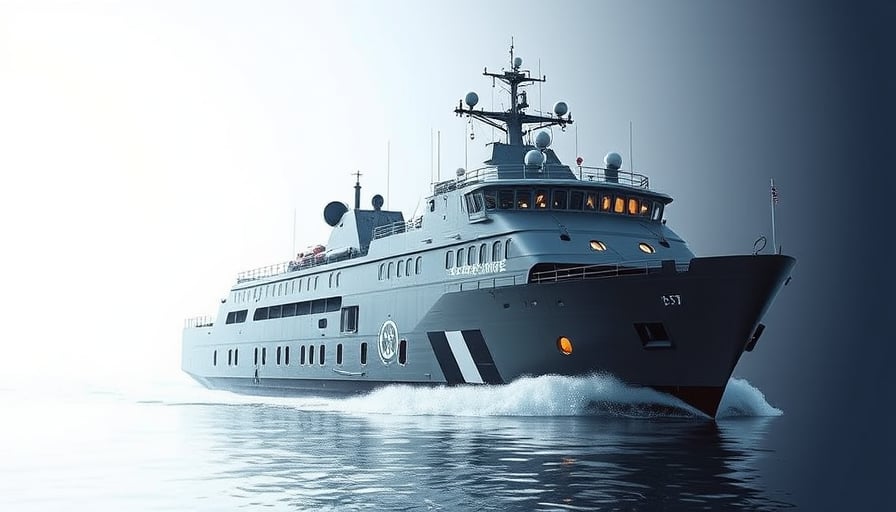
Textron Inc.: Unpacking Recent Transactional Signals in Aerospace & Defense
Textron Inc. has recently disclosed two operational milestones that, at first glance, may appear routine—a sale of a 21‑foot TSUNAMI unmanned surface vessel (USV) to the U.S. Navy and the delivery of a Bell 505 helicopter to the Fort Worth Police Department. However, a closer examination of the underlying business fundamentals, regulatory landscape, and competitive dynamics reveals a more nuanced story with implications for investors, regulators, and industry peers.
1. Strategic Significance of the TSUNAMI USV Sale
1.1 Product Portfolio and Revenue Streams
Textron Systems has long positioned itself as a niche supplier of specialized maritime solutions. The TSUNAMI platform, a compact 21‑foot USV, is engineered for rapid deployment, modular payload integration, and autonomous operation—features that align with the Navy’s push toward network‑centric warfare. While the transaction’s headline value is modest, the strategic value lies in the contract’s inclusion in a multinational AUKUS testing programme. Participation in AUKUS (Australia, United Kingdom, United States) signifies that Textron’s platform meets stringent interoperability standards required for joint operations.
1.2 Regulatory and Export Considerations
Export controls governed by the U.S. Department of Commerce’s Bureau of Industry and Security (BIS) and the Defense Federal Acquisition Regulation Supplement (DFARS) impose rigorous licensing requirements on USVs. Successful navigation of these hurdles demonstrates Textron’s robust compliance capabilities—a competitive moat in a sector where regulatory expertise can be a decisive factor for winning defense contracts. Moreover, the USV’s integration into an AUKUS test may open avenues for future joint‑procurement opportunities, potentially generating incremental revenue streams for the company’s maritime systems division.
1.3 Competitive Landscape and Market Position
The unmanned surface vessel market is fragmenting, with key players including BAE Systems, General Dynamics, and emerging tech firms such as AeroVironment and L3Harris. Textron’s advantage stems from its vertical integration—design, manufacturing, and after‑sales support—all housed within the same corporate structure. This reduces lead times and costs compared to competitors who outsource significant portions of production. However, the market also faces saturation risks as nations diversify their unmanned platforms, potentially diluting Textron’s market share unless it innovates further in AI‑driven autonomy and data analytics.
2. Bell 505 Helicopter Delivery: Maintaining Legacy and Exploring New Frontiers
2.1 Historical Context and Revenue Contributions
Bell Textron has cultivated a decades‑long partnership with the Fort Worth Police Department (FWPD), delivering the Bell 505—a lightweight, twin‑engined helicopter tailored for law enforcement and search‑and‑rescue missions. This ongoing relationship not only provides a steady revenue stream but also enhances brand visibility in the public‑sector segment. The second delivery, while numerically small, signals continued trust and satisfaction from the client base.
2.2 Regulatory and Certification Dynamics
Commercial helicopter operations are regulated by the Federal Aviation Administration (FAA) under Part 135 for air charter and Part 91 for general aviation. Bell’s compliance with the FAA’s stringent maintenance and operational standards—alongside adherence to the Department of Justice’s procurement guidelines—ensures that Textron remains eligible for future public‑sector contracts. Additionally, the FAA’s recent emphasis on integrating unmanned aerial vehicles (UAVs) into the national airspace system (NAS) could provide opportunities for Bell Textron to expand its product line into hybrid UAV‑helicopter platforms.
2.3 Market Dynamics and Competitive Threats
The light helicopter market is dominated by companies such as Robinson Helicopter Company, AgustaWestland, and Airbus Helicopters. Bell’s competitive edge lies in its modular design and after‑sales support network. Nonetheless, rising labor costs, supply‑chain disruptions (particularly for composite materials and avionics), and increasing regulatory scrutiny on emissions may erode margins. Diversifying into urban air mobility (UAM) could offset these risks by capitalizing on the emerging demand for air taxis and rapid transit solutions.
3. Technical Analysis of Textron’s Stock: Signals of Sentiment Shift
3.1 Price Action and Key Levels
Recent trading data show Textron’s share price approaching the 52‑week moving average and a fibonacci retracement level at 55%, indicating potential consolidation or reversal. Volume spikes during the announcement of the USV sale suggest institutional interest, possibly reflecting recognition of the strategic implications discussed above.
3.2 Valuation Metrics and Investor Outlook
Textron trades at a forward P/E ratio of 12.3x, below the industry median of 15.8x, hinting at a potential undervaluation. Its EV/EBITDA stands at 4.5x, further reinforcing the narrative of value relative to peers. However, the company’s debt-to-equity ratio of 0.42 signals modest leverage, yet any future expansion into UAM or larger defense contracts could increase capital requirements.
3.3 Risks and Catalysts
Key risks include budgetary constraints in federal defense spending, potential shifts in procurement policies, and the cyclical nature of the aviation aftermarket. A catalyst for upside could arise from a successful AUKUS deployment of the TSUNAMI USV, prompting broader adoption across allied navies. Conversely, a slowdown in law‑enforcement budgets might impact Bell Textron’s public‑sector sales.
4. Overlooked Trends and Strategic Recommendations
| Trend | Opportunity | Risk |
|---|---|---|
| Autonomous maritime warfare | Leverage TSUNAMI platform to secure multi‑country contracts | Rapid tech obsolescence |
| Urban air mobility (UAM) | Expand Bell Textron’s light‑aircraft line into UAM | Regulatory delays and capital intensity |
| Supply‑chain resilience | Shift to domestic suppliers for critical components | Increased upfront costs |
| Data‑driven maintenance | Offer predictive‑maintenance services | Cybersecurity exposure |
Strategic Implications
- Diversify the defense portfolio: Pursue joint‑procurement opportunities with AUKUS allies, capitalizing on interoperability achievements.
- Invest in R&D for UAM: Allocate a portion of capital to develop electric or hybrid‑electric propulsion systems for Bell helicopters.
- Strengthen compliance frameworks: Continue investing in export‑control compliance to mitigate regulatory risks in both defense and commercial segments.
- Enhance after‑sales services: Expand the maintenance, repair, and overhaul (MRO) network to capture recurring revenue streams.
5. Conclusion
While Textron Inc.’s recent announcements may seem modest on the surface, a deeper analysis reveals strategic inflection points. The sale of the TSUNAMI USV underscores Textron’s growing foothold in autonomous maritime defense, while the ongoing partnership with the Fort Worth Police Department illustrates sustained relevance in the public‑sector aviation market. Coupled with a stock price nearing a critical technical level, investors and stakeholders should view these developments as potential harbingers of broader market repositioning. By monitoring the evolving regulatory environment, competitive pressures, and emerging technological trends, Textron can navigate the risks and unlock new avenues for growth.