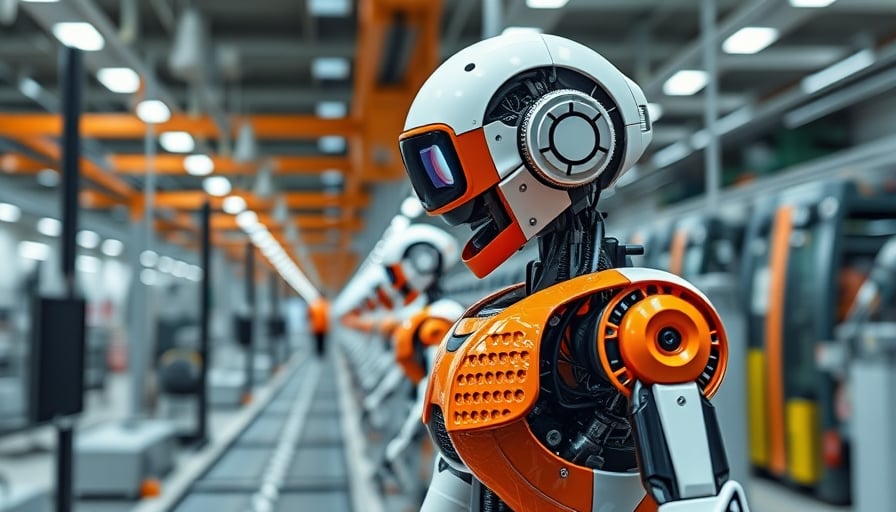
Texas Instruments and NVIDIA Forge a Strategic Alliance to Propel Humanoid Robotics
Texas Instruments Inc. (TXN) has announced a collaboration with NVIDIA that underscores its intent to consolidate leadership in the semiconductor industry, particularly within the rapidly evolving domain of humanoid robotics. The partnership will blend Texas Instruments’ strengths in real‑time control, sensing, and power management with NVIDIA’s cutting‑edge robotics computing platforms—including Jetson Thor and Holoscan—to deliver low‑latency, 3‑D perception and safety functionalities for physical artificial intelligence.
Technical Synergies and Product Roadmap
The alliance leverages Texas Instruments’ extensive portfolio of precision analog, mixed‑signal, and embedded processing solutions to provide deterministic control loops essential for robotic motion. Simultaneously, NVIDIA’s Jetson Thor platform offers high‑performance, low‑power GPU acceleration for deep‑learning inference, while the Holoscan platform supplies robust medical‑grade imaging and data fusion capabilities. By integrating these technologies, the joint effort seeks to deliver an end‑to‑end robotic stack that enables developers to validate complex humanoid systems earlier in the design cycle and with greater fidelity.
Key technical milestones include:
- Ultra‑low latency perception – Combining TI’s high‑speed analog front‑ends with NVIDIA’s real‑time inference to reduce end‑to‑end latency below 10 ms.
- Enhanced safety features – Utilizing TI’s safety‑certified power management and sensing modules alongside NVIDIA’s safety‑centric software frameworks to meet ISO 26262 and IEC 61508 standards.
- Scalable development kit – Packaging the integrated hardware and software into a modular kit that can be adapted for industrial, medical, or consumer robotics applications.
Market Context and Competitive Positioning
The humanoid robotics sector is witnessing accelerated investment from both commercial enterprises and defense agencies, driven by a demand for autonomous systems that can operate safely in complex, human‑centric environments. According to recent industry reports, the global humanoid robotics market is projected to grow at a compound annual growth rate of 22 % over the next five years, reaching $12 billion by 2030. In this context, the TI‑NVIDIA collaboration positions both companies to capture a growing share of a market that increasingly values end‑to‑end integration and safety assurance.
From a competitive standpoint, the partnership differentiates itself by:
- Combining complementary strengths – TI’s hardware expertise in power efficiency and deterministic control counters NVIDIA’s software dominance in AI inference, creating a balanced solution that mitigates typical vendor lock‑in scenarios.
- Accelerated time‑to‑market – By providing a ready‑to‑deploy platform, developers can reduce the prototyping cycle from months to weeks, thereby gaining a first‑mover advantage.
- Robust safety validation – The integrated safety features address regulatory barriers that often slow adoption in sectors such as healthcare and public safety.
Broader Economic Implications
The collaboration exemplifies a broader trend of cross‑industry convergence within the semiconductor ecosystem. As AI workloads intensify and edge computing demands rise, the convergence of processing, sensing, and power solutions becomes critical to sustaining growth. This joint venture also reflects a strategic shift toward “system‑on‑module” architectures that reduce total cost of ownership and accelerate product development cycles.
Furthermore, the partnership aligns with supply‑chain resilience initiatives championed by governments and industry bodies. By combining domestic manufacturing capabilities—Texas Instruments’ facilities in Texas and California—with NVIDIA’s global component ecosystem, the collaboration enhances the reliability of critical supply chains in an increasingly volatile geopolitical environment.
Upcoming Demonstrations and Industry Impact
Texas Instruments plans to showcase the integrated capabilities at NVIDIA’s GTC 2026 conference, a premier event for professionals in AI, robotics, and high‑performance computing. The demonstration will likely feature live robotic platforms executing complex tasks—such as autonomous navigation, object manipulation, and human‑robot interaction—while highlighting the low‑latency perception and safety modules developed through this partnership.
The presentation is anticipated to:
- Validate the technical claims regarding latency reduction and safety certification.
- Illustrate real‑world applications across industrial automation, healthcare, and consumer robotics.
- Generate momentum for subsequent commercial deployments, potentially leading to increased orders for TI’s analog and digital ICs, as well as NVIDIA’s GPU and edge computing platforms.
Conclusion
By forging a strategic alliance with NVIDIA, Texas Instruments not only reinforces its position within the semiconductor landscape but also catalyzes innovation in the nascent field of humanoid robotics. The joint initiative exemplifies how synergistic collaborations can harness complementary capabilities to deliver differentiated, safety‑certified solutions that meet the evolving demands of an AI‑driven economy. As the industry continues to converge around integrated hardware‑software platforms, such partnerships will likely become the norm, setting the stage for accelerated technological progress and sustained market growth.