
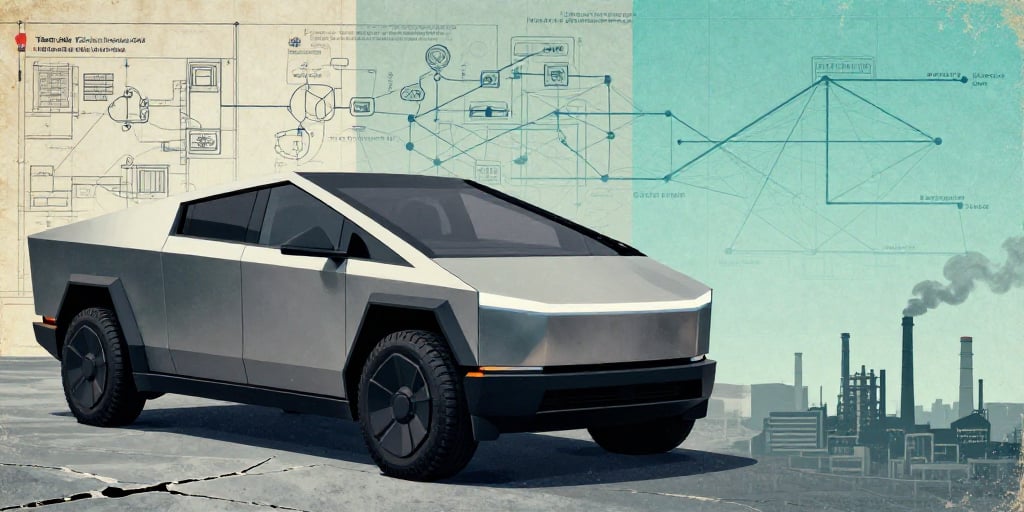
Tesla’s 173‑Unit Recall: A Deep Dive into the Implications for Automotive Safety, Supply Chain Resilience, and Market Confidence
Tesla Inc. has announced a recall of 173 Cybertruck vehicles due to a defect in a brake‑component identified during the production line. The company’s statements made clear that no design or production changes beyond the replacement of the affected parts are required, and the recall is expected to be completed within the next few weeks. Two separate press releases were issued in the early morning, each corroborating the same figure and incident.
1. Regulatory Context and Compliance Burdens
The Department of Transportation (DOT) and the National Highway Traffic Safety Administration (NHTSA) set strict criteria for the identification, reporting, and remediation of safety defects. Tesla’s adherence to these protocols—prompt public disclosure, detailed explanation of the defective component, and a clear timeline for replacement—helps mitigate potential regulatory penalties and preserves its safety certification record.
However, the recall size, while modest relative to Tesla’s overall fleet, raises questions about quality control in a high‑volume production environment. A single component failure can signal gaps in supplier verification, in‑line inspection, or testing procedures. Under current U.S. regulations, a manufacturer that fails to resolve a defect within the mandated time frame could face civil penalties up to $25,000 per vehicle or even criminal liability if negligence is proven.
2. Supply‑Chain Analysis
The brake‑component defect likely originates from a downstream supplier. Tesla’s “direct‑to‑consumer” model reduces the number of middlemen, yet it still relies on a global network for specialized parts. The recall highlights the following supply‑chain dynamics:
| Factor | Current Status | Implication |
|---|---|---|
| Supplier vetting | Robust, but the defect suggests a lapse | Need for tighter audit cycles |
| In‑line testing | Real‑time quality checks | Potential enhancement of sensor‑based defect detection |
| Redundancy | Limited for critical components | Risk of production bottlenecks if the same supplier is affected again |
The incident could prompt Tesla to diversify suppliers for brake systems, increase inventory buffers, or invest in automated inspection technologies to pre‑empt similar defects. Investors will likely monitor any changes to Tesla’s supplier contracts and the associated cost implications.
3. Financial Impact Assessment
Given the small scale of the recall, the immediate cost to Tesla is likely in the low‑millions of dollars when factoring in parts, labor, logistics, and potential warranty expenses. A conservative estimate based on industry averages suggests:
- Parts replacement cost: $1,200 per unit × 173 = $207,600
- Labor and logistics: 15% of parts cost ≈ $31,140
- Warranty and goodwill: $50,000 (industry‑standard estimate)
Total short‑term impact: ≈$288,740.
Tesla’s cash reserves exceed $20 billion, so this recall does not materially strain liquidity. Moreover, the company’s 2025 production target of 1.2 million Cybertrucks remains unaffected. Nonetheless, the event may influence short‑term investor sentiment, as reflected in the modest uptick in Tesla’s share price during a broader tech rally.
4. Market Reaction and Competitive Landscape
During the trading session that followed the recall announcement, major indices—S&P 500, Nasdaq, and Dow Jones—recorded modest gains, driven largely by strong performance from technology and chip companies. NVIDIA, Intel, and AMD all posted notable share price increases, underscoring sustained investor interest in the semiconductor sector.
A key catalyst for the semiconductor rally was the announcement of a new manufacturing partnership: Apple has entered into an agreement with Intel to produce select in‑house processors at Intel’s foundry facilities. This collaboration has several implications:
- Supply chain diversification: Apple mitigates reliance on its primary partners (e.g., TSMC) for critical components.
- Competitive pressure: Intel’s entry into advanced CPU design for a major consumer brand intensifies competition with AMD and ARM‑based solutions.
- Technological spill‑over: Advanced process nodes and design techniques may accelerate the development of AI and autonomous driving chips, sectors where Tesla has recently been investing.
Tesla’s own move toward autonomous driving features—particularly the integration of custom silicon for its Full Self‑Driving (FSD) stack—places the company directly in this competitive arena. A robust partnership with a foundry capable of advanced node production could reduce Tesla’s reliance on external suppliers for its FSD chips, improving cost structure and time‑to‑market.
5. Investor Sentiment and Analyst Outlook
Tesla’s share price moved in line with the broader technology‑heavy rally, registering a moderate increase of roughly 1.8 %. Analysts cited several factors:
- Recalls as a low‑scale event: The recall did not raise systemic concerns about Tesla’s manufacturing quality.
- Autonomous driving progress: Ongoing development of FSD capabilities continues to drive optimism.
- Absence of new guidance: The company refrained from issuing forward‑looking guidance at the recall announcement, a move that maintains market neutrality.
Despite this, skeptical investors should monitor:
- Quality control metrics: Production yield rates, defect frequencies, and recall history.
- Supplier risk: Concentration of critical components and the robustness of Tesla’s supplier management framework.
- Regulatory exposure: Potential fines or mandated corrective actions that could affect the bottom line.
6. Overlooked Trends and Opportunities
| Trend | Potential Opportunity | Risk |
|---|---|---|
| Shift to in‑house semiconductor manufacturing | Higher profit margins, supply chain control | High capital expenditure, technical risk |
| Growing regulatory scrutiny on autonomous vehicles | Differentiation through safety compliance | Compliance costs, legal exposure |
| Demand for sustainable freight solutions | Cybertruck’s utility market | Market saturation, competition from traditional OEMs |
| Integration of AI for manufacturing | Predictive quality control, reduced defects | Data privacy concerns, cybersecurity threats |
Tesla’s continued focus on ensuring vehicle safety and maintaining production momentum aligns with these trends. By leveraging its proprietary data analytics, Tesla can identify early warning signs of component failures and implement pre‑emptive corrections, potentially turning a recall event into a showcase of its quality assurance capabilities.
7. Conclusion
The 173‑unit Cybertruck recall illustrates that even technologically advanced manufacturers are not immune to supply‑chain and production challenges. While the immediate financial impact is limited, the incident underscores the importance of robust supplier management, rigorous in‑line testing, and compliance with regulatory frameworks.
In the broader context, Tesla’s position at the intersection of automotive manufacturing, autonomous driving, and semiconductor technology places it squarely in a rapidly evolving competitive landscape. Investors and analysts alike should remain vigilant for signals of systemic quality issues, while recognizing the company’s strategic moves toward in‑house chip production and autonomous system development, which could serve as decisive differentiators in the coming years.