
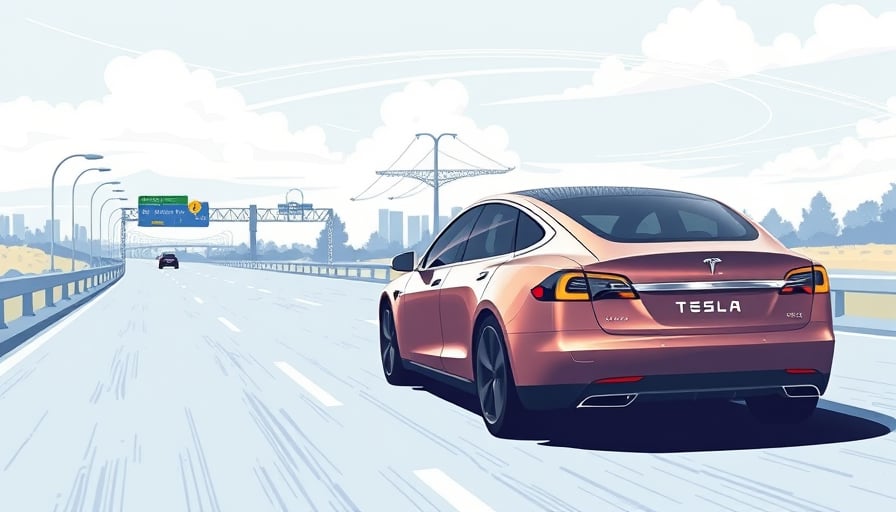
Tesla’s Strategic Pivot Toward Autonomous Mobility
Tesla’s latest corporate communications reveal a continued emphasis on autonomous driving capabilities and an expansion of its service footprint. CEO Elon Musk announced that the company’s Full‑Self‑Driving (FSD) software will permit limited phone use in specific driving contexts, a move that seeks to balance consumer convenience with regulatory constraints. At the same time, Tesla secured ride‑hailing approval in Arizona, a critical milestone for its long‑term robotaxi strategy. These developments occur against a backdrop of volatile sales performance in China, shifting institutional investor sentiment, and heightened regulatory scrutiny worldwide.
Autonomous Driving and Regulatory Landscape
The announcement that FSD will allow brief phone usage aligns with broader industry attempts to integrate “hands‑on” features into advanced driver‑assist systems. Regulators in the United States and Europe have repeatedly warned that texting while driving is a leading cause of accidents. By limiting phone use to specific contexts—such as during automated lane keeping or when the vehicle’s safety monitoring indicates a low risk of incident—Tesla aims to comply with existing statutes while maintaining a competitive edge over rivals such as Waymo, Cruise, and traditional automakers investing in autonomous technology.
From a legal standpoint, the new policy requires Tesla to provide clear in‑vehicle notifications, driver‑hand‑on monitoring, and fail‑safe mechanisms should the system detect distraction. The company must also navigate differing state laws; for instance, some jurisdictions mandate that autonomous features be disabled when a driver engages in non‑essential phone use. Tesla’s ability to harmonize its software across jurisdictions will be critical to scaling its robotaxi service.
Robotaxi Progress and Market Positioning
Arizona’s approval is a strategic win that demonstrates Tesla’s readiness to compete in the emerging ride‑hailing sector. The state’s regulatory framework, which allows autonomous vehicles to operate for commercial purposes, provides a testing ground for Tesla’s fleet operations. By establishing a local presence, Tesla can gather operational data, refine its dispatch algorithms, and create a proof of concept for investors.
The robotaxi market is projected to grow at a compound annual growth rate (CAGR) of 12–15 % over the next decade, driven by urban mobility demands, cost‑effectiveness of shared autonomous rides, and declining fuel costs. Tesla’s advantage lies in its integrated hardware‑software stack and massive data collection from its 20+ million vehicles. However, competitors such as Uber Elevate and Lyft’s autonomous initiatives are also expanding, underscoring the importance of a robust regulatory strategy and service differentiation.
China Sales and Investor Sentiment
Tesla’s sales figures in China have remained resilient, buoyed by strong demand for electric vehicles (EVs) and supportive government incentives. Yet, institutional investors have expressed concerns over the company’s valuation and its recent portfolio realignments. Hedge funds and pension plans have noted the dilution of shares resulting from the issuance of additional equity to fund FSD development and robotaxi infrastructure. These moves have led to a temporary decline in share price, reflecting a market perception that the company’s growth trajectory is still uncertain.
On a macroeconomic level, the Chinese EV market faces tightening competition from domestic manufacturers such as BYD, NIO, and Xpeng. Tesla’s continued market share hinges on its ability to maintain superior performance metrics—range, safety ratings, and software updates—while navigating the complex regulatory environment imposed by the Chinese government, which increasingly requires local data storage and cooperation with state authorities.
Broader Economic Implications
Tesla’s dual focus on autonomous software and robotaxi services exemplifies a broader shift toward mobility‑as‑a‑service (MaaS) models. This transition is reshaping not only the automotive sector but also the logistics, insurance, and urban planning industries. For example, the insurance sector must adapt pricing models to account for autonomous risk profiles, while city planners must reconfigure infrastructure to accommodate shared autonomous fleets. Tesla’s progress in Arizona provides a real‑world case study of how regulatory frameworks can accelerate or impede technology adoption.
Moreover, Tesla’s efforts to reduce reliance on consumer vehicle sales through service and ride‑hailing revenues align with industry trends toward diversified income streams. Companies such as General Motors (through Cruise) and Ford (through Argo AI) are pursuing similar strategies, highlighting a competitive convergence across automotive and technology firms.
Conclusion
Tesla’s recent announcements signal a deliberate strategy to integrate advanced autonomous features while expanding its commercial mobility footprint. The company’s navigation of regulatory complexities—both in the United States and China—will determine its long‑term viability in the robotaxi market. Institutional investor sentiment remains cautious, reflecting broader economic uncertainties and valuation concerns. Nonetheless, Tesla’s robust data ecosystem, proprietary hardware, and ambitious vision position it well to influence the future of transportation and mobility services across multiple industries.