
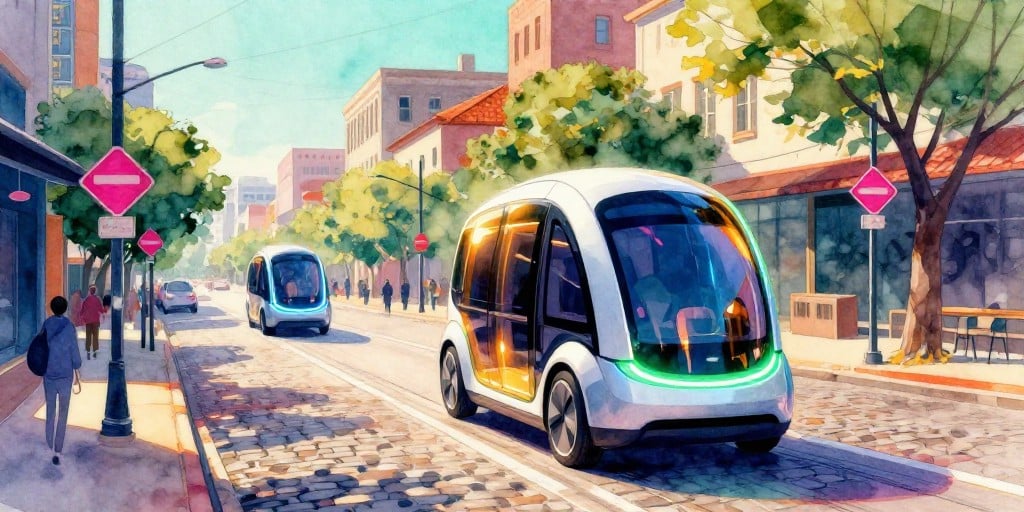
Tesla Inc. Expands Autonomous‑Vehicle Footprint with Cybercab Robotaxi Deployment
Tesla Inc. has begun commercial operations of its Cybercab robotaxi in Austin, Texas, deploying a fleet of two‑seat, fully autonomous electric vehicles that lack conventional steering and pedal controls. This move represents a strategic pivot from the company’s historic focus on electric passenger cars to a broader autonomous‑driving ecosystem aimed at generating new revenue streams through ride‑hailing services.
Business Fundamentals and Revenue Model
The Cybercab is engineered to be integrated into Tesla’s subscription‑based software ecosystem, notably the Full Self‑Driving (FSD) package. By monetizing access to FSD on a per‑trip basis, Tesla could convert a traditionally hardware‑centric business into a recurring‑revenue model. Preliminary financial projections suggest that a modest deployment of 5,000 units could yield annual gross margins comparable to the company’s current vehicle‑sale margins if the fleet operates at an efficiency of 40–45 % of the cost of a comparable conventional taxi.
Key variables driving profitability include:
| Variable | Current Estimate | Impact on Margin |
|---|---|---|
| Average revenue per trip (USD) | 5.00 | Direct lift |
| Operating cost per mile (USD) | 0.25 | Reduces margin |
| Utilization rate | 15 % | Higher utilization yields economies of scale |
| Software subscription uptake | 30 % | Determines recurring revenue share |
Even modest increases in utilization or subscription uptake could shift the Cybercab from a high‑cost pilot to a scalable, margin‑positive unit.
Regulatory Landscape
The Texas Department of Motor Vehicles has approved a broader deployment cap for the Cybercab, permitting up to 3,000 units under the current pilot framework. This regulatory concession is a critical enabler, as other states maintain stricter limits or require extensive proof of safety before permitting driverless operations. Tesla’s ability to secure similar approvals in high‑density markets such as New York or California will be decisive.
Potential regulatory risks include:
- Increased Oversight – If federal or state agencies tighten safety standards, Tesla may face costly retrofits or operational restrictions.
- Liability Shifts – Absence of a safety driver may complicate liability allocation in the event of incidents, potentially leading to higher insurance premiums.
- Data Privacy – Tesla’s reliance on a camera‑centric sensing stack raises concerns around video data handling and compliance with the California Consumer Privacy Act (CCPA) and the EU’s General Data Protection Regulation (GDPR) as the service expands internationally.
Competitive Dynamics
Waymo, Alphabet’s autonomous‑vehicle arm, has invested heavily in a diversified sensor suite that includes LiDAR, radar, and high‑definition mapping. Tesla’s purely camera‑centric approach is technically less expensive but has been subject to scrutiny following high‑profile incidents involving the company’s Autopilot.
Despite this, Tesla enjoys several competitive advantages:
| Factor | Tesla | Waymo |
|---|---|---|
| Vehicle platform cost | Lower (shared EV platforms) | Higher (dedicated platforms) |
| Software update cadence | Rapid (over‑the‑air) | Slower (fleet‑wide testing) |
| Brand recognition in EV market | High | Moderate |
| Existing subscription customer base | Millions | None |
Should Tesla’s cybersecurity and sensor reliability continue to improve, the company could capture a larger share of the autonomous‑vehicle service market, especially in U.S. regions with favorable regulatory stances and a high density of EV users.
Market and Investor Response
Recent trading activity in related stocks—such as Waymo’s parent Alphabet, autonomous‑vehicle software firms, and electric‑vehicle manufacturers—has shown increased volatility in response to Tesla’s Cybercab announcement. Analyst sentiment indicates that Tesla’s move could be a catalyst for a broader shift toward intelligent‑driving concepts. However, skepticism remains about whether the company can transition from a “showcase” to a “commercially viable fleet” within the next 12–18 months.
Risks and Opportunities
Risks
- Operational Inefficiency – Early‑stage fleets often suffer from high maintenance and lower utilization, eroding margins.
- Public Perception – Any safety incident involving a driverless Tesla could damage brand trust.
- Supply Chain Constraints – Scaling a specialized EV platform may expose the company to battery and component shortages.
Opportunities
- Data Monetization – Aggregated trip data could fuel new AI models and partner services.
- Cross‑Sell to Existing Customers – Tesla owners could be offered discounted Cybercab rides, deepening customer engagement.
- Infrastructure Partnerships – Collaborations with municipal transportation agencies could unlock subsidies and dedicated lanes.
Conclusion
Tesla’s Cybercab initiative marks a bold step toward monetizing its autonomous‑driving expertise beyond traditional vehicle sales. While the venture offers significant upside in terms of recurring revenue and data assets, the path to profitability is fraught with regulatory, operational, and reputational challenges that the company must navigate with precision. Investors and market observers will be closely monitoring Tesla’s ability to scale this technology, the speed at which regulatory bodies adapt to driverless fleets, and how the competitive landscape evolves in the coming years.