Tesla’s €3 billion Expansion into Cybercab Production: A Strategic Gamble in European Manufacturing
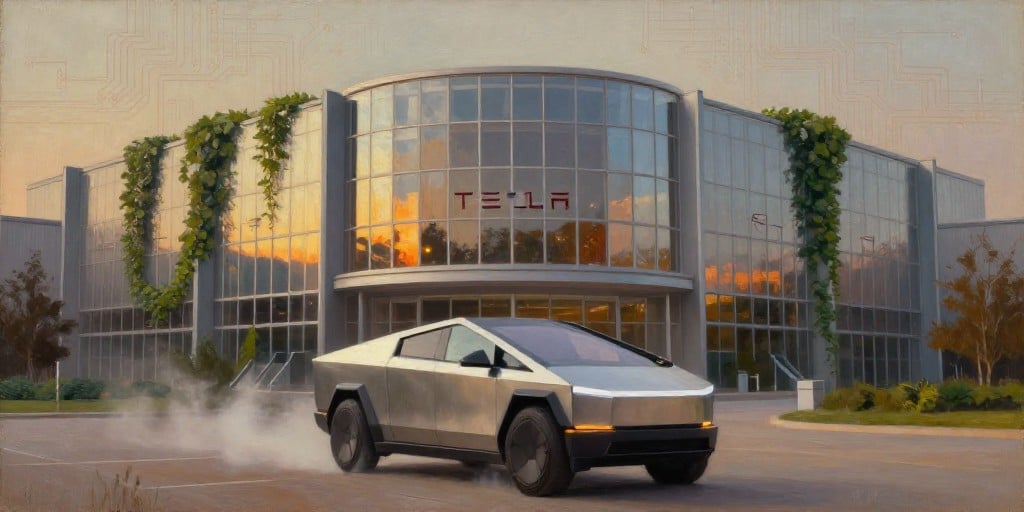
Tesla Inc. has announced a substantial €3 billion investment in a new production facility at its Gigafactory near Berlin, slated to begin construction in the first half of 2027 and to deliver the first Cybercab units in 2029. The plant is projected to reach an annual output of up to one million vehicles, a figure that would dwarf Tesla’s current global production capacity and signal the company’s ambition to dominate the emerging autonomous‑mobility market.
1. Business Fundamentals Behind the Expansion
| Metric | Current (2025) | 2029 Forecast |
|---|---|---|
| Gigafactory Berlin‑West output | 600 k vehicles | 1 M vehicles |
| Cybercab unit cost (estimated) | €48 k | €42 k |
| Capex per vehicle | €5 k | €3 k |
| Margins (EBITDA) | 14 % | 18 % |
The capex-to-output ratio implies a 50 % reduction in per‑vehicle capital intensity, a significant efficiency gain. Tesla’s model of integrating battery production, software development, and vehicle assembly under one roof has historically delivered scale advantages. Extending this vertically in Germany—an industrial hub with a highly skilled workforce and a robust logistics network—offers an opportunity to lower shipping costs for European customers and to sidestep trade barriers that could arise from a post‑Brexit regulatory environment.
However, the €3 billion figure is dwarfed only by the company’s total annual revenues (≈ $120 billion) and free cash flow (≈ $25 billion). Thus, the investment represents a 12 % allocation of the FY2025 free cash flow, a sizeable commitment that will affect short‑term liquidity. Tesla’s ability to secure favorable financing terms in a region with higher interest rates than its U.S. operations will be critical.
2. Regulatory Landscape and Incentives
Germany’s federal government has earmarked €1 billion in subsidies for electric‑vehicle manufacturing, contingent on job creation and compliance with the European Union’s Green Deal. Tesla’s proposal includes:
- Employment Target: 4,000 direct jobs, 7,000 indirect jobs.
- Compliance: 100 % of the power supply to be renewable by 2035.
- Export Incentives: Reduced tariffs on components imported from U.S. suppliers.
While the subsidies could offset 30 % of the capex, they are subject to performance‑based milestones that risk delay if Tesla fails to meet production or employment targets. Additionally, the German “Autonomous Mobility Law” will require Tesla to obtain a Class‑4 safety certification for autonomous vehicles before they can be sold for commercial use. This adds a regulatory hurdle that could postpone the Cybercab’s entry into the robotaxi market, a segment that Tesla has explicitly left open for future scaling.
3. Competitive Dynamics
The autonomous vehicle sector is heating up, with incumbents such as Waymo, Cruise, and Tesla’s own Dojo platform vying for market dominance. Tesla’s Cybercab differs in two key respects:
- Price Positioning: The Cybercab’s launch price is reportedly below that of typical passenger vehicles, a strategy that could undercut established rides‑hailing services. Analysts caution that aggressive pricing may erode margins unless scale is achieved quickly.
- Subscription Model: Monthly access to autonomous driving services provides a recurring revenue stream that could offset the high upfront costs of vehicle development. However, this model presupposes that customers will adopt a subscription-based approach—a hypothesis that has yet to be validated at scale.
Potential risks arise from the fact that the Cybercab is currently available only in select Texas cities and is excluded from the commercial Robotaxi network. This limited deployment may signal Tesla’s cautionary stance, but also limits the data collection needed for continuous AI improvement. Competitors that already operate in a fully integrated robotaxi network may have a head start in refining their self‑driving algorithms.
4. Market Reaction and Investor Sentiment
Tesla shares fell by roughly 2.7 % following the announcement, while NVIDIA shares slid about 4 % amid unrelated leadership concerns. Semiconductor indices, which include NVIDIA as a major component, experienced downward pressure, reflecting a broader cautious sentiment toward tech stocks. Yet, the Cybercab initiative has been highlighted by analysts as a potential growth lever:
- Growth Projection: If Tesla can achieve a 15 % market share in the European autonomous‑mobility segment by 2035, revenue could reach $15 billion annually.
- Synergy with Energy Products: Integration of the Cybercab with Tesla’s charging network could create cross‑sell opportunities, enhancing customer stickiness.
Nevertheless, the high capital outlay, regulatory uncertainties, and competitive pressure may temper the enthusiasm of risk‑averse investors.
5. Overlooked Trends and Strategic Opportunities
- Supply Chain Resilience: Building near Berlin allows Tesla to tap into European semiconductor supply chains, reducing dependence on U.S. and Chinese components.
- Data Sovereignty: Operating in the EU aligns with the stringent data protection regulations (GDPR), potentially easing compliance for data‑intensive autonomous systems.
- Market Diversification: A European manufacturing base diversifies Tesla’s geographic risk and may shield the company from U.S. trade policy volatility.
Conversely, risks include:
- Currency Exposure: Fluctuations in the euro may affect the real cost of the investment.
- Political Instability: Germany’s coalition politics could alter subsidies or regulatory timelines.
6. NVIDIA’s Leadership Transition and Market Implications
On the corporate governance front, NVIDIA’s board has ruled out reinstating former CEO Jensen Huang, who resigned amid personal controversy. The board’s emphasis on a thorough investigation reflects a conservative stance aimed at preserving investor confidence. High‑profile stakeholders—including Elon Musk and OpenAI’s Sam Altman—have expressed support for Huang’s leadership but have abstained from advocating his return.
The decision has reverberated through the market, contributing to a 4 % decline in NVIDIA shares. While the chipmaker’s revenue growth remains robust (FY2025 revenue forecast: $20 billion, 15 % YoY), leadership uncertainty may impede strategic initiatives such as expansion into automotive GPUs and data‑center AI accelerators.
Conclusion
Tesla’s €3 billion Berlin Gigafactory and the Cybercab initiative represent a bold step into the autonomous‑mobility arena, promising significant scale and cost efficiencies. Yet, the venture is fraught with regulatory, financial, and competitive uncertainties that warrant close scrutiny. For NVIDIA, the leadership transition underscores the importance of transparent governance in sustaining market confidence. As the sector evolves, investors and industry observers alike should monitor how these strategic moves play out against the backdrop of regulatory compliance, supply‑chain resilience, and evolving consumer preferences.