Corporate Analysis of Recent Equity Movements and Macro‑Policy Implications
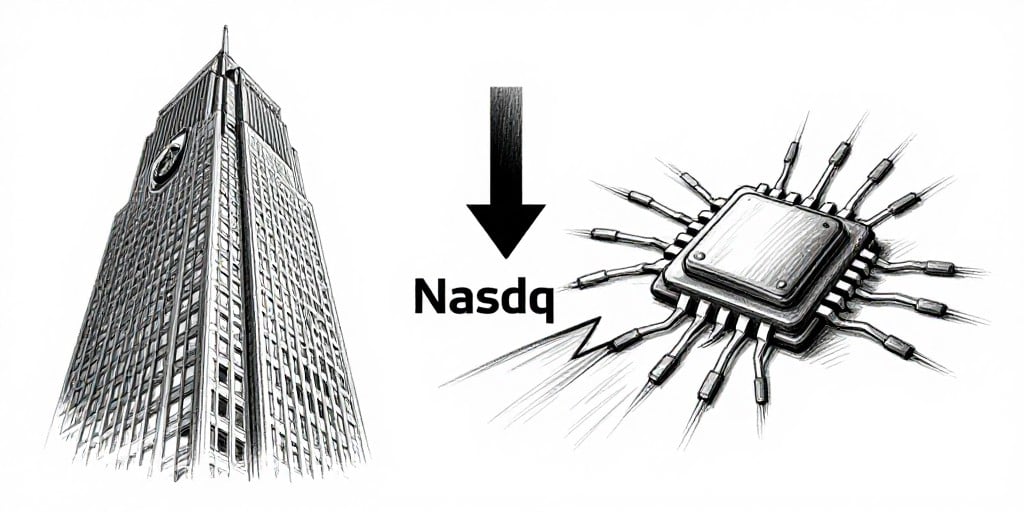
The trading session concluded with a subdued performance on the Nasdaq index, reflecting a broader downturn across U.S. equities. Technology stocks delivered a mixed outcome: prominent names such as Apple and Microsoft posted modest gains, whereas several mid‑cap semiconductor and cloud‑services firms recorded declines. The Nasdaq 100, heavily weighted toward technology, mirrored the index’s downward trajectory. This decline was not attributable to a single catalyst but rather to a confluence of sector‑specific and macro‑economic forces.
1. Technology Sector Dynamics
1.1 Storage‑Chip Demand Slowdown
The memory‑chip market has entered a new contractionary cycle. SK Hynix, Micron Technology, and other memory manufacturers reported lower sales forecasts for the coming quarters, driven by a cooling demand for both consumer and enterprise storage solutions. The slowdown is largely a result of:
- Softening demand for consumer electronics as growth rates in smartphones and personal computing devices have plateaued.
- Reduced data‑center expansion during the post‑pandemic period, leading to slower procurement of high‑capacity memory modules.
- Price‑pressure dynamics that have compressed margins for memory vendors, prompting cautious inventory buildup and reduced production ramp‑ups.
The cyclical nature of memory pricing—typically peaking during periods of heightened demand for cloud and AI workloads—has forced many companies to adopt a defensive inventory strategy, which in turn has weighed on stock valuations.
1.2 Semiconductor Equipment Performance Dip
Semiconductor equipment makers such as Applied Materials and Lam Research experienced a decline in revenue outlooks. Analysts cited a decline in orders for lithography and assembly equipment as firms anticipated a slower pace of chip production. The slowdown in equipment demand reflects the broader semiconductor industry’s transition from a high‑growth to a more stabilised phase, where capital expenditures are being re‑allocated towards capacity optimisation rather than expansion.
1.3 Sector Rotation Toward Defensive Banking
Investor sentiment shifted from high‑growth technology to defensive, dividend‑paying banking stocks. This rotation was driven by expectations that:
- Interest‑rate environments may tighten as the Federal Reserve signals further rate hikes to curb inflation.
- Banking firms are likely to benefit from higher net interest margins, while technology firms may face elevated capital costs.
The net effect has been a modest out‑performance for banks relative to tech, contributing to a widening spread between the two sectors.
2. International Banking Activity
On the Hong Kong market, Chinese banks reached record highs, buoyed by the announcement of increased dividend payouts from the major state‑owned lenders. The dividend announcement was interpreted by investors as a signal of robust balance‑sheet health and confidence in the domestic credit environment. The surge in banking stocks contributed to heightened market volatility, underlining the divergence in performance between traditional finance entities and technology‑centric companies.
2.1 Implications for Global Banking
The dividend uptick reflects a strategic shift by Chinese banks to reward shareholders amid a competitive landscape and to support market confidence during periods of regulatory scrutiny. It also signals that state‑owned banks are leveraging their regulatory advantages to maintain profitability, thereby offering a more stable return profile compared to privately‑held financial institutions.
3. Macro‑Economic Context
3.1 Consumer Price Index (CPI) Expectations
Market participants were closely monitoring the upcoming release of the U.S. Consumer Price Index for September. The CPI data is a critical gauge of inflationary pressures and informs the Federal Reserve’s policy trajectory. Higher-than‑expected inflation would likely accelerate the pace of rate hikes, further influencing equity valuations and capital‑allocation decisions.
3.2 Federal Reserve Policy Signals
Policy signals from the Federal Reserve play a pivotal role in shaping market expectations for interest‑rate trajectories. If the Fed maintains a hawkish stance, equity valuations—particularly in the technology sector—may be compressed due to higher discount rates. Conversely, a dovish pivot could provide a boost to growth‑oriented stocks. The interplay between CPI data and Fed communication will be crucial for investors in calibrating risk‑adjusted returns.
4. Cross‑Sector Linkages and Broader Economic Trends
The observed market dynamics illustrate a fundamental principle that transcends industry boundaries: cyclical demand shifts can have disproportionate impacts on sector valuations. For instance, a slowdown in technology demand directly translates into lower earnings for memory and equipment manufacturers, which in turn affects supply chain partners. The shift toward defensive banking underscores the importance of macro‑environmental factors—such as interest‑rate expectations—in influencing capital flow decisions across disparate sectors.
Moreover, the divergent performance of technology and banking stocks highlights a broader economic trend: risk‑tolerant investors gravitate toward growth sectors when macro fundamentals appear stable, whereas defensive positioning prevails during periods of uncertainty or tightening monetary conditions. This behavioral pattern is observable across multiple global markets, reinforcing the interconnectedness of financial markets and macroeconomic drivers.
5. Conclusion
The recent trading session exemplifies how a combination of sector‑specific catalysts—storage‑chip demand cycles, semiconductor equipment performance, and dividend strategies in banking—interact with macro‑economic signals to shape market outcomes. Investors and analysts must therefore adopt an integrative, evidence‑based approach that accounts for both industry dynamics and the overarching economic environment. Such analytical rigor is essential for navigating the complex landscape of modern corporate finance and for making informed investment decisions in an increasingly volatile and interconnected world.