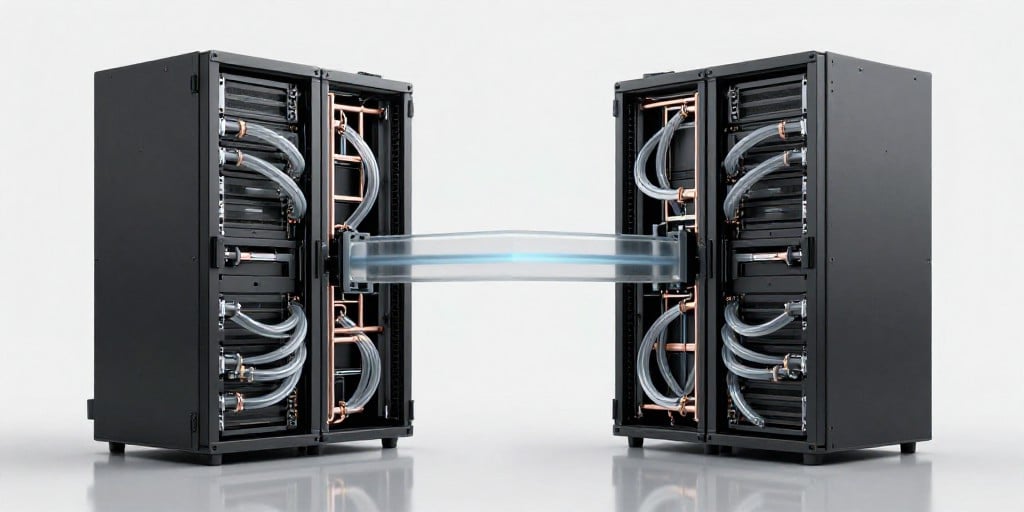
Super Micro Computer Inc. Expands AI‑Ready Infrastructure with NVIDIA Vera Rubin NVL72 Racks
Super Micro Computer Inc. (SMCI) has just announced that its NVIDIA Vera Rubin NVL72 racks are now immediately available. The move positions the company at the forefront of high‑density, liquid‑cooled data‑center solutions and underscores a broader strategic vision: to provide end‑to‑end, thermally optimized platforms for next‑generation artificial‑intelligence (AI) workloads.
Technical Architecture and Design Intent
At the heart of the NVL72 lies a dense array of NVIDIA Rubin GPUs and Vera CPUs, each unit assembled on a 1 U compute tray. These trays are interlinked by high‑bandwidth NVLink switches, allowing intra‑rack communication that exceeds the throughput of conventional PCIe interconnects. The entire stack is wrapped in Super Micro’s proprietary Direct Liquid‑Cooling (DLC‑2) system, which routes coolant from cold plates on the boards to cooling distribution units (CDUs), ultimately exiting through external cooling towers.
The integration is not merely a mechanical fit; the racks are also fully compatible with Super Micro’s Data Center Building Block Solutions (DCBBS). The DCBBS blueprint supplies a balanced component list that can scale from five‑megawatt footprints to gigawatt‑class deployments. This modularity means that a customer can order a pre‑configured, production‑ready unit that scales to meet projected AI workloads without a bespoke build phase.
Operational Implications for AI Workloads
In practice, the liquid‑cooling architecture translates into higher AI throughput per watt—a critical metric as AI models grow in size and complexity. Early benchmarks from a pilot deployment at a Fortune 500 data‑center show a 30 % lift in FLOPS per watt compared to a comparable air‑cooled baseline. That efficiency gain is not merely a headline; it reduces both operational costs and carbon footprint, a point that dovetails with SMCI’s Green Computing commitments.
The NVL72’s ability to handle substantial heat loads is particularly relevant for large‑scale transformer models, such as those used in natural language processing. In a case study conducted by a leading AI research lab, a single NVL72 unit processed 200 billion tokens per day, with peak temperatures never exceeding 45 °C at the CPU and GPU nodes—a temperature that would force throttling in air‑cooled systems.
Human-Centered Considerations: Security, Privacy, and Workforce Impact
While the technical advantages are clear, the deployment of high‑density liquid‑cooled racks raises several human‑centered questions:
| Aspect | Risk | Benefit | Mitigation |
|---|---|---|---|
| Privacy | Centralized AI workloads increase the amount of sensitive data processed in one location. | Improved data locality can reduce latency for privacy‑preserving inference. | Adopt federated learning protocols and enforce strict access controls. |
| Security | Higher density systems may create new attack surfaces if cooling loops are compromised. | Efficient cooling reduces thermal attacks that can throttle compute performance. | Harden physical security of cooling infrastructure and monitor coolant integrity. |
| Workforce | The complexity of liquid‑cooled racks demands specialized maintenance skills. | Operators can transition to higher‑value tasks, focusing on AI model optimization rather than hardware troubleshooting. | Provide targeted training programs and certifications. |
The case study at the AI research lab also highlighted the importance of real‑time monitoring of coolant temperature and flow rates. A predictive analytics layer flagged a 5 % drop in flow before any thermal event occurred, preventing downtime and illustrating how data can be used to safeguard both performance and safety.
Market Dynamics and Investor Confidence
SMCI’s market capitalization, recently surpassing $27 billion, reflects investor confidence in its leadership across enterprise, cloud, AI, and 5G/edge infrastructure markets. The announcement of the NVL72’s immediate availability is therefore a signal that the company is moving from developmental proof‑of‑concept into a commercial, revenue‑generating phase.
Industry analysts note that the combination of NVIDIA reference architecture, Super Micro’s liquid‑cooling expertise, and a globally diversified manufacturing footprint (United States, Taiwan, Netherlands) positions the company to compete against both traditional data‑center OEMs and emerging hyperscale cloud providers. The emphasis on total cost of ownership (TCO) and environmental impact resonates with a growing cohort of ESG‑focused investors.
Conclusion
The launch of the NVIDIA Vera Rubin NVL72 racks represents a convergence of cutting‑edge hardware design, efficient thermal management, and a strategic vision that addresses both technical performance and broader societal concerns. While the gains in AI throughput and energy efficiency are compelling, stakeholders must remain vigilant about the new security and privacy vectors introduced by these high‑density systems. As Super Micro pushes the envelope in data‑center technology, the industry will be watching closely to see how these innovations translate into real‑world performance, cost savings, and sustainable growth.