
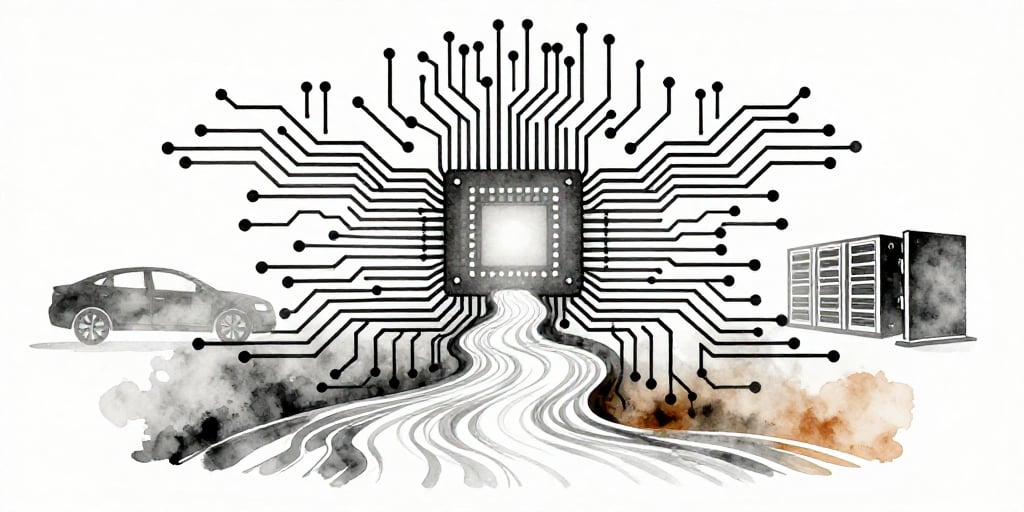
Corporate Update: NXP Semiconductors NV Reports Strong First‑Quarter Results
NXP Semiconductors NV released its first‑quarter financials, showing a solid revenue uptick and improved operating margins relative to the same period last year. The Dutch chipmaker credited growth to its core automotive and industrial divisions, both of which have rebounded from the prolonged downturn that followed the pandemic‑era chip shortage.
Automotive Segment – Software‑Defined Vehicles and Electrification
The automotive business benefited from a shift toward software‑defined vehicles and increased adoption of electric cars. Even in markets where overall vehicle sales have softened, the rising demand for advanced driver‑assist systems, power‑train management, and vehicle‑to‑everything (V2X) communication has sustained chip consumption. NXP’s portfolio, which includes body‑control modules, power‑train management ICs, and connectivity solutions, aligns with the industry’s move toward higher vehicle‑level integration and reduced system‑level cost.
Industrial and IoT Growth
The industrial segment also delivered a respectable earnings contribution. The expansion of the industrial Internet of Things (IoT) continues to drive demand for robust, low‑power sensors, power‑management ICs, and secure connectivity solutions. NXP’s focus on edge‑computing hardware is well‑positioned to capture this trend, as factories and infrastructure deployments seek secure, autonomous operation.
Data‑Centre “Control Plane” Expansion
CFO‑level commentary highlighted a strategic pivot toward the data‑centre “control plane.” This niche involves embedded systems that manage data flow, cooling, and energy usage across server racks. The company projects the data‑centre segment to grow from a modest $200 million base to more than $500 million next year, with a double‑digit addressable‑market growth rate. The move capitalizes on rising data‑centre density, higher demand for energy‑efficient cooling, and the proliferation of edge‑computing nodes that require sophisticated power and thermal management.
Guidance and Investor Reaction
NXP’s forward‑looking guidance surpasses consensus expectations, with revenue projections comfortably exceeding analyst estimates and adjusted earnings per share well above forecasts. Analysts praised the upside surprise and noted a widening gross‑margin range for the quarter. In after‑hours trading, NXP shares gained, outperforming peers in the semiconductor space. The market reaction underscores confidence in the company’s ability to capitalize on the resurgent demand for automotive chips, continued industrial IoT growth, and emerging data‑centre opportunities.
Expert Analysis: Semiconductor Technology Trends and Manufacturing Dynamics
Node Progression and Yield Optimization
Current advanced nodes—3 nm and below—are approaching the limits of planar CMOS, pushing foundries toward extreme ultraviolet lithography (EUV) and 3‑D integration technologies (e.g., monolithic 3‑D, TSVs). Yield optimization at these nodes hinges on:
- Defect Density Control: With feature sizes shrinking, the tolerance for defects narrows. Cleanroom protocols and advanced wafer‑inspection tools (e.g., AI‑driven scatterometry) have become essential.
- Pattern‑Density Uniformity: EUV’s sensitivity to local pattern density requires sophisticated layout design rules and real‑time lithography metrology to maintain uniform critical dimensions.
- Process Variation Management: Statistical process control (SPC) frameworks that incorporate machine learning to predict and compensate for variation in dopant diffusion and etch rates are now standard.
Yield loss often occurs at the back‑end‑of‑line (BEOL), where complex metal interconnects and dielectric layers are formed. Innovations such as low‑k dielectrics and damascene processes with reduced inter‑metal dielectric (IMD) stress help mitigate these losses.
Capital Equipment Cycles and Foundry Capacity Utilization
Foundries invest heavily in capital equipment (CE) to remain competitive. The equipment life cycle for EUV steppers is typically 10–12 years, with a replacement cycle accelerated by rapid node migration. Recent CE trends include:
- Hybrid Lithography: Combining EUV with deep UV (DUV) to reduce cost and improve pattern fidelity.
- High‑Throughput EUV: New steppers capable of 1200 mm²/min throughput aim to lower per‑wafer cost and support high‑volume production.
Capacity utilization remains a balancing act. During the pandemic‑era shortage, many fabs ran at 100 % capacity, causing bottlenecks and elevated costs. In the current environment, foundries are adopting flex‑fab models—shared capacity that can be reallocated to different customers or nodes—to manage demand fluctuations.
Design Complexity vs. Manufacturing Capabilities
Modern chip design complexity—driven by heterogeneous integration, AI accelerators, and secure enclaves—requires close collaboration between IP providers and fabs. Key technical challenges include:
- Design‑for‑Manufacturing (DfM): Engineers must embed process‑specific constraints (e.g., design‑for‑EUV, DfM rules for 3‑D integration) early in the design cycle.
- Advanced Packaging: System‑in‑package (SiP), chip‑on‑board (COB), and wafer‑level packaging (WLP) technologies reduce interconnect length, lower EMI, and enable higher densities.
- Ecosystem Lock‑In: Proprietary process steps (e.g., low‑temperature poly‑SiC deposition) can lock customers into specific fabs, limiting switching flexibility.
Semiconductor innovations such as process‑node‑agnostic design flows, AI‑accelerated design automation, and universal interconnect standards (e.g., CXL, CoWoS) are mitigating these challenges, allowing designers to target multiple fabs without extensive re‑engineering.
Enabling Broader Technology Advances
The ripple effects of semiconductor progress are far‑reaching:
- Automotive: Lower‑cost, higher‑density power‑train controllers reduce vehicle weight, improving range for electric vehicles (EVs).
- Industrial IoT: Energy‑efficient sensors and secure gateways support resilient, scalable smart‑factory ecosystems.
- Data Centres: Advanced power‑management ICs reduce cooling demands, lowering the overall carbon footprint of hyperscale facilities.
- AI/ML: Specialized accelerators (e.g., Tensor Processing Units, neuromorphic chips) deliver inference speeds that underpin autonomous systems and real‑time analytics.
By continuously refining lithographic precision, yield‑optimization strategies, and process‑technology integration, semiconductor manufacturers are driving the next wave of innovation across transportation, manufacturing, and information technology.