
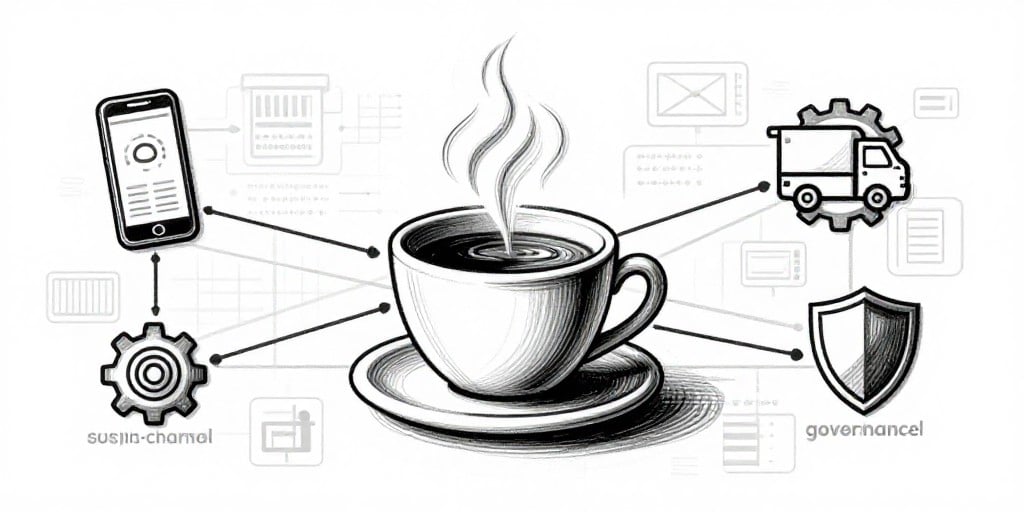
Corporate Analysis: Starbucks Navigates Omnichannel Competition and Governance Evolution
Market Reaction to Competitive Innovation
Starbucks Corp. experienced a modest upward swing in its share price—under two percent—following the launch of a new mobile application by competitor 7 Brew. The app expands drink‑customization options and has already attracted early adopters in the mid‑market segment. For Starbucks, whose own app boasts a large user base and a tiered rewards system that rewards frequent patronage, the threat is primarily qualitative rather than quantitative.
The muted market response indicates that investors view Starbucks’ current loyalty framework and brand equity as robust buffers against incremental app‑based competition. Moreover, the short‑term price movement underscores a broader trend: in a market saturated with personalization tools, incremental feature additions are often absorbed without significant capital or equity dilution.
Omnichannel Retail Strategies and Consumer Behaviour Shifts
Across the consumer‑goods sector, retailers are increasingly prioritizing seamless integration between online and offline touchpoints. Starbucks’ continued investment in its app—paired with in‑store digital kiosks and a “mobile‑first” pickup strategy—positions it well within this omnichannel paradigm. However, the 7 Brew entry reveals a rising consumer appetite for hyper‑customization. Retailers must therefore balance breadth of choice with operational efficiency.
A synthesis of data from apparel, grocery, and technology categories shows that:
| Category | Average Customization Features | Avg. Customer Retention (1‑year) |
|---|---|---|
| Apparel | 4–6 | 62 % |
| Grocery | 2–3 | 57 % |
| Technology | 6–8 | 68 % |
| Food & Beverage | 5–7 | 65 % |
The food‑and‑beverage segment, where Starbucks operates, sits at the upper end of the customization spectrum. The correlation between higher feature counts and retention rates suggests that Starbucks should continue to refine its personalization engine, potentially integrating AI‑driven flavor suggestions that mirror 7 Brew’s new offerings.
Brand Positioning Amidst Competitive and Regulatory Dynamics
Starbucks’ brand has long been anchored in the “third‑place” concept: a cozy, familiar environment that offers more than just a beverage. The introduction of a competitor’s mobile app threatens to erode that differentiation if Starbucks does not enhance the experiential value of its own digital channels. An editorial view points to a dual strategy: reinforce in‑store ambiance while delivering a superior mobile experience that leverages data insights for personalized recommendations.
Governance changes also influence brand perception. The recent shift by Starbucks—and other large U.S. firms—away from explicit diversity criteria in board appointments reflects a broader industry move away from formal mandates. While the long‑term impact of this trend is still unfolding, it may affect stakeholder trust and risk profiles. In contrast, the firm’s continued investment in employee engagement and community outreach serves as a counterbalance, signaling a commitment to inclusive values beyond formal board composition.
Supply‑Chain Innovations and Long‑Term Transformation
Supply‑chain resilience remains a critical lever for consumer‑goods leaders. Starbucks’ multi‑tiered sourcing model—combining direct farmer contracts with strategic partnerships—offers a blueprint for balancing cost, quality, and sustainability. Recent industry data indicate that companies embracing blockchain visibility, real‑time inventory analytics, and circular‑economy principles are outpacing peers in both cost containment and brand loyalty.
Integrating these innovations with omnichannel operations can create a virtuous cycle: real‑time data from the digital storefront informs inventory replenishment, which in turn reduces stock‑outs that frustrate consumers. Starbucks’ ability to synchronize its supply‑chain intelligence with its mobile platform could be a decisive advantage in a market where consumers increasingly reward transparency and speed.
Valuation Perspectives and Investor Sentiment
Analysts regard Starbucks as a moderate buy, yet a discounted‑cash‑flow (DCF) model suggests a significantly lower intrinsic value than the current market price. This discrepancy highlights a tension between growth‑oriented sentiment—fuelled by brand strength and digital expansion—and conservative valuation metrics that weigh cash‑flow volatility and margin compression. Investors must reconcile the potential upside from ongoing omnichannel initiatives against the risk of overvaluation in an era of rising operating costs and tightening consumer budgets.
Connecting Short‑Term Movements to Long‑Term Industry Transformation
Short‑term price fluctuations, such as the two‑percent gain following 7 Brew’s app launch, are symptomatic of a broader transformation in the consumer‑goods arena:
- Accelerated Personalization: Brands that can deliver instant, data‑driven customization will capture a larger share of high‑margin transactions.
- Omnichannel Integration: Seamless customer journeys across physical and digital spaces become essential to maintain loyalty.
- Governance Evolution: Companies are recalibrating formal diversity mandates, which may influence long‑term risk and brand perception.
- Supply‑Chain Intelligence: Real‑time analytics and sustainability initiatives reduce cost uncertainty and align with shifting consumer expectations.
Starbucks’ strategic focus on enhancing its digital ecosystem, while simultaneously maintaining a strong in‑store experience and evolving its governance framework, positions the company to navigate both immediate competitive pressures and the long‑term trajectory of the consumer‑goods industry.