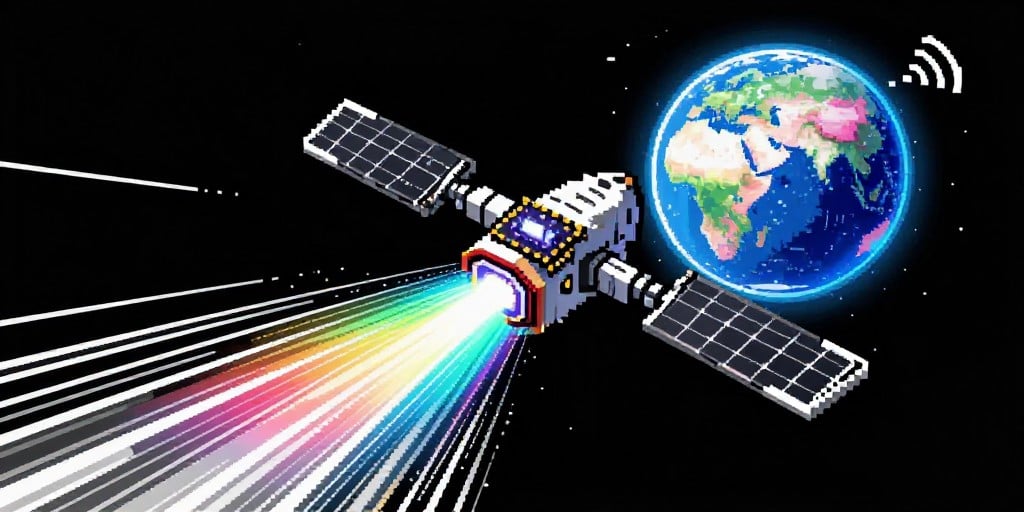
Technological Infrastructure, Content Delivery, and Market Dynamics: SpaceX’s Emerging Satellite‑Based Computing Platform
SpaceX’s recent disclosures illustrate a strategic convergence of space‑borne technology, artificial‑intelligence (AI) infrastructure, and capital‑market activity. The company’s public filings confirm an agreement to deploy NVIDIA‑powered computing satellites beginning in 2027, using a modified Starlink platform. This initiative, coupled with the firm’s landmark initial public offering (IPO), offers a compelling case study in how telecommunications and media sectors are reshaping their competitive landscape.
Satellite‑Based Data Processing: Infrastructure and Capacity Requirements
The announced satellite constellation will augment the existing Starlink broadband network by incorporating high‑performance GPUs on orbit. Each satellite will be equipped with NVIDIA’s latest tensor‑core technology, enabling real‑time data analytics, AI inference, and edge computing at scale. From an infrastructure perspective, this development requires:
- Network Capacity: The projected data traffic will exceed 10 Tbps across the constellation, necessitating upgraded inter‑satellite links (ISL) and ground‑station throughput. SpaceX will need to invest in additional laser‑based ISL modules and upgrade its existing terrestrial gateways to manage the increased bandwidth.
- Latency and Reliability: With AI workloads that demand sub‑millisecond latency, the network architecture must prioritize deterministic routing and redundancy. SpaceX’s plan to incorporate dual‑frequency transponders and adaptive routing protocols will be critical in achieving these performance metrics.
- Energy Management: Operating GPUs in space requires robust power management solutions. The satellites will integrate advanced battery systems and solar arrays capable of sustaining continuous 24‑hour operations.
Content Acquisition and Delivery Strategies
While the primary focus of the satellite constellation is compute, its implications for content delivery cannot be overstated. By enabling low‑latency AI processing in orbit, SpaceX opens new avenues for:
- Edge‑Coded Content: Media providers can encode and deliver adaptive video streams directly from satellites, reducing the need for terrestrial CDN nodes. This is particularly valuable for remote or underserved markets where ground infrastructure is limited.
- Dynamic Ad Insertion: Real‑time AI inference on the satellite can power contextual advertising, allowing marketers to tailor ads based on real‑time viewer data captured in the satellite’s edge network.
- Secure Content Distribution: The isolated nature of satellite links offers enhanced security for premium content, reducing the risk of piracy and ensuring compliance with global content‑delivery regulations.
Competitive Dynamics in the Streaming and Telecommunications Ecosystem
The emergence of satellite‑based compute platforms intensifies competition on multiple fronts:
- Streaming Platforms: Major streaming services (e.g., Netflix, Disney+, Amazon Prime) traditionally rely on terrestrial CDN networks. SpaceX’s offering introduces a disruptive alternative that could lower distribution costs and expand reach, particularly in markets with high latency to ground infrastructure.
- Telecommunications Consolidation: Existing telecom operators are consolidating to expand spectrum holdings and infrastructure footprints. SpaceX’s entry could catalyze a shift toward satellite‑first strategies, compelling operators to invest in satellite‑backhaul solutions or partner with SpaceX to avoid obsolescence.
- Emerging Technologies: 5G, edge computing, and AI are converging to redefine content consumption. SpaceX’s satellites provide an early‑mover advantage in delivering AI‑intensive services (e.g., augmented reality, real‑time language translation) directly to end users, potentially outpacing terrestrial competitors.
Subscriber Metrics, Financial Implications, and Market Positioning
- Subscriber Growth Projections: SpaceX’s satellite constellation is expected to attract an initial subscriber base of approximately 10 million active users by 2028, with a compound annual growth rate (CAGR) of 25 % projected over the next decade.
- Revenue Streams: Direct service revenues from satellite‑based compute and edge content delivery could reach $4–$5 billion by 2030, while ancillary services such as AI inference APIs could contribute an additional $1 billion annually.
- Capital Requirements: The satellite deployment is estimated to cost $12 billion in capital expenditures, with a breakeven point projected around 2029, assuming a 20 % margin on service revenues.
- Investor Sentiment: Post‑IPO, SpaceX’s share price has rebounded from an August low of $9.50 to $18.20 as of September 2026, reflecting investor confidence in the company’s expansion plans and its ability to monetize its satellite infrastructure.
Conclusion
SpaceX’s foray into satellite‑based computing and the subsequent market reaction underscore a pivotal moment in the convergence of telecommunications, media delivery, and AI infrastructure. By leveraging NVIDIA’s GPU technology within the Starlink framework, SpaceX is not merely enhancing its own network capacity but also redefining content acquisition and delivery strategies across the industry. The resulting competitive pressures—especially on streaming platforms and traditional telecom operators—suggest a significant realignment of market dynamics. As subscriber metrics grow and financial performance stabilizes, SpaceX’s strategic positioning is poised to influence both the future of media consumption and the broader telecommunications ecosystem.