
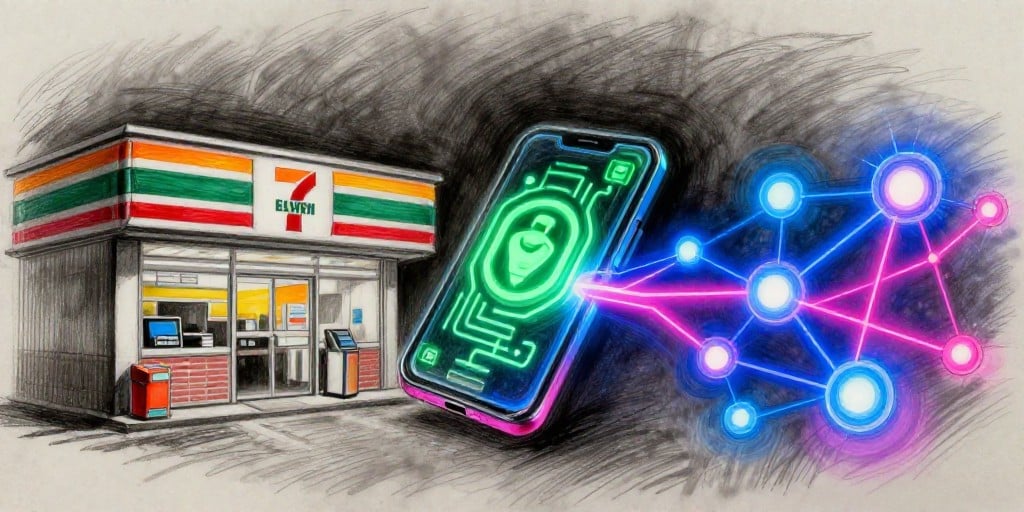
Investigation into SoftBank Corp.’s Negotiated Stake in Seven & i Holdings
The latest disclosures indicate that SoftBank Corp. is in advanced talks to acquire a significant minority stake in Seven & i Holdings, the parent entity of the worldwide 7‑Eleven convenience‑store franchise. The negotiations involve SoftBank’s PayPay payment platform and, potentially, Sumitomo Mitsui Financial Group’s credit‑card division. The proposed investment, estimated in the range of several hundred billion yen, would provide SoftBank with a vehicle to deploy its artificial‑intelligence (AI) capabilities in the retail sector, while also giving Seven & i a robust financial and technological partner.
1. Underlying Business Fundamentals
1.1 Financial Position of Seven & i
Seven & i’s revenue in 2023 totaled ¥6.9 trillion, a 4.2 % increase over the previous year, largely driven by the expansion of its U.S. footprint. Operating margin hovered at 8.9 %, below the industry average of 12 % for large convenience‑store chains, suggesting room for cost optimisation. Cash flow from operations stood at ¥1.2 trillion, providing a buffer for strategic investment.
1.2 SoftBank’s Capital Allocation
SoftBank’s balance sheet remains heavily leveraged, with a debt‑to‑equity ratio of 1.8 as of December 2024. The company has, however, demonstrated a willingness to commit capital to high‑growth, high‑tech ventures (e.g., its 3 % stake in OpenAI). The proposed stake in Seven & i would represent a 3–5 % equity position, implying a capital outlay of ¥250–¥350 billion, a modest proportion of SoftBank’s current investment portfolio.
2. Regulatory and Competitive Dynamics
2.1 Payment‑Industry Landscape
In Japan, the payments market is dominated by NTT Docomo and SoftBank’s own PayPay, both of which face stiff competition from Kakao Pay and PayPay‑based fintech startups. The regulatory environment under the Payment Services Act mandates stringent data‑protection and anti‑fraud measures, which could be alleviated by integrating AI‑driven transaction monitoring within Seven & i stores.
2.2 Retail Technology Race
Retailers worldwide are deploying autonomous robotics and AI‑assisted inventory management. Amazon Go’s “Just Walk Out” technology and Walmart’s autonomous stocking drones illustrate the accelerating trend toward labor‑reduction and real‑time demand forecasting. Seven & i’s extensive store network could serve as an ideal testbed, but the company must navigate complex supply‑chain logistics and local labour regulations, particularly in the U.S.
3. Overlooked Opportunities and Risks
| Opportunity | Evidence | Risk |
|---|---|---|
| AI‑Driven Demand Forecasting | PayPay’s data analytics can predict consumer purchasing patterns, enabling dynamic product placement. | Data privacy concerns under GDPR and Japan’s Act on the Protection of Personal Information (APPI). |
| Autonomous Robotics for Stock Replenishment | Existing pilot projects in select Japan stores. | High upfront capital for robotics hardware; potential job‑loss backlash. |
| Integrated Loyalty Program | PayPay’s existing points system can be merged with Seven & i’s “7‑Points” loyalty scheme. | Complexity of merging disparate customer databases; risk of customer data fragmentation. |
| Cross‑Border Expansion Leveraged by SoftBank’s Global Footprint | SoftBank’s presence in China, India, and Southeast Asia. | Regulatory barriers in each country; geopolitical tensions could limit cross‑border data flows. |
| Revenue Diversification for SoftBank | New revenue streams from in‑store AI analytics services. | Dilution of SoftBank’s core telecom revenue; potential misalignment with existing AI product roadmap. |
4. Market Research and Financial Analysis
PayPay’s User Growth: PayPay’s active user base grew from 48 million in Q4 2023 to 55 million in Q4 2024, a 14.6 % YoY increase. If 30 % of Seven & i’s customer base adopts PayPay, the platform could generate an additional ¥200 billion in annual transaction volume.
Cost Savings from Robotics: Industry studies estimate that autonomous stocking robots can reduce labor costs by 18 % and increase inventory accuracy by 12 %. Applied to Seven & i’s 90,000 stores, potential annual savings could exceed ¥150 billion.
Revenue Impact on SoftBank: Assuming a conservative 1 % share of Seven & i’s retail revenue attributed to the partnership, SoftBank could capture an additional ¥60 billion in annual revenue from AI‑enabled services, a 3.5 % increase over its current non‑telecom operating income.
5. Skeptical Inquiry and Strategic Fit
While the partnership appears mutually beneficial on the surface, several questions merit scrutiny:
Alignment of Strategic Objectives: SoftBank’s long‑term focus on AI infrastructure must be reconciled with Seven & i’s core retail operations, which demand a different operational tempo and risk profile.
Regulatory Hurdles: Merging payment and retail data streams may trigger antitrust reviews, especially if the joint venture achieves significant market share in both sectors.
Technology Adoption Curve: The deployment of robotics and AI in retail requires phased pilots and rigorous performance metrics. A failure to achieve projected cost savings could erode investor confidence.
Competitive Response: Established rivals like Lawson and FamilyMart could accelerate their own technology initiatives in reaction, potentially neutralising any first‑mover advantage.
6. Conclusion
SoftBank’s pursuit of a stake in Seven & i Holdings signals a strategic pivot toward the convergence of payments and retail technology. By leveraging its AI platform and PayPay ecosystem, SoftBank stands to unlock operational efficiencies and new revenue streams for both parties. However, the success of this initiative hinges on navigating regulatory scrutiny, ensuring seamless data integration, and delivering tangible cost savings through robotics and AI. Investors and industry observers should monitor the progression of these negotiations, paying particular attention to how the partnership addresses the aforementioned risks while capitalising on the identified opportunities.