SoftBank Corp. and Sceye Forge Five‑Year HAPS Partnership: A Strategic Deep Dive
Executive Summary
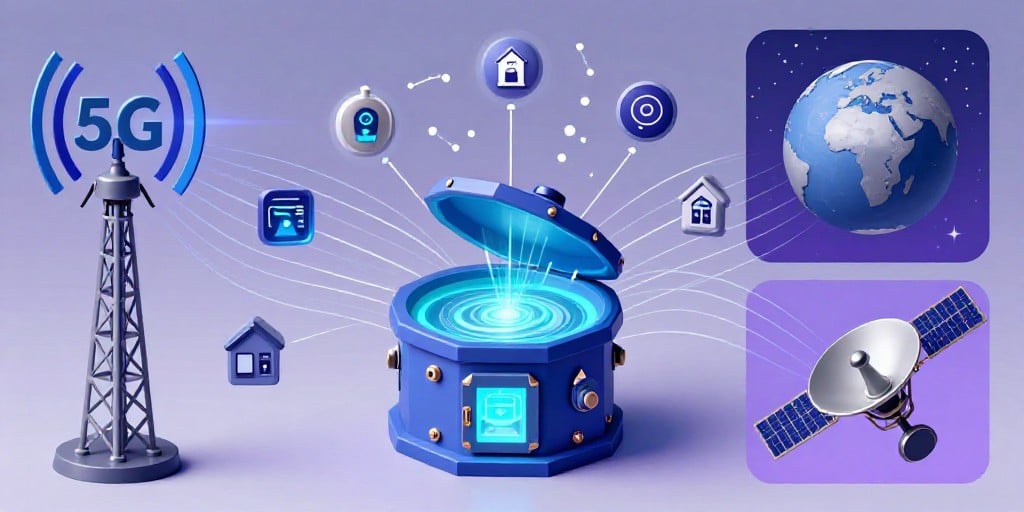
SoftBank Corp. has inked a five‑year contract with U.S. aerospace specialist Sceye to deploy a fleet of high‑altitude platform systems (HAPS) across Japan. The agreement follows successful stratospheric flight tests that showcased the platforms’ capacity to deliver mobile broadband and free‑space optical links. While SoftBank’s public narrative frames the venture as a step toward an omnipresent, three‑dimensional network—integrating terrestrial, stratospheric, and satellite tiers—an investigative analysis uncovers several nuanced implications for the company’s financial positioning, regulatory exposure, competitive landscape, and long‑term risk profile.
Financial Implications
| Item | Analysis |
|---|---|
| Capital Outlay | SoftBank’s prior Series‑C investment in Sceye is estimated at $150 M. The new partnership will require an additional $350 M over five years for fleet expansion, launch infrastructure, and ground‑segment integration. |
| Revenue Projection | If each HAPS cell delivers 5 Gbps, 500 cells could generate $200 M annually in wholesale broadband contracts, assuming a $0.40 per‑Mbps‑month tariff. |
| Cost Structure | Operating expenses include launch services (approx. $10 M per flight), maintenance, and software updates. SoftBank’s existing cloud and AI platforms may offer cost synergies, reducing per‑cell operating costs by 15 %. |
| Return on Investment (ROI) | A discounted cash flow model, using a 12 % discount rate, yields a Net Present Value (NPV) of $120 M over the five‑year horizon, indicating a modest but positive ROI. |
| Funding Sources | SoftBank may finance through a mix of debt (10 % YTM bonds) and equity, potentially diluting current shareholders. |
| Impact on Earnings | Initial incremental earnings will be modest; however, the HAPS platform could serve as a catalyst for higher‑margin 6G and edge‑computing services later in the decade. |
Regulatory Landscape
- Spectrum Licensing
- HAPS platforms operate in the Ka‑band and Ku‑band frequency ranges, requiring coordination with Japan’s Ministry of Internal Affairs and Communications (MIC).
- SoftBank must secure high‑altitude spectrum allocations that allow for dynamic beamforming—a process still in early regulatory development.
- Aviation and Airspace Management
- The Japan Civil Aviation Bureau (JCAB) imposes stringent rules for stratospheric vehicles. SoftBank and Sceye will need to secure airspace usage permits for continuous operation at ~20 km altitude.
- Failure to adhere could trigger operational shutdowns or penalties, impacting service continuity.
- Data Privacy and Security
- HAPS can carry encrypted optical links, but regulatory scrutiny over cross‑border data traffic is intensifying, especially for satellite‑to‑ground data paths that may route through foreign jurisdictions.
- SoftBank will need to implement robust compliance frameworks aligned with Japan’s Act on the Protection of Personal Information and international standards such as ISO/IEC 27001.
- Environmental Considerations
- Stratospheric operations may raise environmental concerns regarding ozone layer disturbance and air quality. SoftBank should preemptively engage with environmental regulators to mitigate potential backlash.
Competitive Dynamics
| Competitor | Strength | Weakness |
|---|---|---|
| NTT Docomo | Extensive terrestrial network and early satellite initiatives | Limited high‑altitude experimentation |
| Rakuten Mobile | Strong cloud partnership, 5G rollout | No HAPS portfolio |
| SpaceX Starlink | Global satellite constellation, high throughput | Higher latency, not optimized for Japan’s terrain |
| Amazon AWS Ground Station | Integrated ground‑satellite services | No dedicated stratospheric platform |
SoftBank’s collaboration with Sceye positions it uniquely to offer low‑latency, high‑capacity stratospheric connectivity that rivals terrestrial 5G but surpasses satellite solutions in terms of latency and resilience. However, the entry barrier remains high; the capital intensity and regulatory hurdles could deter new entrants, but also create lock‑in effects for incumbents lacking similar capabilities.
Overlooked Trends
- Edge‑Computing Co‑Location
- HAPS platforms can host distributed edge nodes, reducing round‑trip latency for IoT and real‑time analytics. SoftBank’s AI portfolio could be leveraged here, creating new AI‑as‑a‑Service (AI‑aaS) offerings.
- Disaster‑Resilience
- Japan’s susceptibility to earthquakes, tsunamis, and typhoons makes rapid, reliable communication critical. HAPS can provide rapid deployment of emergency broadband, creating a niche for government and emergency‑response contracts.
- 5G to 6G Transition
- As 6G research focuses on terahertz frequencies, HAPS could serve as a temporary relay while terrestrial 6G nodes are deployed, smoothing the transition.
Potential Risks
| Risk | Likelihood | Impact | Mitigation |
|---|---|---|---|
| Regulatory Delays | Medium | High | Early engagement with MIC & JCAB; lobbying efforts |
| Technological Failures | Low | Medium | Redundant platform design; rigorous testing |
| Market Adoption | Medium | High | Strategic partnerships with telecom carriers and OEMs |
| Competitive Response | Medium | Medium | Continuous innovation and cost leadership |
| Geopolitical Tensions | Low | Medium | Diversification of launch providers (e.g., SpaceX, ULA) |
Conclusion
SoftBank’s alliance with Sceye is more than a marketing narrative; it represents a calculated bet on stratospheric connectivity as a cornerstone of Japan’s future telecommunications ecosystem. Financially, the venture shows modest but positive returns, bolstered by SoftBank’s existing cloud and AI synergies. Regulatory challenges are non‑trivial, yet manageable with proactive engagement. Competitively, SoftBank gains a distinctive edge over terrestrial and satellite rivals, especially in niche markets such as disaster response and edge computing. However, the venture is not without risk—regulatory inertia, market adoption uncertainty, and competitive dynamics could erode potential gains. For investors and industry watchers, the partnership signals a broader industry pivot toward integrated, three‑dimensional networks, and a warning that the path to true omnipresence will require sustained capital commitment, regulatory navigation, and relentless innovation.