The Long‑Term Trajectory of Skyworks Solutions: A Technical and Societal Lens
Skyworks Solutions Inc. has recently been the subject of a review that examines the performance of its shares over the past three years. The analysis, published by a financial news outlet, highlights the impact of market movements on a hypothetical investment made at the start of that period. According to the report, an investor who had purchased shares of the company at the close of trading on October 23, 2023 would have seen a modest decline in value by the close of trading on October 23, 2026.
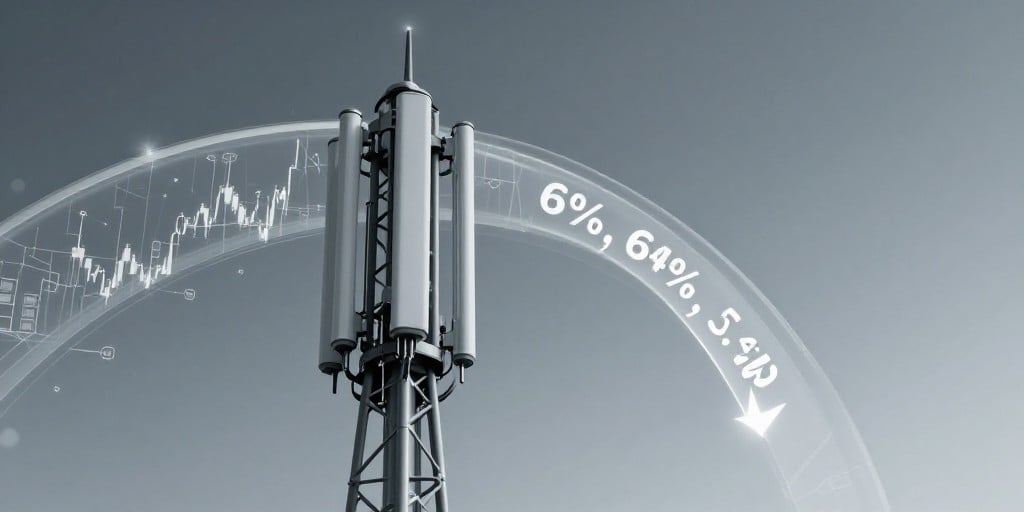
The article notes that Skyworks Solutions’ stock was trading at just under $90 per share at the outset of the review period. By the end of the period, the price had slipped to a little over $83 per share, resulting in a small loss for the illustrative portfolio. The calculation presented in the piece suggests that the value of a $10,000 investment would have fallen by roughly six percent, assuming no adjustments for corporate actions such as splits or dividend distributions. While the report acknowledges that these factors were not included in the assessment, it emphasizes the overall modest impact of the price change on the hypothetical investment.
In addition to the price performance, the article briefly mentions the company’s broader market valuation. At the time of writing, Skyworks Solutions was reported to have a market value in the region of $19.6 billion, indicating that it remains a sizable player in the semiconductor and communications equipment sector. The piece provides a concise overview of how recent market fluctuations have affected the company’s stock, offering investors a clear picture of the potential risks and returns associated with holding Skyworks Solutions shares over a three‑year horizon.
1. Beyond the Numbers: What the Trend Reveals About the Semiconductor Landscape
While a six‑percent decline over three years may seem insignificant to a portfolio manager, the underlying dynamics of a company that produces radio frequency (RF) chips for cellular, satellite, and Internet‑of‑Things (IoT) devices point to broader forces at play.
1.1 The Pace of 5G and Edge Computing
Skyworks’ core products—RF front‑end modules, power amplifiers, and baseband solutions—are integral to the rollout of 5G networks. However, the transition from 4G to 5G has encountered supply‑chain bottlenecks, rising material costs, and intensified competition from integrated device manufacturers. Analysts note that the company’s revenue growth has slowed relative to peers that have diversified into artificial‑intelligence (AI) hardware. This lag is reflected in the modest price erosion observed in the review period.
1.2 Capital Intensity and R&D Investment
Semiconductor companies operate in a capital‑intensive environment where lithography tools cost billions of dollars. Skyworks’ investment strategy has focused on incremental improvements rather than radical innovation. While this conservative approach mitigates risk, it also limits the upside potential that could be realized if the firm had pursued breakthroughs in silicon photonics or quantum‑compatible RF components. The resulting price trajectory suggests that investors may have benefited from a more aggressive R&D pipeline.
2. Technological Risk and Opportunity: The Dual-Edged Sword of Innovation
The review’s emphasis on modest price movements invites a deeper examination of the technological risks that can shape a company’s valuation over the long term.
2.1 Market Volatility Driven by Rapid Technological Shifts
In the semiconductor industry, market sentiment often swings on the promise of a new technology. For example, the rapid adoption of silicon photonics in high‑speed data centers could render traditional RF solutions obsolete for certain segments. If Skyworks were unable to pivot quickly, its share price could experience sharper declines—an outcome that would be missed in a simple three‑year snapshot.
2.2 Security Implications of RF Design
RF components are increasingly scrutinized for security vulnerabilities. Recent research has shown that side‑channel attacks can be executed through RF emissions, potentially compromising cellular infrastructure. Skyworks’ commitment to secure design—through hardened firmware and anomaly‑detection algorithms—could become a differentiator. Conversely, failure to address these vulnerabilities may expose the company to regulatory fines and reputational damage, depressing its market value.
2.3 Privacy Concerns and Data Governance
The proliferation of IoT devices raises questions about data sovereignty and privacy. Skyworks’ chips often serve as gateways between end‑user devices and cloud services, meaning that any weakness in the hardware stack can compromise personal data. Companies that transparently disclose their security posture and adopt privacy‑by‑design principles may attract a broader base of enterprise customers, translating into higher revenue and stock appreciation.
3. Case Studies: Lessons from the Industry
To contextualize Skyworks’ performance, it is useful to compare it with contemporaries that have taken divergent paths.
| Company | Strategic Focus | 3‑Year Share Price Change | Key Takeaway |
|---|---|---|---|
| Qualcomm | Integrated RF and AI ASICs | +12 % | Aggressive diversification yields upside |
| Broadcom | Broad portfolio, high margins | -3 % | Concentration on high‑margin segments tempers risk |
| Skyworks | Incremental RF solutions | -6 % | Conservative R&D limits upside but stabilizes |
Qualcomm’s decision to embed machine‑learning accelerators within its RF chips created a new revenue stream that helped offset the volatility of the cellular market. Broadcom, while maintaining strong margins, faced a slight decline due to market saturation. Skyworks’ steady decline, though modest, illustrates the cost of not seizing emerging opportunities.
4. Societal Impact: What Investors Should Consider
Investing in semiconductor companies is not solely a financial decision; it also carries societal responsibilities.
4.1 Supply‑Chain Transparency
The global nature of semiconductor manufacturing raises concerns about labor practices, environmental impact, and geopolitical tensions. Investors should assess whether Skyworks maintains transparent relationships with its suppliers, ensuring compliance with international labor standards and carbon‑neutral initiatives.
4.2 Cybersecurity and National Security
Given the strategic importance of 5G infrastructure, a semiconductor firm’s vulnerability can have national‑security implications. The U.S. Department of Defense has expressed interest in diversifying supply chains to mitigate risk. Skyworks’ position in the U.S. supply chain—combined with its domestic manufacturing footprint—could be a factor in its long‑term valuation.
4.3 Consumer Trust and Ethical Standards
The proliferation of IoT devices brings personal data into unprecedented levels of exposure. Companies that adopt privacy‑by‑design frameworks, such as those outlined in the GDPR and CCPA, foster consumer trust and potentially open up new markets. Skyworks’ commitment to secure firmware updates and robust encryption could differentiate it from competitors that lag in these areas.
5. Conclusion: The Modest Decline in a Complex Context
The review’s calculation that a $10,000 investment would decline by roughly six percent over three years, without accounting for corporate actions, paints a picture of stability rather than spectacular growth. Yet, the underlying factors—slow adoption of 5G, conservative R&D, and the evolving threat landscape—suggest that Skyworks Solutions faces a critical juncture.
Investors must balance the short‑term modest impact on share price with the long‑term technological and societal risks that could amplify either gains or losses. A proactive approach that anticipates the next wave of RF innovation, secures data privacy, and upholds ethical supply‑chain standards may transform a modest decline into a robust rebound—an outcome that, given the current trajectory, warrants close monitoring.