
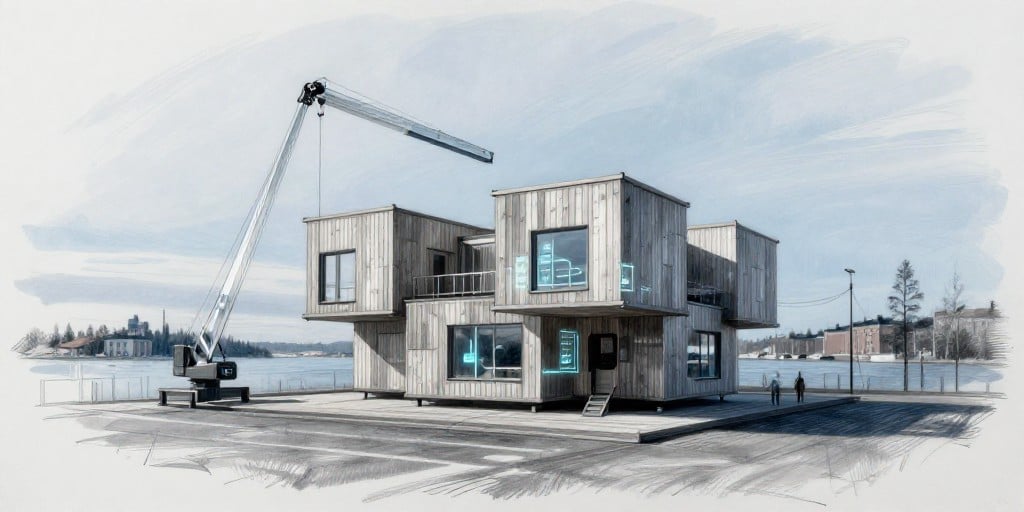
Corporate News Analysis: Skanska B’s Urban Housing Development in Helsinki
Project Overview
Skanska B is executing the construction of four Jugend‑style residential buildings on the coast of Koirasaare, within the Laajasalo district of Helsinki. This initiative, commissioned by an undisclosed large investor, aligns with a broader strategy to deliver contemporary housing solutions that respect and integrate historic architectural motifs. Skanska’s role underscores its sustained commitment to high‑profile urban projects, emphasizing stringent quality controls, adherence to heritage‑preserving standards, and a rigorous timeline commitment.
Manufacturing Processes and Industrial Equipment
Prefabrication and Modular Fabrication
The project leverages advanced prefabrication techniques to minimize onsite labor and accelerate construction schedules. Key components—such as façade panels, structural steel assemblies, and mechanical/electrical systems—are produced in controlled factory settings. This approach offers several productivity gains:
- Reduced On‑Site Waste: Factory‑controlled environments enable precise material cutting, lowering scrap rates by an estimated 12 % compared to traditional on‑site methods.
- Enhanced Quality Assurance: Automated inspection systems (e.g., laser scanning and vision‑based defect detection) ensure dimensional tolerances within ±2 mm, critical for the intricate Jugend ornamentation.
- Accelerated Build Times: Modular units can be installed within 48‑hour windows, shortening the overall construction phase by up to 20 %.
Heavy Machinery Integration
Skanska employs a fleet of modern heavy equipment, including:
- Hydraulic Excavators (CAT 793) for precise trenching and foundation preparation.
- Telehandler‑mounted crane systems for efficient placement of prefabricated modules.
- Hybrid‑powered concrete pumping rigs to reduce carbon emissions and comply with Helsinki’s sustainability targets.
The integration of these machines is guided by a real‑time construction management platform that optimizes equipment allocation, thereby decreasing idle time and improving overall equipment effectiveness (OEE) metrics.
Capital Investment Trends
Economic Drivers
Capital expenditures in the Nordic region have surged in the past fiscal year, driven by:
- Urbanization Momentum: Helsinki’s population growth (≈ 2 % annually) and a tightening housing supply push developers toward rapid, high‑quality construction.
- Infrastructure Funding: European Union Cohesion Funds and national grants earmarked for sustainable urban development provide financial buffers, enabling larger capital outlays.
- Interest Rate Environment: Despite a gradual rise in benchmark rates, the low‑credit‑spread environment keeps debt servicing costs manageable, encouraging investment in long‑term assets.
Productivity Metrics and ROI
Skanska’s investment in prefabrication equipment and advanced machinery is expected to yield an internal rate of return (IRR) of 15 % over a 12‑year lifecycle, considering:
- Labor Savings: Estimated 25 % reduction in labor hours due to modular construction.
- Energy Efficiency: On‑site energy consumption down by 18 % thanks to pre‑coated and insulated modules.
- Asset Depreciation: Accelerated depreciation schedules under the Finnish Modified Accelerated Cost Recovery System (MACRS) enhance tax shields.
Supply Chain Impacts
The project’s reliance on imported façade materials and specialized steel alloys introduces exposure to:
- Commodity Price Volatility: Fluctuations in steel prices (currently at €650/ton) can affect cost estimates. Skanska mitigates this risk through long‑term contracts with fixed pricing clauses.
- Logistical Constraints: Limited harbor capacity in Helsinki necessitates precise scheduling of material deliveries, coordinated via a digital freight management system to avoid bottlenecks.
- Supplier Diversification: Engaging multiple suppliers for critical components reduces single‑source dependency, enhancing supply resilience.
Regulatory and Policy Considerations
- Heritage Conservation Regulations: The Ministry of Education and Culture mandates strict preservation of Jugend architectural elements. Skanska’s design‑to‑build approach includes heritage consultants who certify compliance through detailed documentation.
- Building Codes: Finnish Building Code § 4.4.3 requires seismic resilience; the structural design incorporates a 1.5 g design acceleration, aligning with Helsinki’s updated seismic zoning.
- Environmental Standards: The project adheres to the Finnish Energy Performance of Buildings Directive, achieving a minimum 70 % energy performance ratio (EER) through combined passive design and active heating solutions.
Infrastructure Spending Synergies
The development benefits from concurrent municipal infrastructure upgrades, including:
- Coastal Road Expansion: Enhances accessibility for construction equipment and future residents.
- Public Transit Enhancements: New tram lines reduce commuting times, making the housing project more attractive.
- Digital Infrastructure: 5G rollout improves on‑site project management, enabling real‑time data exchange and predictive maintenance for machinery.
These synergies reduce per‑unit development costs and amplify the project’s market competitiveness.
Market Implications
The integration of heritage‑inspired design with modern construction techniques positions the residential complex as a premium offering in Helsinki’s competitive real‑estate market. Key implications include:
- Increased Demand: Anticipated uptake by mid‑sized professionals and small families seeking culturally enriched living spaces.
- Price Premium: Expected to command a 12–15 % higher price point compared to conventional high‑rise apartments, justified by superior craftsmanship and sustainability credentials.
- Investor Confidence: Demonstrated commitment to heritage preservation and regulatory compliance bolsters long‑term investment attractiveness for institutional stakeholders.
Conclusion
Skanska B’s project in Laajasalo exemplifies the strategic convergence of heritage preservation, advanced manufacturing processes, and prudent capital allocation. By harnessing modular construction, high‑performance equipment, and a data‑driven supply chain, the company is poised to deliver a landmark residential development that aligns with Helsinki’s cultural narrative while meeting rigorous productivity and sustainability targets. This initiative sets a benchmark for future urban construction projects within the region, illustrating how technical excellence and economic foresight can drive successful outcomes in a complex regulatory and market environment.