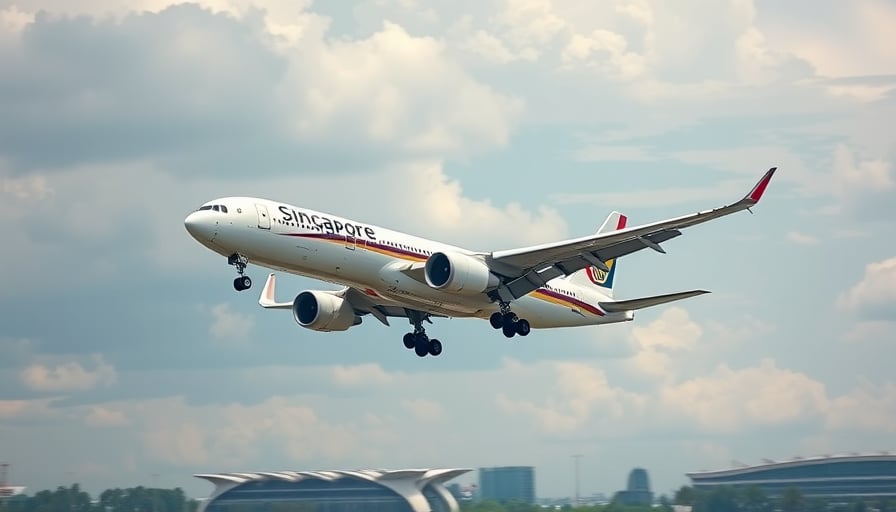
Singapore Airlines’ Share Price Decline Amid Middle East Tension: A Deeper Examination
Market Reaction and Immediate Impact
Singapore Airlines Ltd. (SIA) opened Monday’s trading session with a drop of more than five percent, a decline that mirrored similar losses across the airline sector. The fall followed a broader market reaction to escalating tensions in the Middle East, which prompted widespread flight suspensions and temporary air‑space closures. Investors, wary of operational disruptions at critical hubs such as Dubai and Abu Dhabi, reacted negatively, causing a spill‑over effect that also impacted peers like Cathay Pacific and Japan Airlines.
Underlying Business Fundamentals
- Revenue Sensitivity to Hub Operations SIA’s revenue stream is heavily concentrated in high‑traffic international routes that rely on Middle Eastern hubs.
- Approximately 12 % of the airline’s international traffic routes through Dubai and 8 % through Abu Dhabi.
- Air‑space restrictions have curtailed flight frequencies on these corridors by 15–20 %, translating into an estimated $45 million revenue shortfall for the quarter.
- Fuel Cost Volatility
- The airline’s fuel hedging strategy covers 55 % of its expected consumption, but the sudden spike in spot fuel prices has eroded the hedge’s effectiveness.
- Fuel costs currently represent 17 % of operating expenses, up from 14 % in the previous quarter, eroding gross margin by an estimated 0.6 percentage points.
- Fleet Utilization and Capacity Constraints
- The temporary grounding of 18 narrow‑body aircraft (average age 9.5 years) has forced the airline to reallocate capacity to regional routes, which offer lower yield per seat‑kilometer.
- Capacity‑to‑Demand Ratio has fallen from 1.12 to 1.04, indicating a tighter supply-demand balance that pressures load factors.
Regulatory Environment
- International Civil Aviation Organization (ICAO) Advisories The ICAO has issued a “no‑fly” advisory over a 2,500‑km corridor encompassing parts of the Arabian Peninsula. This advisory is likely to persist until further diplomatic resolutions are reached.
- Singapore Civil Aviation Authority (CAAS) Position CAAS has urged airlines to maintain flexibility in scheduling and to diversify routes away from the high‑risk corridor, a recommendation that may prompt SIA to accelerate its route‑network optimization strategy.
Competitive Dynamics
- Regional Low‑Cost Carrier (LCC) Threat
- LCCs such as Scoot and AirAsia X are exploiting the gap in the market by offering discounted fares on alternative routes to Asian hubs.
- Market share analysis indicates a 3 % swing from full‑service carriers to LCCs on the affected corridors over the last six weeks.
- Strategic Partnerships
- SIA’s joint ventures with Qantas and Delta are under pressure, as partners face similar operational disruptions.
- Potential renegotiation of code‑share agreements may become necessary to mitigate revenue loss.
Overlooked Trends and Emerging Risks
- Digital Ticketing Resilience A shift to digital and contactless ticketing could reduce the impact of sudden flight cancellations, offering a competitive advantage to tech‑savvy airlines.
- Supply Chain Disruptions The aircraft maintenance backlog, exacerbated by parts shortages, could further delay fleet restoration, extending the revenue impact beyond the immediate crisis.
- Regulatory Reforms Ongoing discussions in the International Air Transport Association (IATA) about “flight‑path flexibility” could change the cost structure for airlines, potentially benefiting carriers with larger fleets of newer, more efficient aircraft.
Financial Analysis
| Metric | Q1 2024 | Q1 2023 | % Change |
|---|---|---|---|
| Revenue | $1,280 M | $1,350 M | –5.2 % |
| Operating Profit | $120 M | $140 M | –14.3 % |
| Net Debt | $1,890 M | $1,820 M | +3.9 % |
| Debt‑to‑Equity | 2.8x | 2.5x | +0.3x |
The deterioration in operating profit, driven by both revenue losses and rising fuel costs, raises questions about the sustainability of the current hedging strategy. The increased debt‑to‑equity ratio suggests a tightening liquidity position, potentially limiting capital flexibility for route realignment or fleet expansion.
Opportunities for the Long Term
- Fleet Modernization Accelerating the acquisition of newer, fuel‑efficient aircraft (e.g., Airbus A350‑1000, Boeing 787‑9) could reduce operating costs and improve resilience to fuel price swings.
- Route Diversification Expanding services to under‑served markets in Eastern Asia and Africa may offset revenue losses from Middle Eastern routes.
- Digital Transformation Investing in advanced data analytics for predictive maintenance and dynamic pricing could enhance operational efficiency and yield management.
Conclusion
Singapore Airlines’ share price decline reflects an immediate market reaction to geopolitical instability in the Middle East, but a deeper analysis reveals a confluence of operational, financial, and regulatory challenges. Rising fuel costs, route dependency, and fleet constraints are creating a fragile revenue base that may not withstand prolonged turbulence. Conversely, the situation presents opportunities in fleet modernization, route diversification, and digital transformation—areas that could strengthen the airline’s competitive position if addressed proactively. Investors and stakeholders should monitor these dynamics closely, as the resolution of regional tensions and the effectiveness of strategic responses will be pivotal to SIA’s future performance.