
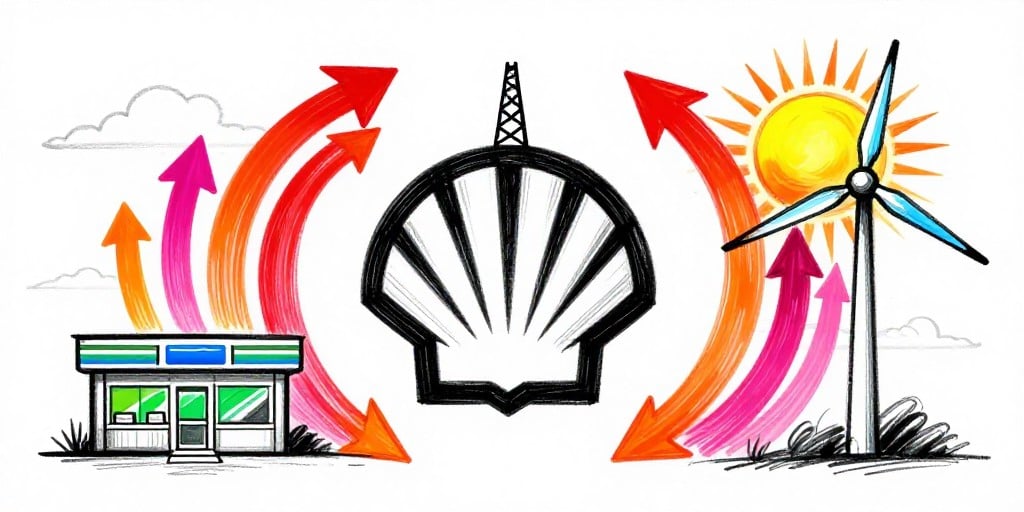
Shell plc’s September 2026 Corporate Activity and Its Implications for Energy Markets
Shell plc’s announcements in early September 2026 illustrate the company’s continued strategy of balancing shareholder returns with growth initiatives across both conventional and renewable sectors. The company’s share‑buy‑back program, new share issuance, and expansion of its U.S. convenience‑retail portfolio each carry implications for market participants, commodity pricing, and the broader energy transition narrative.
1. Share‑Buy‑Back Programme
Shell announced the launch of a share‑buy‑back managed by Goldman Sachs International, to be executed until 23 October 2026. The programme has been carried out through on‑market transactions on the London Stock Exchange (LSE), Chi‑X, and the Dutch XAMS, as well as off‑market deals. Prices for the repurchased shares hovered around GBP 30‑35 and EUR 30‑35, reflecting a valuation that is modestly above the recent trading average but below the company’s historical buy‑back levels.
From a market‑dynamics perspective, the buy‑back exerts a tightening effect on the supply of shares, potentially supporting the share price amid a backdrop of heightened volatility in the energy sector. Commodity‑price data for Brent crude and West Texas Intermediate (WTI) suggest that oil prices have remained range‑bound between USD 70–85 per barrel, limiting the upside pressure that could otherwise buoy energy‑producing equities. The buy‑back therefore serves as an active tool to offset dilution and signal confidence in the company’s valuation, even as oil markets remain sensitive to geopolitical shocks in the Middle East and supply‑side curbs by OPEC+.
2. New Ordinary Share Issuance and ARC Resources Acquisition
In a filing with the U.S. Securities and Exchange Commission, Shell disclosed a 6‑K report outlining an application to admit new ordinary shares at €0.07 each onto the LSE. These shares form part of the consideration for the acquisition of ARC Resources Ltd., a U.S.‑based producer of oil‑shale resources. By issuing new shares that carry the same voting rights as existing shares, Shell preserves governance structure while raising capital for the acquisition.
The acquisition of ARC aligns with broader trends in the U.S. shale sector, where commodity prices for natural gas and light‑tight oil have oscillated between USD 3–4 per MMBtu and USD 60–70 per barrel of oil equivalent, respectively. The strategic addition of ARC’s production assets provides Shell with a hedge against volatile gas prices and grants access to high‑quality reserves that can be leveraged for both conventional sales and future conversion to low‑carbon products.
3. Expansion of the U.S. Convenience‑Retail Footprint
Shell’s purchase of Tri Star Energy extends its presence in the southeastern United States from 33 % ownership to full control, adding 320 fuel and convenience sites and reinforcing supply agreements with 552 dealer‑owned locations. This acquisition is positioned as a high‑return business, consistent with Shell’s focus on retail margins, which currently average USD 0.25–0.30 per gallon for gasoline in the region.
The retail expansion dovetails with the increasing importance of local fuel distribution in the context of decarbonization. As electric‑vehicle (EV) adoption accelerates, convenience‑retail sites become critical nodes for charging infrastructure deployment. Shell’s acquisition of Tri Star positions the company to invest in EV charging stations, leveraging existing retail real estate to accelerate the transition toward electrified mobility while maintaining robust cash flow from conventional fuel sales.
4. Market‑Level Implications
Supply‑Demand Fundamentals
Oil and natural‑gas markets continue to exhibit a delicate balance between supply constraints—stemming from geopolitical tensions and production caps—and demand recovery following the COVID‑19 pandemic. Brent and WTI prices remain above USD 80 per barrel, but are pressured by increased supply from U.S. shale producers and potential OPEC+ production ramp‑ups. Shell’s diversified portfolio, combining conventional upstream assets with strategic retail operations, provides resilience against supply shocks.
Technological Innovations
Technological advances in energy storage, such as next‑generation lithium‑ion batteries and flow‑cell systems, are reshaping the value proposition of conventional energy producers. Shell’s investments in renewable hydrogen production, coupled with its retail footprint, create synergies for deploying hydrogen refueling stations alongside traditional fuel pumps. The company’s willingness to issue new equity for acquisitions reflects a recognition that capital will be required to adopt and commercialize these emerging technologies.
Regulatory Impacts
Regulatory developments in both the UK and the U.S. are influencing corporate actions. In the UK, the UK listing rules and market‑abuse regulations govern buy‑back programmes, ensuring transparency and fair treatment for investors. In the U.S., the SEC’s disclosure requirements for share issuances and acquisition financing reinforce corporate accountability. Moreover, environmental regulations—such as the EU Emissions Trading System and California’s cap‑and‑trade program—exert upward pressure on carbon prices, prompting energy companies to diversify into low‑carbon assets. Shell’s strategic moves demonstrate an attempt to align with these regulatory trajectories while maintaining shareholder value.
5. Short‑Term vs Long‑Term Dynamics
| Aspect | Short‑Term Impact | Long‑Term Outlook |
|---|---|---|
| Share buy‑back | Supports share price, improves EPS | Signals confidence; may limit liquidity |
| New share issuance | Raises capital for ARC acquisition | Expands asset base; supports decarbonization |
| Retail expansion | Increases cash flow from high‑margin sales | Positions for EV charging infrastructure |
| Commodity prices | Volatile, driven by geopolitical events | Moderately bullish trend with supply constraints |
In the short term, Shell’s corporate actions provide tangible returns for shareholders and a platform for operational integration. Over the longer horizon, the company’s focus on high‑return businesses, coupled with strategic acquisitions in the U.S. and an expansion of retail assets, positions it to navigate the evolving energy landscape. The integration of conventional and renewable portfolios, supported by commodity‑price resilience and regulatory compliance, underscores Shell’s continued relevance in both global energy markets and the U.S. retail fuel sector.