
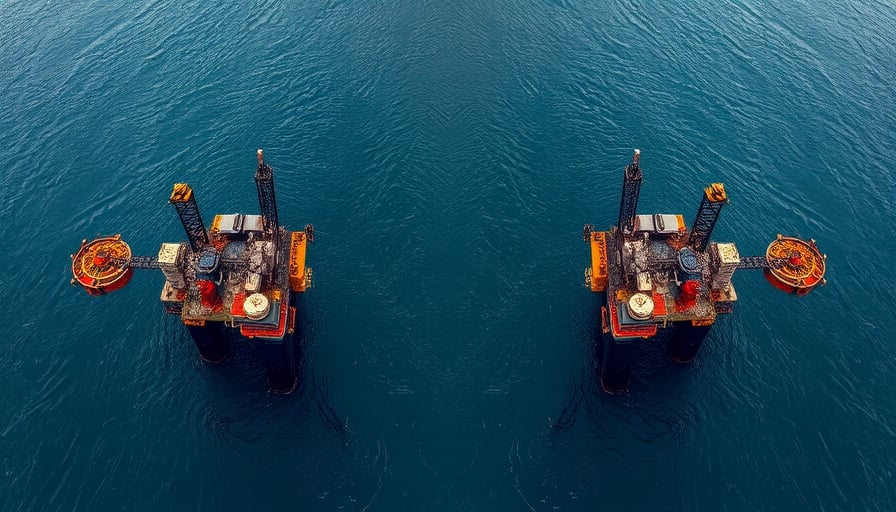
Shell PLC Prepares for 2025 Financial Disclosure Amidst Market Volatility
Executive Summary
Shell Plc, a London‑stock‑listed multinational in the oil and gas sector, is set to release its fourth‑quarter and full‑year 2025 financial statements on 5 February. The company’s recent exposure to volatile crude‑oil prices has manifested in a downward pressure on its equity valuation, prompting analysts to scrutinize the forthcoming results for insight into earnings stability, dividend policy, and capital‑allocation decisions such as share buybacks. In parallel, Shell’s strategic emphasis on expanding operations in West Africa signals a potential pivot in growth orientation, while external geopolitical developments—including U.S. policy deliberations on Venezuelan oil production and tensions in the Middle East—continue to influence market sentiment.
1. Business Fundamentals Under Review
1.1 Earnings Volatility and Cost Structure
Shell’s operating income for 2025 Q4 is projected to reflect the confluence of lower crude prices (average Brent at $83 / bbl versus $90 / bbl in 2024) and a modest rise in refining margins due to supply constraints in key refining hubs. Analysts estimate a 12‑15 % decline in operating profit relative to Q4 2024, driven primarily by a 20 % fall in upstream production revenue. Despite these headwinds, Shell’s diversified portfolio—combining upstream, midstream, and downstream assets—provides a buffer, with downstream operations accounting for 35 % of total revenue and delivering a more predictable cash‑flow profile.
1.2 Capital Expenditure and Investment Priorities
Shell’s capital‑expenditure (CAPEX) plan for 2025 is slated at $27 billion, a 7 % reduction from 2024 figures. The majority of CAPEX is earmarked for the West African expansion, including the development of the new Sine-Saloum offshore block in Senegal and a gas processing facility in Nigeria. This shift aligns with Shell’s broader strategy to secure mid‑stream assets that enhance its supply‑chain resilience, but it also raises questions about the opportunity cost of diverting funds from higher‑margin North‑American and Gulf‑Coast projects.
2. Regulatory and Geopolitical Landscape
2.1 U.S. Policy on Venezuelan Oil
The U.S. Treasury’s contemplation of a general license for Venezuelan oil production could unlock a substantial source of crude for U.S. refiners and, by extension, European importers. However, the policy’s implementation would be contingent upon stringent anti‑terrorism and anti‑sanctions compliance, potentially limiting the pace at which Shell could leverage this supply. Moreover, the political volatility in Venezuela introduces a geopolitical risk that could jeopardize long‑term supply commitments.
2.2 Middle Eastern Tensions and Energy Supply Stability
Ongoing conflict dynamics in the Middle East—particularly in Iraq and Syria—continue to pose a risk to global oil transport corridors. While Shell maintains diversified routes, the sector’s exposure to potential pipeline disruptions and port blockages remains a concern. In contrast, Shell’s West African projects benefit from relatively stable political environments, yet the region’s regulatory frameworks for hydrocarbons are still evolving, potentially affecting project timelines and cost structures.
3. Competitive Dynamics and Market Position
3.1 Peer Comparisons
Compared to peers such as BP and TotalEnergies, Shell’s downstream market share in Europe remains robust (approximately 6 % of the market), but its upstream production volumes lag behind those of BP’s U.K. and U.S. operations. The strategic focus on West Africa may narrow this gap, yet the region’s lower extraction costs and high recovery rates could provide a competitive advantage if operational efficiencies are achieved.
3.2 Diversification into Renewable Energy
While Shell’s public commitments to net‑zero carbon emissions by 2050 are visible, the company’s renewable portfolio—comprising 1.1 GW of solar and wind capacity—constitutes less than 2 % of its total energy mix. This limited diversification raises concerns about long‑term competitiveness, especially as European policy frameworks increasingly favor low‑carbon alternatives. Shell’s decision to retain a significant upstream footprint could be questioned in light of potential regulatory shifts that may impose higher carbon taxes.
4. Investment Risks and Opportunities
4.1 Risks
| Category | Risk | Potential Impact |
|---|---|---|
| Regulatory | U.S. general license restrictions | Delayed access to Venezuelan crude, increased compliance costs |
| Geopolitical | Middle Eastern supply chain disruptions | Volatility in refining margins, potential refinery shutdowns |
| Market | Shift to renewable energy | Decreased demand for crude, higher capital‑intensity for low‑carbon assets |
| Operational | West African project delays | Cost overruns, missed revenue windows |
4.2 Opportunities
| Opportunity | Rationale | Strategic Fit |
|---|---|---|
| West African gas infrastructure | Growing regional gas demand and low capital cost | Enhances mid‑stream resilience |
| Refining margin optimization | Tightening global supply enhances downstream profitability | Supports dividend payout potential |
| Asset divestiture in high‑carbon regions | Reallocation of CAPEX to low‑carbon projects | Aligns with ESG commitments |
5. Analyst Outlook and Market Sentiment
Financial analysts predict that Shell’s 2025 results will exhibit a modest earnings recovery, contingent upon a rebound in crude prices and the successful execution of its West African expansion. Dividend policy is expected to remain cautious, with a potential reduction of the 30 % payout ratio to preserve cash for capital expenditures. Share buyback plans remain on the agenda but are likely to be scaled back unless market conditions improve significantly.
Investors remain wary of the sector’s exposure to geopolitical shocks and regulatory changes, yet the company’s strategic repositioning toward West Africa offers a differentiated growth path. The forthcoming results will be pivotal in determining whether Shell can leverage its diversified operations to mitigate the inherent risks of the global energy transition.
6. Conclusion
Shell Plc’s impending disclosure of its 2025 financial performance will serve as a litmus test for its ability to navigate a volatile oil market, balance capital allocation between traditional upstream assets and emerging regional opportunities, and adapt to an increasingly regulated and geopolitically complex environment. Analysts and investors alike should closely monitor the company’s earnings resilience, dividend policy decisions, and capital‑expenditure execution, as these factors will shape Shell’s trajectory in an era where energy supply chains and market sentiment are in perpetual flux.