
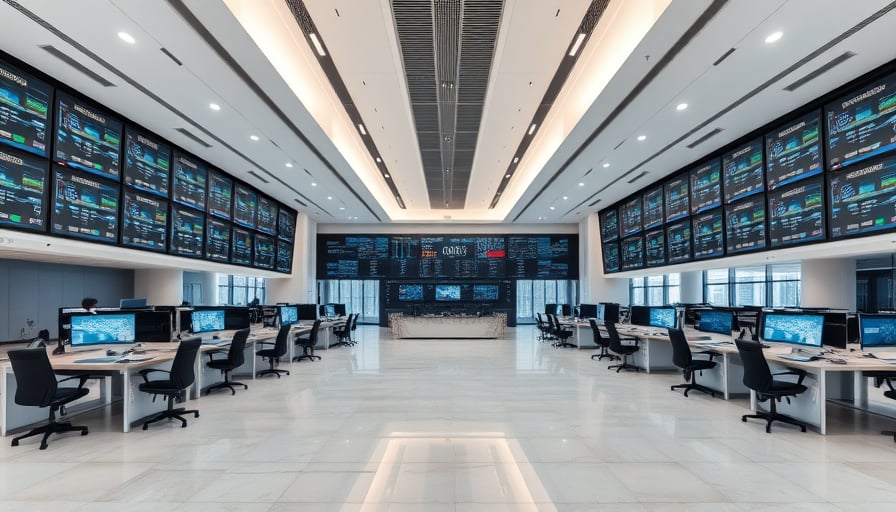
Charles Schwab Corporation Releases 2026 Market Outlook and Announces Trading Platform Enhancements
Charles Schwab Corporation, one of the largest U.S. financial‑services firms, today published its 2026 market outlook through the Schwab Center for Financial Research (SCFR). The research briefing, delivered to institutional and retail investors alike, outlines the macro‑economic and regulatory environment expected to shape financial markets over the next twelve months. Simultaneously, Schwab announced a series of updates to its electronic trading platform aimed at improving client experience and positioning the firm to capture additional asset growth.
Key Themes Identified in the 2026 Outlook
| Theme | Expected Impact | Quantitative Indicator |
|---|---|---|
| Monetary Policy Tightening | Persistently elevated interest rates are projected to curb equity valuations and shift investor appetite toward fixed‑income securities. | U.S. 10‑yr Treasury yield projected to average 4.2 % through Q4‑2026, up from 3.8 % at year‑end 2024. |
| Regulatory Evolution | Increased capital requirements under Basel III and potential U.S. banking reforms are anticipated to raise the cost of equity for banks. | Tier 1 capital ratio for U.S. banks forecast at 11.5 % in 2026, a 0.8 % rise from 2024. |
| Extended Trading Hours | Demand for 24‑hour market access, driven by international investors, is expected to lift after‑hours trading volume by 12‑15 %. | Nasdaq’s proposed 23‑hour trading platform could raise total daily volume by ~US $4 bn. |
| Digital Wealth Management | The rise of robo‑advisory platforms will intensify competition in the wealth‑management space. | Robo‑advisory assets under management projected to grow to US $1.2 trillion in 2026, a 25 % increase from 2024 levels. |
The SCFR briefing emphasizes that while the equity market will likely experience moderate volatility, disciplined risk management and diversified exposure will be key for both retail and institutional portfolios. The research team also highlights that the continued shift toward passive index investing will exert upward pressure on expense ratios for actively managed funds, nudging investors toward low‑cost alternatives.
Platform Enhancements: A Strategic Move
Schwab’s announced platform updates focus on three core areas:
- Latency Reduction
- Deployment of next‑generation colocation servers in Chicago and New York to cut order‑to‑execution time from 45 ms to 22 ms on average.
- Extended Trading Window
- Integration of a 23‑hour trading interface that will allow clients to place orders between 8:00 p.m. and 7:00 a.m. ET.
- Advanced Data Analytics
- Introduction of AI‑driven trade‑cost analysis tools providing real‑time slippage and impact metrics to help traders optimize execution strategies.
These upgrades are designed to align with industry momentum toward continuous market access, mirroring Nasdaq’s own push for 23‑hour trading. By offering a more responsive, data‑rich platform, Schwab aims to retain existing clients and attract new fee‑seeking investors seeking superior execution performance.
Market Position and Capital Strength
- Market Capitalization: As of 31 March 2025, Schwab’s market cap stands at approximately US $46 billion, up 7 % from the previous year.
- Revenue Composition (FY 2024):
- Brokerage: 38 %
- Wealth Management: 24 %
- Banking Services: 18 %
- Research & Analytics: 20 %
- Net Assets Under Management (AUM): US $4.6 trillion, representing a 5 % increase YoY.
- Return on Equity (ROE): 12.3 % in FY 2024, a slight decline from 12.8 % in FY 2023, attributed to higher operating expenses associated with platform upgrades.
Despite the modest range in share price over the past year—remaining between US $95 and US $104—the firm’s robust capital base and diversified product suite provide a cushion against market volatility and regulatory shifts.
Implications for Investors and Financial Professionals
- Portfolio Allocation
- The projected tightening of monetary policy suggests a strategic rebalancing toward fixed‑income securities with higher credit quality, particularly U.S. Treasury bonds and investment‑grade corporate notes.
- The expected growth in digital wealth management signals opportunities in low‑cost, robo‑advisory platforms, potentially offering higher fee‑income growth relative to traditional advisory services.
- Risk Management
- Extended trading hours will increase after‑hours volatility; investors should employ advanced risk controls and be mindful of liquidity constraints during non‑standard trading windows.
- Basel III capital requirements will elevate the cost of equity for banks, thereby affecting their valuation multiples.
- Strategic Partnerships
- Schwab’s platform improvements could attract strategic collaborations with fintech firms seeking to leverage its low‑latency infrastructure and advanced analytics tools.
- Firms looking to enhance their own trading capabilities may consider similar upgrades to remain competitive.
Conclusion
Charles Schwab Corporation’s dual announcement of a forward‑looking market outlook and significant trading platform enhancements signals a proactive stance amid a rapidly evolving financial landscape. By positioning itself at the nexus of regulatory adaptation, technological advancement, and market‑driven client needs, Schwab aims to sustain its leadership role and deliver value to investors in the coming year. Financial professionals and institutional investors should monitor Schwab’s performance closely, as its initiatives may set broader industry benchmarks and influence capital flows across the U.S. financial‑services sector.