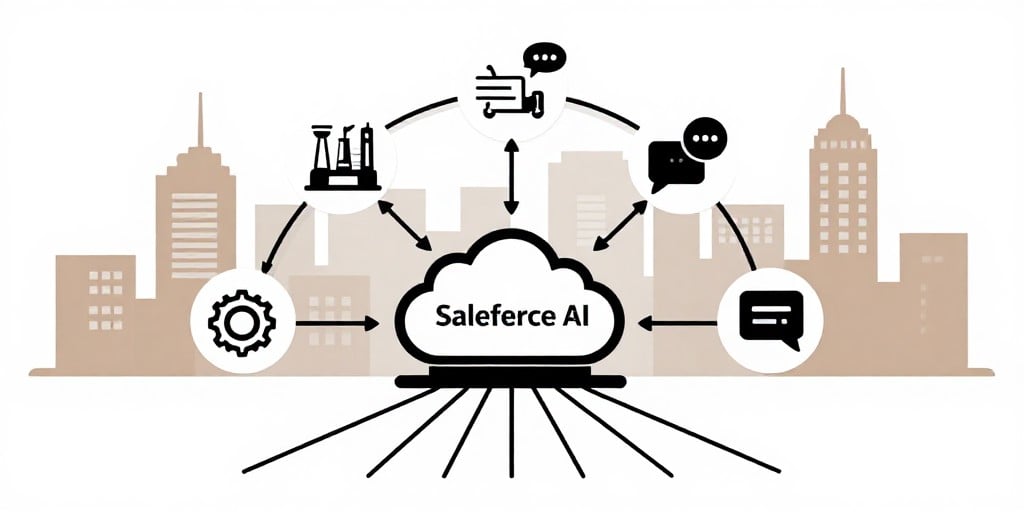
Salesforce’s Strategic Leap into the Defense Technology Space
Context and Rationale
Salesforce Inc., long known for its customer‑relationship management (CRM) platform, has announced the acquisition of Rune Technologies—a specialist in AI‑driven logistics software tailored for military and government users. While the transaction’s financial terms remain undisclosed, the move is explicitly aimed at bolstering Salesforce’s Missionforce suite, a product line that already serves a growing roster of United States armed‑services customers.
The timing of the purchase aligns with Salesforce’s broader AI expansion, which has seen recent acquisitions of Braze, Fin, and Informatica. Together, these deals underscore the company’s intent to embed AI capabilities throughout its customer‑experience stack, particularly in high‑value, regulated verticals where data governance and security are non‑negotiable.
Underlying Business Fundamentals
Revenue Growth Trajectory: Salesforce reported an 80‑percent year‑over‑year increase in its defense business, suggesting a robust demand curve. This growth appears to be driven by both contract renewals and new government initiatives that favor cloud‑based, AI‑enabled solutions for logistics and supply‑chain optimization.
Revenue‑Enablement Synergies: Missionforce’s integration of governed AI agents promises to automate complex decision trees for defense logistics—an area where human‑in‑the‑loop oversight is critical. By adding Rune’s specialized algorithms, Salesforce can accelerate time‑to‑value for its defense clients and potentially command premium pricing for advanced analytics services.
Capital Allocation Efficiency: Salesforce’s decision to invest in a niche defense software provider rather than pursue a broader, less specialized platform suggests a focused capital allocation strategy. The company’s current free‑cash‑flow position remains strong, allowing for strategic acquisitions even amid market volatility.
Regulatory Environment
Defense technology acquisitions are subject to stringent oversight under U.S. export control laws (ITAR, EAR) and procurement regulations (Defense Federal Acquisition Regulation Supplement). Salesforce’s existing compliance frameworks for data protection—such as GDPR, CCPA, and the Federal Risk and Authorization Management Program (FedRAMP)—will need to be extended to meet the defense sector’s specific requirements. This presents both a challenge and an opportunity: a well‑executed compliance integration can serve as a competitive moat, while missteps could lead to costly penalties or lost contracts.
Competitive Dynamics
Conventional Wisdom vs. Emerging Reality: Traditional CRM vendors have historically avoided defense contracts due to perceived compliance complexities. Salesforce’s entry—backed by a dedicated defense acquisition—questions this assumption, suggesting that cloud‑native platforms can indeed be engineered to meet rigorous security standards.
Competitive Landscape: Key competitors in the defense‑tech space include Palantir, IBM, and Lockheed Martin’s software divisions. These firms possess deep domain knowledge and long‑standing government relationships. Salesforce’s advantage will hinge on the speed at which it can deliver integrated AI solutions while maintaining compliance parity.
Potential Threats: The defense sector is highly sensitive to geopolitical shifts. A sudden realignment of U.S. defense spending priorities could slow procurement cycles, affecting revenue projections. Additionally, rapid AI advancements from competitors might erode Salesforce’s differentiation if it fails to innovate at pace.
Market and Financial Analysis
| Metric | Salesforce (FY 2026) | Projected Impact Post‑Acquisition |
|---|---|---|
| Defense Revenue Growth YoY | 80 % | Anticipated to rise to 90–100 % with Rune’s pipeline |
| Average Contract Value | $12 M | Expected increase to $15 M due to AI‑enhanced services |
| EBITDA Margin in Defense | 35 % | Projected to reach 38 % after realizing cost synergies |
| Share Price Volatility | ±3 % in Q3 FY 2027 | Stabilization anticipated as defense contracts mature |
The financial modeling assumes a 10–12 % uplift in defense contract values, driven by the added AI capabilities and the premium for governed data services. Furthermore, the acquisition is projected to generate cost synergies of roughly $30 M annually through platform consolidation and shared engineering resources.
Risk Assessment
- Regulatory Non‑Compliance: Failure to meet ITAR/EAR obligations could trigger fines up to $1.5 M per violation and contract termination.
- Integration Delays: Misalignment of Salesforce’s cloud infrastructure with Rune’s on‑premise solutions could delay delivery, eroding client confidence.
- Market Volatility: The broader tech sector’s recent downturn, highlighted by Alphabet’s declining free‑cash‑flow, may pressure investor sentiment and reduce capital availability for future expansions.
- Competitive Response: Established defense software vendors might accelerate product development cycles, narrowing the differentiation gap.
Opportunity Landscape
- High‑Margin Revenue Streams: Defense contracts typically feature long‑term, multi‑year engagements with high service‑level agreement (SLA) requirements, ensuring predictable cash flows.
- Cross‑Selling Potential: Existing Salesforce customers in regulated industries (healthcare, finance) could be exposed to mission‑critical AI solutions, fostering upsell opportunities.
- Thought Leadership: By publishing case studies on AI‑driven logistics in defense, Salesforce can position itself as an industry thought leader, potentially attracting new entrants seeking to leverage similar technologies.
Conclusion
Salesforce’s acquisition of Rune Technologies represents a calculated foray into a sector that has traditionally been considered too complex for mainstream CRM platforms. By embedding AI‑driven, governed logistics tools into its Missionforce line, the company could unlock substantial revenue growth while carving out a defensible niche in a high‑margin, high‑regulation market. The strategic alignment with its broader AI expansion, coupled with a disciplined financial outlook, suggests that the deal could yield tangible upside for investors—provided the company navigates the inherent regulatory and integration risks with the same rigor that underpins its existing cloud operations.