
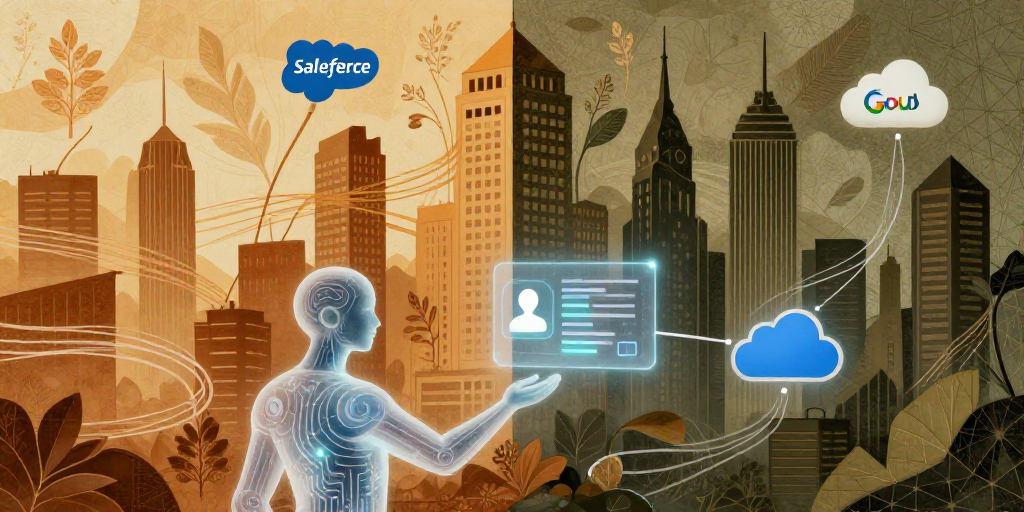
Salesforce Deepens Cloud Partnership to Deliver Seamless AI Agent Integration
Salesforce Inc. has announced a strategic expansion of its collaboration with Google Cloud, targeting the creation of autonomous artificial‑intelligence agents that operate fluidly across both ecosystems. The partnership leverages a newly established technical bridge that connects Google’s Gemini Enterprise models to Salesforce’s proprietary Agentforce engine, enabling bidirectional data flow between the two platforms. This move directly addresses persistent fragmentation in customer‑relationship‑management (CRM) data—a problem that has long hampered the adoption of fully integrated AI workflows.
Technical Synergy: Gemini Meets Agentforce
At the core of the alliance lies the integration of Google’s Gemini Enterprise—its flagship generative AI framework—into Salesforce’s Agentforce architecture. By allowing enterprise data to traverse seamlessly between Google Cloud and Salesforce’s cloud services, the collaboration eliminates the siloed data environments that have historically impeded large‑scale AI deployment within CRM solutions. This bridge supports a unified data schema, enabling AI agents to draw insights from a broader spectrum of customer touchpoints without compromising compliance or data residency requirements.
Agent Albert: From Beta to Full‑Featured Release
Salesforce’s own AI initiative, branded Agent Albert, is progressing from a nascent prototype toward a comprehensive, production‑ready platform. The Agentforce tool, currently available to an expanding user base, will be showcased in its full‑featured form during the upcoming Dreamforce event. Early adopters have reported increased efficiency in handling routine customer inquiries, while the platform’s self‑learning capabilities promise to reduce the need for manual rule‑setting. The launch underscores Salesforce’s commitment to positioning itself as a leader in the agent‑based workflow space.
Market Dynamics: Investor Sentiment vs. Strategic Vision
Despite these technical advances, Salesforce’s shares have fallen by approximately 25 % over the past year. Investors remain concerned that the rapid proliferation of generative AI tools could diminish the demand for traditional user‑license models—a cornerstone of Salesforce’s revenue structure. CEO Marc Benioff has publicly addressed these anxieties, asserting that the platform’s robust security, regulatory compliance, and entrenched brand equity serve as formidable barriers to entry for customer‑built alternatives. His message underscores the company’s belief that AI integration can coexist with, rather than replace, its established licensing model.
Subscription Revenue Outlook
Notwithstanding the market sell‑off, Salesforce’s subscription revenue guidance remains stable. The company continues to allocate capital toward AI integration, signaling confidence that the long‑term benefits of agent‑based workflows will outweigh short‑term volatility. This strategy positions Salesforce to capitalize on the growing corporate appetite for automation, data‑driven decision‑making, and customer‑centric intelligence.
Peer Landscape: A Sector in Transition
The broader SaaS sector is experiencing similar headwinds. Valuation multiples for other software peers have contracted as the market reassesses the lasting impact of generative AI on traditional SaaS businesses. Analysts, however, point out that Salesforce’s extensive customer base, coupled with its expanding AI capabilities, could preserve its competitive advantage. The company’s ability to embed AI deep within its CRM stack—now further reinforced by the Google Cloud partnership—offers a differentiated proposition that may prove resilient in the evolving technology landscape.
Strategic Implications
- Ecosystem Integration: By bridging two dominant cloud platforms, Salesforce is creating a hybrid ecosystem that may become a de facto standard for enterprises seeking unified AI and CRM capabilities.
- Competitive Differentiation: The combination of security compliance, brand trust, and AI innovation could cement Salesforce’s position as the go‑to platform for agent‑based workflows, even amid broader market skepticism.
- Long‑Term Growth: As AI adoption accelerates across industries, enterprises will likely demand seamless, secure, and scalable solutions—an area where Salesforce’s integrated offering is poised to thrive.
Conclusion
Salesforce’s deepened partnership with Google Cloud and the maturation of its Agent Albert platform signal a deliberate pivot toward a future dominated by autonomous AI agents. While investor concerns about shifting revenue models persist, the company’s strategic focus on integration, security, and brand strength provides a solid foundation for navigating the rapidly transforming technology landscape. The next few months will reveal whether Salesforce’s calculated gamble translates into sustained growth and market leadership in the era of generative AI.