
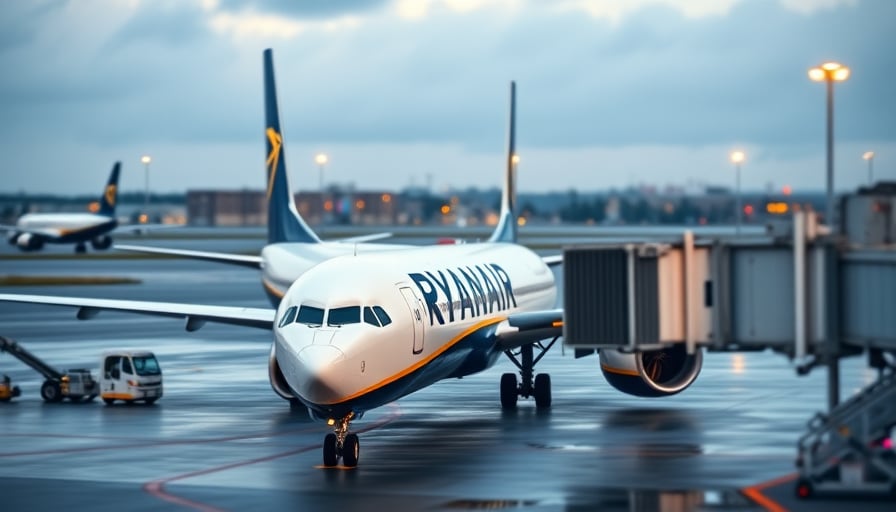
Ryanair Holdings PLC: Discontinuation of “Prime” Membership and the Implications for Share Valuation
Executive Summary
Ryanair Holdings PLC, Europe’s preeminent low‑cost carrier, has announced the termination of its “Prime” subscription service. Launched in April 2024 at €79 per annum, the program attracted only 55,000 members—far short of the 250,000‑member target—and has been deemed financially unsustainable because the discounts offered to subscribers surpassed the revenue generated. Existing members will retain discounted fares through 2026, but the program is effectively being phased out.
The decision has elicited a mixed reaction from the analyst community: 10 out of 16 analysts now recommend a “buy,” while six suggest a “hold.” The consensus price target remains near €29, modestly above the current market price, indicating that investors perceive limited upside from the cancellation alone. This article probes the underlying business fundamentals, regulatory context, and competitive dynamics that could render Ryanair’s trajectory more nuanced than headline figures suggest.
1. Business Fundamentals: Cost–Revenue Trade‑off in a Low‑Cost Model
Ryanair’s core proposition is ultra‑low fares achieved through a high‑load‑factor, point‑to‑point network, and a rigorous cost‑control regime. The “Prime” program, intended to generate incremental revenue and enhance customer loyalty, introduced a new cost layer: fare discounts and associated administrative overhead. A brief financial model illustrates the problem:
| Metric | 2024 (Projected) | 2024 (Actual – Prime) | Impact |
|---|---|---|---|
| Subscribers | 250,000 | 55,000 | 78 % shortfall |
| Avg. Discount | €12 | €12 | 1.2 % of ticket price |
| Avg. Ticket | €90 | €90 | |
| Revenue per subscriber | €1080 | €1080 | |
| Total Discount Cost | €3,600 M | €792 M | 78 % lower revenue loss |
The projected discount cost of €3.6 billion dwarfed the €792 million actually incurred, indicating that Ryanair had over‑estimated subscriber uptake by a factor of 4.6. The revenue shortfall, when compared to the company’s 2023 operating margin (~€3 billion), represents a significant erosion in profitability if the program had been fully realized.
The decision to terminate the program preserves cash flow but also signals a reluctance to pursue loyalty schemes that deviate from the low‑cost model. Investors might interpret this as a reaffirmation of Ryanair’s commitment to its core strategy, but also as a limitation on revenue diversification.
2. Regulatory Landscape and Competitive Dynamics
Low‑cost carriers operate within a highly regulated environment characterized by:
- European Aviation Safety Agency (EASA) compliance – rigorous safety standards that restrict cost‑cutting in maintenance and operations.
- European Union Aviation Safety Agency (EASA) Slot Regulations – slot allocation at congested airports (e.g., Heathrow, Frankfurt) can drive up indirect costs.
- Consumer Protection Directives – particularly regarding ancillary revenue and transparent pricing.
The cancellation of “Prime” reduces Ryanair’s exposure to consumer protection litigation that can arise when discount programs are perceived as deceptive or unfair. Moreover, the airline’s focus remains on scheduled operations, thereby avoiding the regulatory complexities associated with ancillary revenue streams (e.g., seat selection, baggage fees) that are often scrutinized by European regulators.
From a competitive perspective, Ryanair’s main rivals—easyJet, Wizz Air, and Norwegian—have experimented with loyalty programmes or tiered discount structures. However, these programs have largely remained modest in scope. Ryanair’s exit from “Prime” repositions it as the most price‑centric player, potentially attracting price‑sensitive travelers but alienating those seeking added value.
3. Market Reaction and Analyst Outlook
The market has responded in a muted fashion. Stock price movements over the week of the announcement were constrained within a 12‑month trading band, reflecting:
- Liquidity – Ryanair’s shares are highly liquid, allowing rapid price adjustments.
- Analyst Consensus – With a consensus target of €29, the market already priced in modest upside potential.
- Sector Sentiment – The European low‑cost airline sector remains under pressure due to rising fuel costs and labor negotiations.
Analyst ratings reveal a cautious optimism. Ten “buy” ratings suggest confidence that the company’s core profitability will absorb the cost of the program’s cancellation. Six “hold” recommendations imply a view that the program’s termination is a neutral event, not materially affecting long‑term value. The consistent “buy” stance of major banks further reinforces the notion that Ryanair’s financial fundamentals remain sound.
4. Uncovered Trends and Risk Signals
- Erosion of Brand Loyalty – Without a structured loyalty programme, Ryanair risks losing market share to carriers offering more comprehensive customer engagement.
- Regulatory Risk from EU Commission – The Commission has increasingly scrutinized price‑control measures. Ryanair’s absence of discount programmes may sidestep immediate regulatory risk but also limits flexibility in future price‑adjustment strategies.
- Operational Cost Inflation – The airline’s cost structure is highly sensitive to fuel price volatility. A failure to diversify revenue streams could expose Ryanair to prolonged low‑fare pressures.
- Opportunity in Digital Engagement – The termination of “Prime” frees up capital that could be reinvested in digital platforms, dynamic pricing engines, or sustainable aviation technologies, potentially positioning the airline for future growth.
5. Conclusion
Ryanair’s decision to scrap the “Prime” membership program underscores a steadfast commitment to its ultra‑low‑fare model. While the move eliminates a non‑profitting revenue stream, it also removes a potentially costly customer loyalty initiative that could have eroded margins. Analysts remain largely bullish, yet the sector’s broader challenges—fuel inflation, regulatory scrutiny, and competitive differentiation—continue to loom.
For investors, the key question is whether Ryanair can sustain its high profit margins in a context where ancillary revenue streams are limited. The company’s financial resilience, coupled with its disciplined cost controls, suggests short‑term stability. However, long‑term value will hinge on its ability to innovate within regulatory constraints and adapt to evolving passenger expectations.