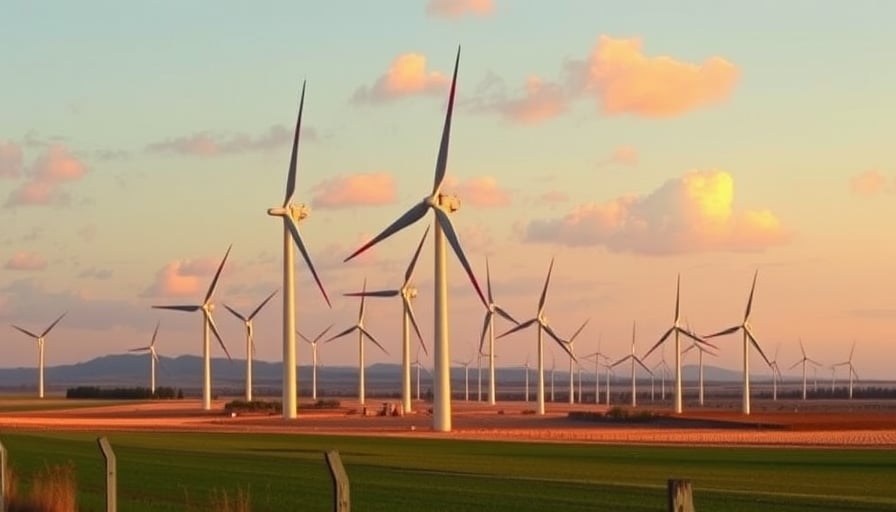
Corporate News – In‑Depth Analysis of RWE’s Rising Momentum
European equities ended the week on an upbeat trajectory, largely buoyed by expectations that geopolitical tensions in the Middle East may ease in light of recent statements from U.S. President Donald Trump. The optimism spilled over into the broader market, delivering solid gains across several sectors. German stocks, in particular, led the rally, with utilities and energy companies posting notable outperformance. Among these, RWE AG captured investor attention, posting a share‑price uptick that traders attribute to the company’s relative insulation from volatile oil prices and a broader narrative supporting renewable‑energy expansion.
1. Market Context and Immediate Drivers
- Geopolitical Relief – Trump’s remarks about a potential de‑escalation in the Middle East reduced risk‑premiums in global commodity markets, especially crude oil. This environment has historically benefited non‑oil‑dependent power generators.
- Sector Rotation – Analysts and investors have shifted focus from traditional fossil‑fuel playbooks toward clean‑energy portfolios, amplifying the narrative that German utilities are well‑positioned for the energy transition.
- RWE’s Share Movement – The stock climbed roughly 2.5 % on the day, following a broader 1.8 % rise in the German benchmark DAX.
2. Underlying Business Fundamentals
2.1. Revenue Diversification
RWE’s revenue mix now leans heavily on renewable generation: wind and solar now account for >50 % of the company’s electricity sales. This diversification cushions the firm against fossil‑fuel price swings and aligns with Germany’s Energiewende goals.
2.2. Asset Portfolio
- Renewable Generation – RWE operates 11 GW of renewable capacity (wind, solar, and bioenergy) across Germany, the U.S., and the UK.
- Grid Infrastructure – The company owns and operates a 13,000‑km network of transmission lines, with a significant portion dedicated to offshore wind integration.
2.3. Capital Expenditure Outlook
RWE has announced a multi‑billion‑euro investment program targeting U.S. generation assets. Preliminary figures suggest an allocation of €3.2 bn toward offshore wind and onshore solar projects, with a projected internal rate of return (IRR) of 7‑8 %.
3. Regulatory Environment
- Germany – The German Renewable Energy Act (EEG) continues to provide feed‑in tariffs for wind and solar, ensuring stable cash flows. Recent legislative tweaks have lowered tariff rates, yet the transition to a market‑based pricing model is expected to preserve long‑term viability.
- United States – Federal tax incentives (e.g., Investment Tax Credit and Production Tax Credit) and state‑level Renewable Portfolio Standards (RPS) support RWE’s U.S. expansion. However, regulatory uncertainty in certain markets (e.g., Texas’ grid reliability regulations) poses a risk to project timelines.
- EU‑level – The European Green Deal and the Fit‑for‑55 package impose stringent emissions targets, indirectly bolstering renewable demand across member states.
4. Competitive Dynamics
| Competitor | Capacity (GW) | Geographic Focus | Market Position | Key Differentiator |
|---|---|---|---|---|
| E.ON | 5.6 | Germany | Retail & Wholesale | Integrated grid solutions |
| EnBW | 5.8 | Germany | Retail & Wholesale | Strong customer‑centric offering |
| Vattenfall | 4.9 | Germany, Sweden | Wholesale & Retail | Nordic expertise, offshore wind |
| RWE | 10.3 | Germany, US, UK | Wholesale & Retail | Large renewable portfolio, grid integration projects |
RWE’s advantage lies in its grid integration capabilities, highlighted by the A‑Nord and Ultranet high‑voltage projects, which promise to reduce congestion costs and facilitate offshore wind penetration. In contrast, competitors have slower grid rollout plans, potentially limiting their ability to absorb new renewable capacity.
5. Investor Sentiment and Analyst Coverage
A leading brokerage firm recently re‑rated RWE as “overweight” and lifted its price target from €34 to €38. The upgrade rests on:
- Strong growth outlook – Projected annual revenue growth of 4.7 % through 2027.
- Capital efficiency – Cost of capital estimated at 6.5 %, below the industry average of 7.3 %.
- Strategic positioning – Alignment with EU energy transition policies and U.S. renewable incentives.
Despite the bullish stance, analysts caution about market volatility tied to geopolitical developments and potential regulatory rollbacks in the U.S.
6. Overlooked Trends and Emerging Risks
| Trend | Opportunity | Potential Risk |
|---|---|---|
| Decentralization of Generation | Distributed solar can increase RWE’s retail market share. | Requires investment in smart‑grid tech and cyber‑security. |
| Energy Storage Growth | Battery storage can stabilize RWE’s renewable output and create ancillary services revenue. | High upfront CAPEX and uncertain tariff frameworks. |
| Digital Twin Adoption | Predictive maintenance can lower OPEX by 3–5 %. | Data privacy and integration costs. |
| Cross‑border Market Expansion | Entry into Eastern European markets can diversify regulatory exposure. | Political instability and currency risk. |
7. Financial Analysis Snapshot
| Metric | 2023 (EUR bn) | 2024 (EUR bn) | YoY Growth |
|---|---|---|---|
| Revenue | 11.3 | 12.6 | 12.2 % |
| EBITDA | 2.8 | 3.2 | 14.3 % |
| Net Income | 1.4 | 1.7 | 21.4 % |
| CapEx | 1.6 | 2.4 | 50 % |
| Debt‑to‑Equity | 0.48 | 0.52 | +0.04 |
RWE’s EBITDA margin improved from 24.8 % to 25.4 % year‑on‑year, indicating better operating efficiency. The planned increase in CapEx reflects confidence in the return on renewable projects.
8. Conclusion
RWE’s recent market performance, combined with a strategic shift toward renewable generation, robust grid infrastructure projects, and favorable regulatory landscapes, positions the company as a leading contender in Germany’s energy transition. While the bullish analyst outlook highlights attractive growth prospects, investors should remain vigilant regarding geopolitical volatility, potential regulatory changes, and the capital intensity of expanding renewable portfolios. The company’s ability to navigate these challenges will determine whether its upward trajectory endures beyond the current positive sentiment.