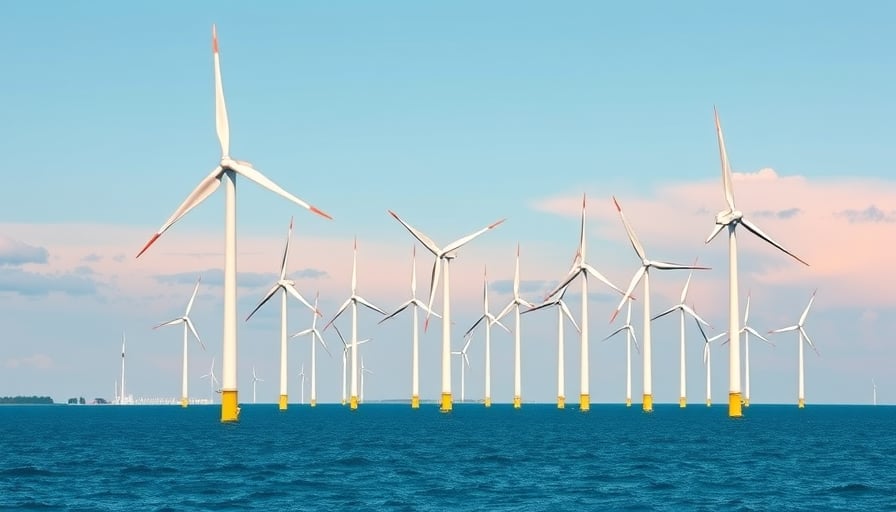
RWE AG Secures 900‑MW Offshore Wind Expansion in the German North Sea
RWE AG has obtained planning approval from the German Federal Maritime and Hydrographic Agency (BfGM) for a new offshore wind phase in the Nordseecluster, bringing the total installed capacity of the two phases to 900 MW. The expansion adds 60 turbines to the existing 840 MW facility and is slated for construction in 2025, with first turbines commissioning in late 2028 and full commercial operation in early 2029.
Project Characteristics
| Item | Details |
|---|---|
| Total Capacity | 900 MW (two phases) |
| Turbine Count | 60 additional turbines |
| Annual Generation | ≈ 6.5 TWh renewable electricity |
| Ownership | 51 % RWE AG, 49 % Norwegian state fund |
| Construction Start | 2025 |
| First Turbines Online | Q4 2028 |
| Commercial Operation | Q1 2029 |
| Strategic Context | Supports RWE’s decarbonisation strategy and power‑purchase agreements with industrial clients, including a recent contract with a technology company |
The additional capacity will augment RWE’s already substantial offshore portfolio, reinforcing its position as a leading renewable producer in Germany. The project’s integration into the German grid presents a complex set of technical and regulatory challenges that will shape the future of the national power system.
Grid Stability and Renewable Integration
Transmission Pathways
The new turbines will connect to the Norddeich–Cuxhaven high‑voltage (HV) substation, which feeds into the 380 kV and 400 kV transmission corridors that serve the North Sea coast. Engineers anticipate that the additional 900 MW will increase peak export capacity by 20 % in the summer months. To maintain grid stability, the project will incorporate dynamic voltage‑regulation equipment—static synchronous compensators (STATCOMs) and flexible AC transmission systems (FACTS)—to manage power flows and mitigate voltage sags caused by variable wind output.
Frequency Control and Reserves
Germany’s grid frequency must be kept within ±0.05 Hz of 50 Hz to ensure synchronous operation of all connected loads. The new wind farm will deliver up to 180 MW of spinning reserves by leveraging turbine pitch‑control and power‑curve optimization. RWE plans to coordinate with the TenneT grid operator to provide inertia‑simulating services using battery energy‑storage systems (BESS) co‑located near the offshore wind farm. Such hybrid solutions are expected to reduce the reliance on conventional fossil‑fuel plants for frequency regulation during low‑wind periods.
Curtailment and Curtailment‑Resilient Design
With the German grid increasingly saturated during peak generation periods, curtailment risks persist. The project incorporates circuit‑breakers and power‑factor correction to allow for controlled shutdowns of selected turbine blocks. In addition, a grid‑forming converter is planned to enable islanding support should the main transmission line be temporarily disconnected.
Infrastructure Investment Requirements
The offshore wind expansion demands a significant capital outlay:
- Turbine procurement: €120 million for 60 turbines (average €2 million each).
- Subsea cable installation: €80 million, including 80 km of 700 kV export cable.
- Onshore substation upgrades: €40 million for STATCOMs and HV transformer capacity.
- Energy‑storage integration: €30 million for a 200 MW/400 MWh BESS.
Total investment is projected at ≈ €270 million over the 2025–2029 construction horizon. The financing mix will likely include equity from RWE and its Norwegian partner, debt from German and European banks, and potential green bond issuance. The project aligns with the European Union’s Fit for 55 climate package, which incentivizes renewable infrastructure through tax credits and reduced borrowing costs.
Regulatory Frameworks and Rate Structures
German Energy Law
Under the German Electricity Act (EnWG), renewable projects must obtain grid connection agreements and adhere to the grid access fee determined by TenneT. The 2024 EnWG amendments introduced a “renewable integration surcharge” of €0.03/kWh for large offshore wind farms, aimed at compensating for grid upgrades. RWE’s project will qualify for a fee waiver if it can demonstrate in‑grid self‑consumption of at least 30 % of the generated power, a requirement that may influence the placement of the onshore BESS.
European Commission Guidelines
The European Commission’s Regulation on the Integration of Renewable Energy Sources mandates that member states ensure grid resilience and system security when adding large offshore farms. Germany is required to publish an updated grid stability assessment by 2027, which will evaluate the cumulative impact of the Nordseecluster on the national grid’s inertia and frequency response.
Rate Structures
RWE’s commercial power purchase agreements (PPAs) with industrial clients, including a recent deal with a technology firm, are structured at fixed rates of €45/MWh over a 15‑year term. The integration of additional renewable capacity allows RWE to hedge market price volatility and offer grid‑stabilizing services at premium rates. However, the regulated tariff for electricity distributed to German households (≈ €0.25/kWh) imposes a ceiling on how much of the renewable premium can be passed through to consumers. Consequently, RWE must balance consumer cost stability against the need to finance ongoing infrastructure upgrades.
Economic Impacts of Utility Modernization
Consumer Costs
The addition of 6.5 TWh of renewable electricity will marginally reduce Germany’s reliance on fossil‑fuel imports, thereby dampening the inflationary pressure on energy prices. According to a study by the German Institute for Economic Research (DIW), a 5 % increase in offshore wind capacity could reduce average residential electricity costs by €1.50 per year per household, assuming efficient tariff integration and minimal curtailment.
Job Creation and Local Economy
The construction phase will generate ≈ 1,200 construction jobs and 200 engineering positions over the 2025–2028 period. Post‑construction, the farm will support 30 permanent maintenance roles. The local economies in Lower Saxony and Schleswig‑Holstein are expected to benefit from increased demand for maritime services, logistics, and high‑tech manufacturing.
Financial Performance
Deutsche Bank Research’s recent upgrade of RWE’s target price to €63 from €55 reflects confidence in the company’s steady cash‑flow generation from large‑scale renewables. The conservative profit‑growth outlook to 2031 is underpinned by the projected return on investment (ROI) of 7–8 % for the Nordseecluster expansion, after accounting for capital costs and operating expenses. The upgrade signals a favorable assessment of RWE’s ability to navigate regulatory hurdles and integrate new capacity into a stabilizing grid.
Market Context and Investor Sentiment
On Friday, German indices slipped amid geopolitical tensions and persistent inflationary pressures. The DAX and LUS‑DAX both recorded modest declines, with energy stocks showing relative resilience. RWE’s share price fell by only ≈ 3 %, remaining a few percent below its 52‑week high. Analysts interpret this muted reaction as a cautionary stance: investors weigh the company’s robust project pipeline against short‑term market volatility and the potential for rate‑regulation adjustments.
The regulatory approval and Deutsche Bank’s positive coverage have bolstered investor confidence, yet the short‑term price dip underscores the sensitivity of utility stocks to broader macroeconomic concerns. Long‑term investors, however, view RWE’s offshore expansion as a strategic asset that aligns with Germany’s energy transition goals and offers a stable platform for future renewable investments.
Conclusion
RWE AG’s newly approved 900‑MW offshore wind phase represents a significant milestone in Germany’s pursuit of a decarbonized grid. The project’s technical sophistication—spanning advanced transmission, frequency‑regulation systems, and energy‑storage integration—addresses the pressing challenges of grid stability and renewable intermittency. While the required infrastructure investment is substantial, the economic benefits in terms of consumer cost mitigation, job creation, and long‑term financial returns provide a compelling case for continued utility modernization. As Germany navigates evolving regulatory frameworks and rate structures, RWE’s strategic positioning and disciplined growth outlook are likely to sustain investor confidence, even amid broader market fluctuations.