
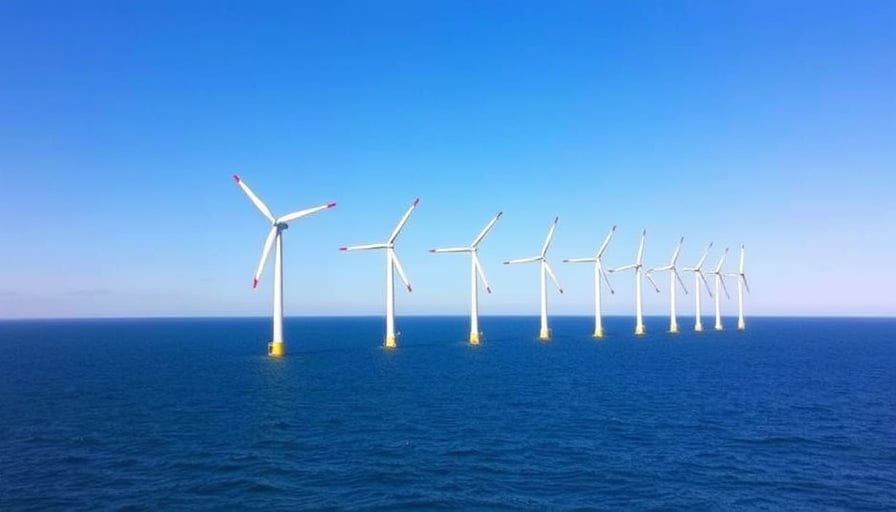
RWE AG Advances Renewable Footprint Amid Grid Stability Challenges
RWE AG has announced a series of strategic moves that reinforce its position as a leading renewable energy developer in the United Kingdom and across the North Sea. The company’s latest actions—securing long‑term generation contracts, completing critical substation infrastructure, and addressing grid bottlenecks—highlight the technical and regulatory complexities that utilities face while modernising the power system and integrating higher shares of variable resources.
Long‑Term Contracts Strengthen Revenue Predictability
In late February, RWE secured contracts for approximately 290 MW of solar and onshore wind capacity through the UK Government’s Allocation Round 7. These contracts, set to deliver revenue streams over the next twenty years, provide the company with a stable financial foundation that can be used to fund further grid investments. The 20‑year horizon also aligns with the typical lifespan of wind turbines and photovoltaic installations, ensuring a consistent cash flow that supports both the company’s balance sheet and the broader financing ecosystem for renewables.
From an engineering perspective, the long‑term nature of the agreements allows for detailed load forecasting and capacity planning. The grid operator can predict generation contributions with higher confidence, enabling more accurate scheduling of conventional resources and reducing the need for curtailment of renewable output.
Substation Deliverables for the Nordseecluster A Offshore Park
The French shipyard Chantiers de l’Atlantique has completed two substations for the Nordseecluster A offshore wind park. These substations, destined for installation near the island of Juist, are a critical link between the offshore wind farm and the onshore transmission network.
Key technical considerations include:
- High‑Voltage Interconnection – The substations will step up the 3 kV AC output from the turbines to the 400 kV transmission level, minimizing transmission losses.
- Reactive Power Support – By incorporating static VAR compensators, the substations can manage voltage profiles and improve power quality across the grid.
- Grid Compliance – The design meets the IEC 61968‑2 and IEC 61850 standards, ensuring seamless integration with the existing substation automation infrastructure.
The successful delivery of these substations accelerates the deployment timeline for offshore generation and demonstrates RWE’s capability to manage complex, cross‑border supply chains.
Grid Build‑Out: A Bottleneck for Renewable Deployment
RWE’s leadership has highlighted the expanding transmission network as a critical bottleneck. The current grid build‑out cannot keep pace with the rapid increase in renewable capacity, particularly in remote coastal regions where wind farms are concentrated. Several technical and regulatory factors contribute to this challenge:
| Factor | Impact on Grid Expansion |
|---|---|
| Line Capacity | Existing 400 kV corridors are at or near their thermal limits, requiring reinforcement or new routes. |
| Voltage Regulation | Variable output from wind and solar creates voltage excursions that necessitate on‑load tap changers and capacitor banks. |
| Dynamic Stability | Higher penetration of inverter‑based resources reduces system inertia, demanding fast frequency response solutions. |
| Regulatory Approval | Permitting processes for new lines can take 3–5 years, delaying project timelines. |
| Land Use Constraints | Community opposition and environmental constraints limit new right‑of‑way acquisition. |
The consequence is a potential curtailment of renewable output, reduced grid reliability, and increased operational costs.
Addressing Bottlenecks with Grid‑Scale Storage and Network Resilience
To mitigate these constraints, RWE is investing in grid‑scale battery storage projects. Battery Energy Storage Systems (BESS) provide several grid services:
- Frequency Regulation – Rapid response to frequency deviations, compensating for the low inertia of inverter‑based generation.
- Voltage Support – Dynamic reactive power injection or absorption to maintain voltage stability.
- Peak Shaving – Storage can smooth load peaks, allowing the grid to accommodate higher renewable output without overloading lines.
- Deferral of Infrastructure Upgrades – By storing surplus renewable power during low demand periods, BESS can delay the need for new transmission corridors.
From an engineering standpoint, the integration of BESS requires careful sizing, control strategy development, and coordination with the Transmission System Operator (TSO) to ensure that the storage units provide the intended ancillary services without introducing new stability issues.
Regulatory and Rate‑Structure Implications
The European Union’s Renewable Energy Directive (RED II) and the UK’s Net Zero Strategy set clear targets for renewable penetration, which influence tariff design and investment incentives. Key regulatory mechanisms affecting RWE’s operations include:
- Power Purchase Agreements (PPAs) – Long‑term PPAs secure revenue but may include clauses that adjust for market price changes, affecting profitability.
- Feed‑in Tariffs (FITs) vs. Contracts for Difference (CfDs) – The UK’s CfD scheme offers price certainty, reducing financial risk for developers.
- Grid Access Fees – Tariffs imposed by TSOs for connecting to the transmission network can be substantial; rate structures that reflect the cost of new infrastructure are crucial for fairness.
- Ancillary Services Markets – BESS participation in frequency regulation markets can generate additional revenue streams.
The interaction of these policies creates a dynamic environment where utility modernization must balance cost, reliability, and environmental objectives. Consumer costs are influenced by how these investment expenses are recovered through tariff adjustments. However, higher renewable penetration can reduce long‑term fuel costs, potentially offsetting the initial infrastructure outlay.
Economic Impacts of Utility Modernization
Investments in transmission and storage translate into broader economic benefits:
- Job Creation – Construction, operation, and maintenance of new grid assets create skilled employment opportunities.
- Energy Security – Diversified generation sources reduce dependence on imported fuels, enhancing national security.
- Technology Development – Large‑scale projects stimulate innovation in inverter technology, grid‑management software, and battery chemistry.
- Consumer Prices – While upfront costs may lead to tariff adjustments, the eventual decline in marginal fuel costs and reduced transmission losses can lower electricity prices over the life of the assets.
Utility modernization, therefore, presents a cost–benefit profile that must be carefully weighed by regulators, investors, and consumers.
Conclusion
RWE AG’s recent contractual wins, substation completions, and proactive grid‑scale storage initiatives underscore the company’s strategic focus on achieving long‑term, stable revenue streams while advancing renewable integration. The technical challenges of grid bottlenecks—stemming from line capacity constraints, voltage regulation needs, and dynamic stability—require a combination of infrastructure upgrades, regulatory alignment, and innovative solutions such as battery storage. As the energy transition accelerates, the interplay between engineering insights, regulatory frameworks, and economic considerations will shape the trajectory of utility modernization and its implications for both grid stability and consumer costs.