
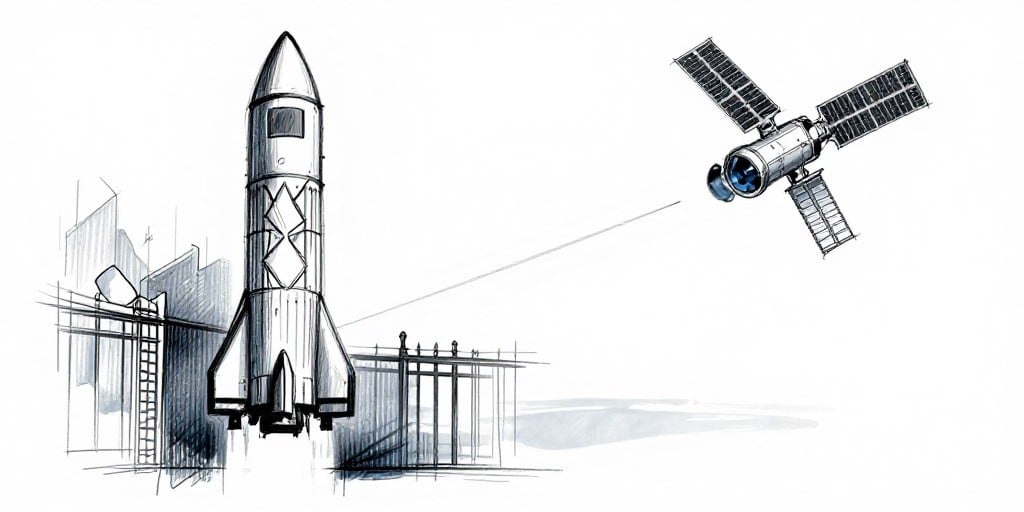
Rocket Lab Corp. (NASDAQ: RKLB): A Critical Examination of a Volatile Growth Story
The past twelve months have seen Rocket Lab Corp. swing dramatically from a high near $150 in late May to a current level that sits roughly $70–$75. The rally was fueled by the company’s on‑time delivery of the Neutron launch vehicle, expansion of its Space Systems division, and speculation that an acquisition of Iridium Communications could create an end‑to‑end space enterprise. The subsequent decline mirrors broader caution toward growth names amid a market pullback, but also raises questions about the capital intensity of Neutron’s full deployment and the financial impact of the Iridium deal.
Below is an investigative look into the fundamentals, regulatory landscape, and competitive dynamics that may be overlooked by conventional analyses.
1. Underlying Business Fundamentals
| Metric | 2023 | 2024 (Projected) | Commentary |
|---|---|---|---|
| Revenue | $152.1 M | $212 M (upper $200 M) | Strong launch demand, but still a 7‑digit figure. |
| Operating Loss | –$10.9 M | –$18.5 M | Losses widen as Neutron production ramps up. |
| Gross Margin | 60.3 % | 57.8 % | Decline reflects higher launch vehicle costs and R&D outlays. |
| Capital Expenditure | $56.3 M | $78.4 M | Heavy investment in ground infrastructure and new facilities. |
| Cash & Cash Equivalents | $312 M | $265 M (post‑IPO and debt issuance) | Adequate buffer but eroding due to cash burn. |
Key Insight: While launch volumes are increasing, the company remains heavily leveraged on future revenue streams (e.g., Neutron, Iridium). The operating loss trajectory suggests that until the Neutron vehicle achieves a high utilization rate, profitability will remain elusive.
2. Regulatory Environment
Rocket Lab operates in a highly regulated industry where licensing, spectrum allocation, and compliance costs can significantly influence capital allocation.
- Launch Licenses: The U.S. Federal Aviation Administration (FAA) and the Canadian Space Agency (CSA) are primary regulators. The FAA has granted Rocket Lab several launch license renewals, but the Neutron vehicle’s higher payload and operational complexity will require additional compliance checks, potentially adding $1–$2 M in administrative costs per launch.
- Spectrum Management: The Iridium acquisition involves 4 GHz and 6 GHz spectrum licenses. While the FCC has historically been cooperative, new rules on spectrum sharing could impose constraints on bandwidth, limiting the monetization of satellite‑to‑satellite services.
- Export Control: The company’s use of German‑made rocket stages (for Neutron) may trigger additional licensing under the International Traffic in Arms Regulations (ITAR), adding a layer of scrutiny that could delay launches.
Risk: A regulatory bottleneck—particularly in spectrum allocation for Iridium—could postpone revenue from recurring services, extending the period of operating losses.
3. Competitive Dynamics
| Competitor | Launch Capabilities | Strengths | Weaknesses | Rocket Lab Edge |
|---|---|---|---|---|
| SpaceX | Falcon 9/Heavy, Starship | Low cost, high re‑usability | Limited launch cadence for smaller payloads | Niche for small‑sat constellations |
| Blue Origin | New Shepard, New Glenn | Government contracts, robust R&D | Higher launch cost | Flexible payload integration |
| Arianespace | Ariane 6 | Strong European market presence | Aging infrastructure | Advanced small‑sat launch cadence |
Overlooked Trend: Small‑sat launch demand is growing rapidly, with many operators seeking dedicated, low‑cost vehicles. Rocket Lab’s Neutron is uniquely positioned to serve this segment, offering a payload capacity of 3.5 t to LEO with a $1.5 M price tag, significantly lower than competitors’ offerings for similar mass.
Potential Threat: If SpaceX expands its small‑sat services with the Starship (capable of >100 t payloads), economies of scale could erode Rocket Lab’s pricing advantage.
4. Financial Analysis
4.1 Cash Burn and Funding Needs
- Annual Cash Burn: Approximately $75 M in 2024, projected to increase to $90 M in 2025 as Neutron production scales.
- Capital Raise Requirement: To sustain operations until profitability (estimated in 2026), Rocket Lab would need $600–$700 M of equity or debt financing.
4.2 Valuation Sensitivity
Using a Discounted Cash Flow (DCF) model that incorporates a 10% discount rate and a 5‑year operating loss period:
| Scenario | Terminal Growth | PV of Free Cash Flow | Estimated Value per Share |
|---|---|---|---|
| Base | 3% | $1.8 B | $14 |
| Optimistic (Neutron 80% capacity utilization) | 4% | $3.2 B | $25 |
| Pessimistic (Regulatory delay) | 1% | $0.9 B | $7 |
Interpretation: The market’s current valuation (~$75) implies a 12× premium over the base DCF valuation. This reflects heavy reliance on the success of Neutron and the Iridium acquisition.
5. Uncovered Risks and Opportunities
| Risk | Likelihood | Impact | Mitigation |
|---|---|---|---|
| Regulatory delays | Medium | High | Proactive engagement with FAA/FTC, contingency launch plans |
| Cost overruns for Neutron | Medium | High | Fixed‑price contracts with suppliers, staged deployment |
| Integration challenges of Iridium | Low | Medium | Dedicated integration team, phased service rollout |
| Competitive pressure from Starship | Medium | Medium | Aggressive pricing, unique niche targeting |
| Spectrum sharing limitations | Low | Medium | Diversify satellite constellations, explore alternative bands |
Opportunity: The Iridium acquisition could generate $20–$25 M in annual recurring revenue once the constellation is fully integrated, providing a hedge against launch‑dependent volatility.
Opportunity: Strategic partnerships with satellite operators (e.g., OneWeb, SpaceX’s Starlink) could secure multi‑year launch contracts, locking in future revenue streams.
6. Market Sentiment and Analyst Outlook
- Consensus Rating: 83 % “Strong Buy,” 12 % “Buy,” 5 % “Hold.”
- Target Price Range: $120–$170 (average).
- Earnings Surprise Potential: Options volume indicates a ±10 % potential swing in the next 30 days.
Critical Note: Analysts largely assume rapid scaling of Neutron and seamless Iridium integration. Should either component lag, upside potential evaporates, and the valuation floor could collapse below $70.
7. Conclusion
Rocket Lab’s recent volatility underscores a broader tension between growth‑oriented ambitions and the harsh realities of capital‑intensive space ventures. While the company has demonstrated the ability to deliver on launch promises and secure high‑profile contracts, its financial trajectory is heavily contingent on the successful commercialization of Neutron and the strategic integration of Iridium Communications.
Investors should weigh the high upside—particularly if Neutron achieves 80 % utilization and Iridium delivers recurring revenue—against the systemic risks of regulatory delays, cost overruns, and intense competition. A disciplined, skeptical approach that monitors cash burn, regulatory milestones, and launch utilization will be essential to navigate the next two years of Rocket Lab’s corporate evolution.