
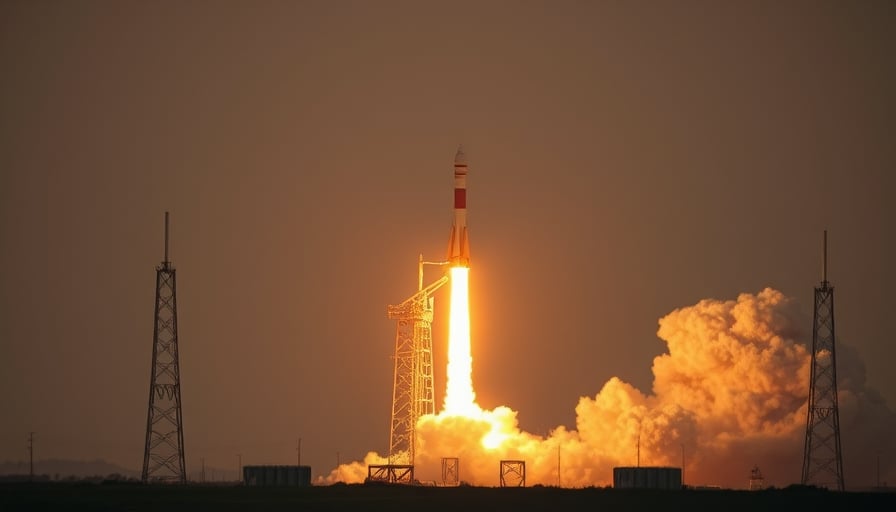
Corporate Development in the Space Sector: Rocket Lab Corp. Receives Canadian Funding and Advances Neutron Launch Vehicle
Rocket Lab Corp. (NASDAQ: RKLB) has experienced a measurable uptick in its stock price following the announcement that the company secured multiple funding rounds from the Canadian Space Agency (CSA). The CSA grants are earmarked for the development of satellite technology and advanced space‑system components, including new reaction wheels and other critical satellite subsystems. This financial injection is expected to fortify Rocket Lab’s competitive positioning within the commercial launch market, which remains highly capital intensive and technologically demanding.
Funding and Its Strategic Implications
The CSA grants, distributed across several projects, provide Rocket Lab with the fiscal flexibility to accelerate the development of next‑generation satellite payloads. Reaction wheels, which are pivotal for satellite attitude control, represent a significant segment of the small‑satellite ecosystem. By investing in this technology, Rocket Lab is not only enhancing the reliability of its payloads but also strengthening its appeal to satellite operators seeking proven, low‑cost launch solutions.
From a corporate standpoint, the infusion of public funds reduces the company’s equity dilution and improves its balance sheet. This, in turn, may lower the cost of capital for future expansions—such as the construction of new launch facilities or the procurement of additional launch vehicles—thereby reinforcing long‑term growth trajectories.
Neutron Launch Vehicle and the “Hungry Hippo” Fairing Milestone
In parallel with the funding announcement, Rocket Lab disclosed that its Neutron launch vehicle has successfully passed critical qualification tests for a new fairing, internally dubbed the “Hungry Hippo.” The fairing’s successful qualification is a key milestone, demonstrating that the vehicle can accommodate increasingly larger and more complex payloads. The development is projected to enable an inaugural launch scheduled for 2026.
The Neutron program is central to Rocket Lab’s strategic intent to transition from a niche launch service provider to a full‑scale commercial launch operator capable of servicing a broad spectrum of payloads, from small satellites to heavy‑lift missions. The successful testing of the fairing indicates that the company is on track to achieve higher payload capacities and potentially lower unit launch costs through economies of scale.
Market Reception and Investor Sentiment
The market’s positive reaction—reflected in a sharp rise in RKLB’s share price—underscores investors’ confidence in Rocket Lab’s expanding technological capabilities. The company’s ability to secure public funding while simultaneously advancing its flagship launch vehicle suggests robust operational resilience and an effective management of risk. Furthermore, the developments align with broader industry trends, such as the increasing demand for reusable launch systems and the diversification of launch service offerings to meet the needs of a rapidly expanding small‑satellite market.
Cross‑Sector Relevance and Economic Context
The trajectory of Rocket Lab illustrates key dynamics that resonate across multiple high‑technology sectors. First, strategic public‑private partnerships, exemplified by the CSA grants, are becoming a common mechanism to de‑risk advanced research and development in fields that require significant upfront capital. Second, the emphasis on component standardization—such as the universal fairing design—mirrors trends in other manufacturing domains, where modularity drives cost efficiency and reduces time to market.
In the broader economic context, the increasing accessibility of launch services is fostering innovation in data collection, Earth observation, and telecommunications. This, in turn, fuels ancillary markets—including ground‑segment services, satellite manufacturing, and data analytics—creating a virtuous cycle of investment and growth across the space economy. Rocket Lab’s recent milestones position it as a pivotal player within this ecosystem, poised to capitalize on the expanding demand for reliable, cost‑effective access to orbit.
Conclusion
Rocket Lab Corp.’s recent achievements—a secured CSA funding package and the successful qualification of its Neutron launch vehicle’s new fairing—represent substantive progress in both financial and technical dimensions. These developments are likely to sustain the company’s upward momentum in the stock market and reinforce its strategic positioning within the competitive landscape of commercial launch providers. As the company moves closer to its 2026 launch target, it will continue to serve as a case study in how targeted public investment, coupled with disciplined engineering and strategic vision, can accelerate growth in a high‑stakes, high‑growth sector.