
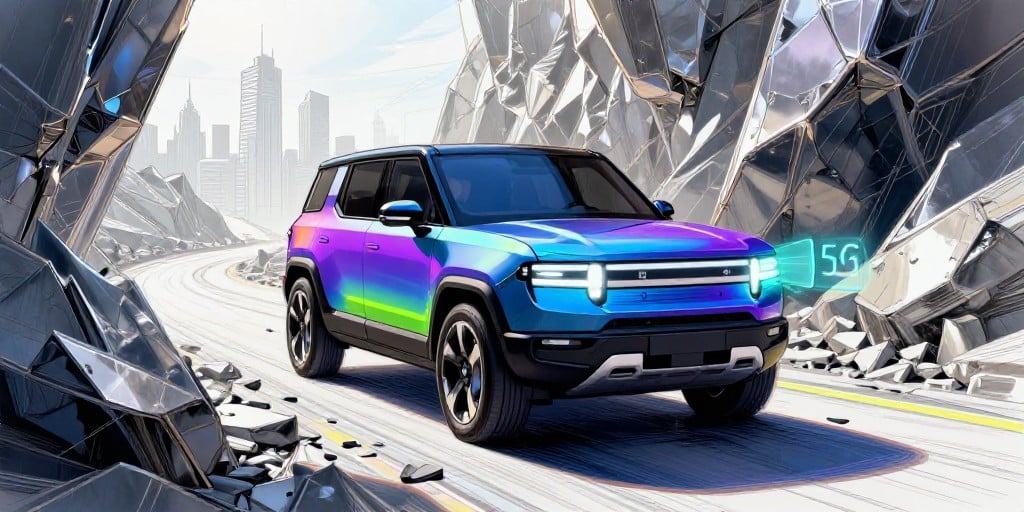
Rivian Automotive Inc. Sees Modest Share Gain as R2 Electric SUV Grows Investor Interest
Rivian Automotive Inc. reported a modest rise in its shares on Wednesday, a movement that analysts attribute to a confluence of product‑launch momentum, strategic connectivity partnerships, and recent corporate disclosures. The company’s newest model, the R2 electric SUV, was introduced in March and is slated to open for orders on June 9. Analysts highlighted that the R2’s range and efficiency are comparable to, or exceed, those of the Tesla Model Y, the benchmark vehicle in the compact‑SUV segment.
Product Positioning in a Competitive Segment
The R2 is positioned as a mass‑market electric SUV that balances affordability with performance. Its range figures—reported to be 280‑300 miles on a single charge—place it close to the Tesla Model Y, while its payload capacity and off‑road capability differentiate it from other competitors. Rivian’s focus on “open‑world” adventures has historically appealed to a niche segment; the R2’s broader appeal signals the company’s intent to capture a wider customer base.
From a financial‑modeling perspective, the R2’s introduction is expected to serve as a catalyst for higher sales volumes. Analysts project that, should the vehicle meet its projected demand, Rivian could see a 20–30 % uplift in revenue within the first year of production. However, the company’s current cash burn—estimated at approximately $300 million annually—remains a concern as it scales production. The capital intensity required to ramp up manufacturing capacity, secure supply chains, and invest in marketing is significant, and the firm will need to manage its burn rate carefully.
Strategic Connectivity Partnership with AT&T
A key differentiator for the R2 is Rivian’s partnership with AT&T to embed 5G connectivity into the vehicle’s architecture. The collaboration will enable faster over‑the‑air (OTA) updates, a richer infotainment experience, and enhanced vehicle intelligence through Rivian’s AI‑powered assistant. AT&T’s role is to provide the data connectivity backbone, ensuring that core digital functions are reliable and that the vehicle’s software ecosystem can evolve rapidly.
From a broader industry perspective, connectivity is increasingly becoming a core component of automotive value proposition. The automotive industry’s shift toward “connected‑car” ecosystems is driven by consumer demand for seamless digital experiences and by regulatory requirements around vehicle safety and data privacy. Rivian’s partnership with AT&T aligns it with a broader trend of automakers collaborating with telecom operators to secure high‑speed, low‑latency connections—an area that also sees significant investment from incumbents like Ford, General Motors, and emerging players such as Lucid.
Corporate Governance and Investor Sentiment
Investor sentiment was further buoyed by a corporate filing that disclosed a significant number of shares sold by senior officer Claire McDonough under a 10‑b‑5‑1 trading plan. While the volume of sales was noteworthy, the disclosure did not indicate any immediate change in management strategy or financial outlook. Analysts interpret the sale as a normal exercise of a pre‑arranged plan rather than a signal of impending instability.
The broader market reaction was one of cautious optimism. While the R2’s launch may strengthen Rivian’s presence in the mass‑market electric‑vehicle arena, analysts caution that the firm will still need to navigate intense competition from established players such as Tesla and emerging entrants like Rivian’s own competitors in the SUV segment.
Economic Context and Cross‑Sector Connections
Rivian’s performance cannot be examined in isolation from macroeconomic drivers that affect the entire automotive ecosystem. Rising interest rates and tightening credit conditions are impacting consumer financing, thereby influencing vehicle purchase decisions across all segments. Concurrently, the supply‑chain constraints that have plagued the industry—particularly semiconductor shortages—continue to exert pressure on production timelines.
The connectivity partnership with AT&T also illustrates a broader convergence between the automotive and telecommunications sectors. As vehicles become increasingly software‑centric, telecom operators are positioning themselves as essential infrastructure providers, creating new revenue streams and reinforcing the interdependence of these industries.
Outlook
Rivian’s upcoming R2 launch is positioned as a pivotal event that could elevate the company’s market standing. However, the firm’s ability to convert this potential into sustained profitability will hinge on its capacity to manage cash burn, scale production efficiently, and maintain a compelling product‑pricing strategy in a crowded market. For now, the modest share gain reflects an investor belief that Rivian’s strategic moves—product differentiation, connectivity integration, and disciplined governance—are laying the groundwork for long‑term growth.