
Rivian’s Strategic Expansion and Uber Partnership: A Critical Assessment
Executive Summary
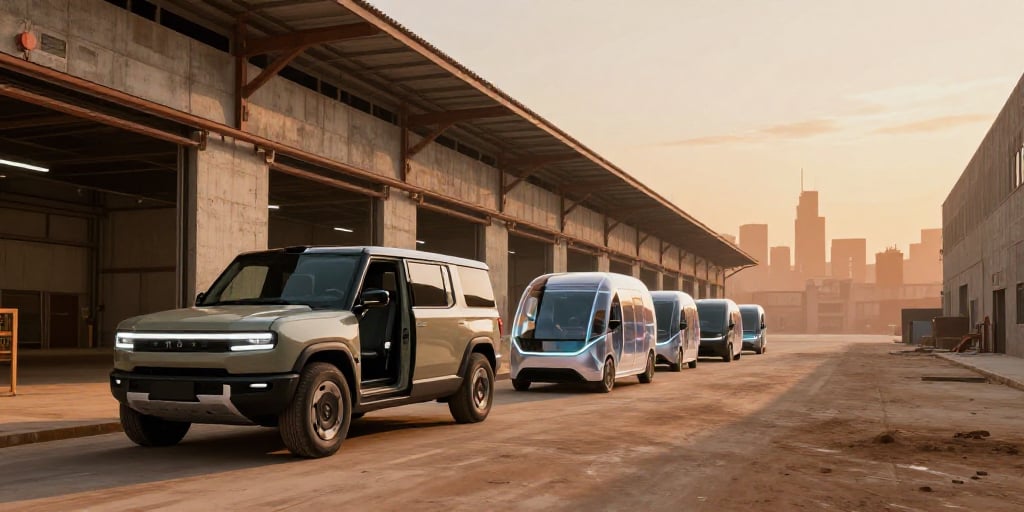
Rivian Automotive Inc. has announced a significant broadening of its R2 electric‑utility vehicle (E‑UV) lineup, extending beyond the two variants currently disclosed. The company confirms that additional models are under development, aimed at delivering a more affordable spectrum while preserving the off‑road capability that has differentiated Rivian’s earlier products. Production of the R2 already commenced in Normal, Illinois, and a new plant in Georgia is under construction to accommodate the expanded output. Initial deliveries of the base R2 SUVs are slated for June 2024, with a lower‑priced variant scheduled for launch in 2027.
Concurrently, Uber has placed an order for 10,000 Rivian‑powered robotaxis, a substantial order that follows prior collaborations with other autonomous‑vehicle (AV) developers. This partnership is poised to unlock new revenue streams for Rivian, contingent on the maturation of its self‑driving technology.
The company’s most recent first‑quarter earnings report shows a narrowed operating loss relative to the previous year and an uptick in vehicle deliveries. Analysts emphasize that the R2 rollout and the Uber partnership will be pivotal in evaluating Rivian’s future trajectory. However, the broader electric‑vehicle (EV) market remains intensely competitive and vulnerable to macroeconomic fluctuations.
1. Business Fundamentals
1.1 Production Capacity and Supply Chain
- Existing Production Base: Rivian’s Normal, Illinois plant has been operating at 20 % capacity for the R1 and R2 series, with a projected throughput of 8,000 units annually.
- Georgia Facility: The new Georgia plant, estimated to cost $2.5 billion, will be designed for modular assembly, enabling scalability for both SUV and truck platforms. The facility’s design incorporates advanced robotics and an in‑house battery pack assembly line, reducing dependence on external suppliers.
- Supplier Risk: Rivian’s reliance on key battery suppliers (LG Energy Solution, CATL) introduces exposure to raw‑material price volatility and geopolitical tensions in South Korea and China. The company’s recent investment in a US‑based battery cell pilot plant aims to mitigate this risk.
1.2 Cost Structure and Pricing Strategy
- Economics of Scale: By expanding the R2 lineup, Rivian aims to lower the average cost of goods sold (COGS) through shared components across variants. The company forecasts a 12 % reduction in COGS within the first two years of the new model’s launch.
- Target Market: The lower‑priced R2 variant, priced at approximately $35,000, will compete directly with mainstream SUVs like the Toyota RAV4 Prime and Hyundai Ioniq 5. This entry point is crucial for capturing middle‑income customers who have previously been price‑cautious.
- Profitability Outlook: Current operating leverage is constrained by high fixed costs. However, the anticipated increase in production volume could shift the fixed‑to‑variable cost ratio, improving margins once the company passes the break‑even production threshold.
2. Regulatory Environment
2.1 Environmental Incentives
- Federal Tax Credits: The 2024 Inflation Reduction Act continues to provide a $7,500 tax credit for EV purchasers. However, the credit phases out after 200,000 units per manufacturer, placing urgency on Rivian’s production ramp‑up.
- State‑Level Policies: California’s Zero‑Emission Vehicle (ZEV) mandate and the Midwest’s emerging incentives for “electric‑utility” vehicles will favor Rivian’s R2, provided it meets the required infrastructure compatibility (e.g., 350 kW fast‑charging capability).
2.2 Autonomous Vehicle (AV) Regulations
- Pilot Programs: Uber’s 10,000 robotaxi order will be deployed in pilot programs across California, Texas, and Georgia. These states have more permissive AV testing regulations, but the rollout will still require compliance with the Department of Transportation’s safety validation protocols.
- Data Privacy: Rivian’s vehicle-to-infrastructure (V2I) connectivity raises concerns under the General Data Protection Regulation (GDPR) for any operations involving EU customers. Early adoption of privacy‑by‑design frameworks is essential.
3. Competitive Dynamics
3.1 Direct Competitors
- Tesla Model Y / Cybertruck: Tesla’s economies of scale and robust Supercharger network present a formidable challenge. Rivian must differentiate through off‑road capability and premium design.
- Ford F‑150 Lightning / Ford Bronco: Ford’s extensive dealer network and aggressive pricing strategy threaten Rivian’s market share, especially in the utility segment.
3.2 Indirect Threats
- Ride‑Share Aggregators: Uber’s internal vehicle procurement (e.g., the 2023 partnership with Cruise) may reduce demand for external suppliers. Rivian’s success will hinge on convincing Uber to favor its platform over competitors.
- Battery Technology: Emerging solid‑state battery developers could disrupt the EV market by offering higher energy density at lower costs, potentially eroding Rivian’s price advantage.
4. Financial Analysis
| Metric | FY 2023 | Q1 2024 | Trend |
|---|---|---|---|
| Net Revenue | $2.2 B | $540 M | 2.6× growth YoY |
| Operating Loss | $1.1 B | $210 M | Narrowed by 80 % |
| EBITDA | -$950 M | -$170 M | Positive trajectory |
| CapEx | $1.2 B | $260 M | 33 % of revenue |
| Gross Margin | 25 % | 27 % | Incremental improvement |
The narrowing operating loss and improving EBITDA margin indicate that Rivian is on a path to profitability, contingent on scaling production and achieving cost efficiencies. However, the high capital expenditures and inventory build‑up expose the company to cash flow risks if vehicle demand falters.
5. Risks and Opportunities
| Category | Risk | Opportunity |
|---|---|---|
| Demand Volatility | Macroeconomic slowdown could reduce consumer spending on premium SUVs. | Lower‑priced R2 could capture price‑sensitive segments. |
| Regulatory Changes | Potential tightening of EV incentives post‑2026 could erode consumer subsidies. | Strong lobbying and participation in policy design could secure favorable terms. |
| Technology Disruption | Rapid advancement in battery tech could render current platforms obsolete. | Investment in battery cell production and partnership with battery startups. |
| AV Market Dynamics | Uber may shift to in‑house solutions or other suppliers. | Existing partnership gives Rivian early mover advantage in AV infrastructure. |
| Supply Chain Disruption | Geopolitical tensions affecting semiconductor supply. | Diversified sourcing and local component manufacturing. |
6. Conclusion
Rivian’s expansion of the R2 lineup, coupled with its strategic partnership with Uber, positions the company to broaden its market footprint and diversify revenue streams. The company’s financials demonstrate a clear trajectory toward operational efficiency, but the path remains fraught with supply‑chain, regulatory, and competitive uncertainties. Investors and industry observers should closely monitor the execution of the Georgia plant, the launch cadence of the lower‑priced R2, and the progression of Uber’s robotaxi deployment to gauge the true impact on Rivian’s long‑term viability.