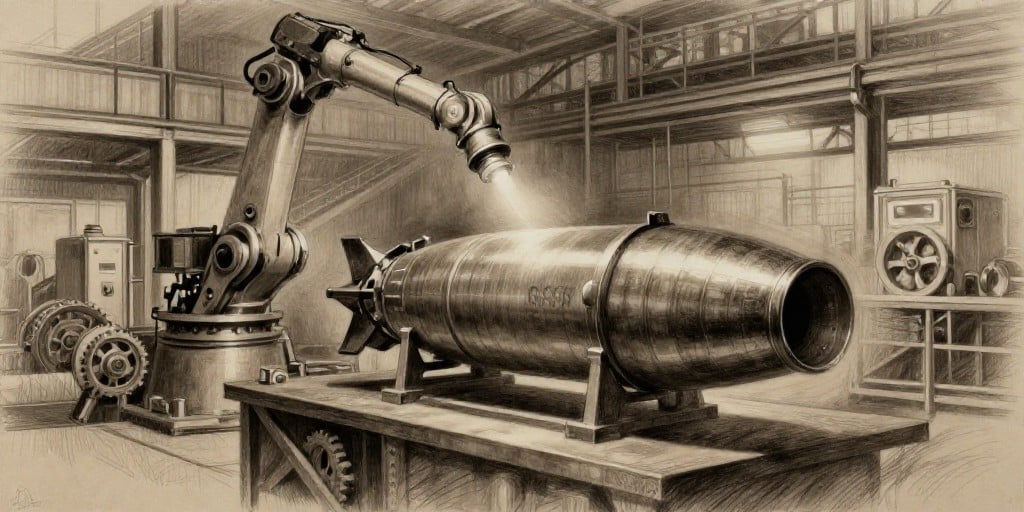
Corporate News – Industrial & Defense Sector Update
Rheinmetall AG’s recent artillery‑ammunition contract underscores the sector’s resilience and the critical role of advanced manufacturing systems in meeting strategic demand.
1. Contract Details and Production Status
Rheinmetall AG announced a five‑figure order for 155‑mm artillery shells destined for a 2027 delivery horizon. The order is already underway in the company’s integrated production lines, illustrating the firm’s capability to scale output rapidly in response to national security needs. The procurement volume—while modest in absolute terms—represents a significant revenue contribution relative to the company’s annual sales mix and reflects a continued demand trajectory across NATO member states.
2. Manufacturing Process Excellence
The production of 155‑mm shells demands tight control over material properties, dimensional tolerances, and explosive filling safety. Rheinmetall’s process chain integrates the following high‑value engineering practices:
| Process Step | Technical Focus | Impact on Productivity |
|---|---|---|
| Material Selection | Utilization of high‑strength alloy steels (e.g., 30CrMoV) and corrosion‑resistant coatings. | Reduces part failure rates and extends barrel life. |
| Precision Machining | CNC‑driven machining with sub‑micrometer repeatability for shell casings and projectile bodies. | Accelerates lead times and improves surface finish critical for aerodynamics. |
| Explosive Filling | Automated filling rigs coupled with real‑time pressure monitoring. | Enhances safety margins and ensures consistent detonation velocity. |
| Quality Assurance | Integrated nondestructive testing (X‑ray, ultrasonic) and statistical process control (SPC). | Lowers scrap rates to <0.2 % and supports traceability for regulatory compliance. |
These process enhancements directly translate into higher throughput and lower unit costs, thereby reinforcing the company’s competitive edge in the high‑calibre munitions market.
3. Capital Expenditure Trends in Heavy Industry
The defense sector’s capital‑expenditure (CapEx) landscape is characterized by:
- Infrastructure Modernization: Upgrading blast‑proof workshops and expanding automated material handling to support increased volumes.
- Automation & Digitization: Implementation of Industry 4.0 platforms (IoT sensors, predictive maintenance) to reduce downtime and enhance production flexibility.
- Supply‑Chain Resilience Investments: Stockpiling critical raw materials (tantalum, high‑strength steel) to mitigate geopolitical supply shocks.
Rheinmetall’s current contract encourages further CapEx in high‑automation manufacturing cells and material‑handling robotics to maintain the lead time advantage demonstrated by the existing production ramp.
4. Economic Drivers of Defence CapEx
Several macro‑economic factors are shaping defence spending trajectories:
| Driver | Effect on CapEx |
|---|---|
| Supply Constraints in the United States | Drives European manufacturers to secure supply chains, increasing domestic CapEx. |
| Japan’s Expanded Defence Budgets | Signals global demand shift, encouraging European firms to pursue joint‑venture and licensing agreements. |
| Rising Energy Costs | Justifies investment in energy‑efficient processes and on‑site renewable generation. |
| Higher Bond Yields | Elevates borrowing costs but can also incentivize asset‑backed financing of large projects. |
The recent Chancellor Friedrich Merz announcement of potential fuel‑price relief measures may temper cost pressures for defence contractors, indirectly supporting future investment cycles.
5. Supply‑Chain and Regulatory Landscape
- Regulatory Compliance: Export controls (e.g., ITAR, EAR) require rigorous documentation, influencing manufacturing timelines. Rheinmetall’s integrated compliance framework mitigates risk and expedites order fulfilment.
- Supply‑Chain Resilience: The current contract’s reliance on domestically sourced steel reduces exposure to international trade disruptions. However, the company continues to monitor global supply shocks (e.g., semiconductor shortages) that could affect auxiliary equipment procurement.
- Infrastructure Spending: Germany’s recent focus on “Infrastruktur 2026” includes upgrading rail and logistics networks, which directly benefits large‑scale munitions transport.
6. Market Implications and Investor Sentiment
The stock’s 3 %+ surge reflects a broader trend of investor confidence in defence companies amid geopolitical tensions. Key takeaways for market participants include:
- Productivity Metrics: Rheinmetall’s capacity to maintain high throughput while keeping unit costs low positions it favorably against competitors.
- Technological Innovation: Continued adoption of additive manufacturing for casings and advanced composites could further reduce weight and improve ballistic performance.
- Economic Context: While oil prices remain above $100 per barrel, the sustained demand for defense spending and potential fiscal stimulus in Germany support a bullish outlook for the sector.
7. Forward‑Look Statement
Rheinmetall’s recent contract win, combined with a supportive macro‑economic environment, signals robust demand and a stable supply chain for high‑calibre munitions. The company’s commitment to advanced manufacturing and CapEx in automation positions it to capitalize on future defence procurement cycles, reinforcing investor confidence and reinforcing the German defence sector’s resilience within the broader European industrial ecosystem.