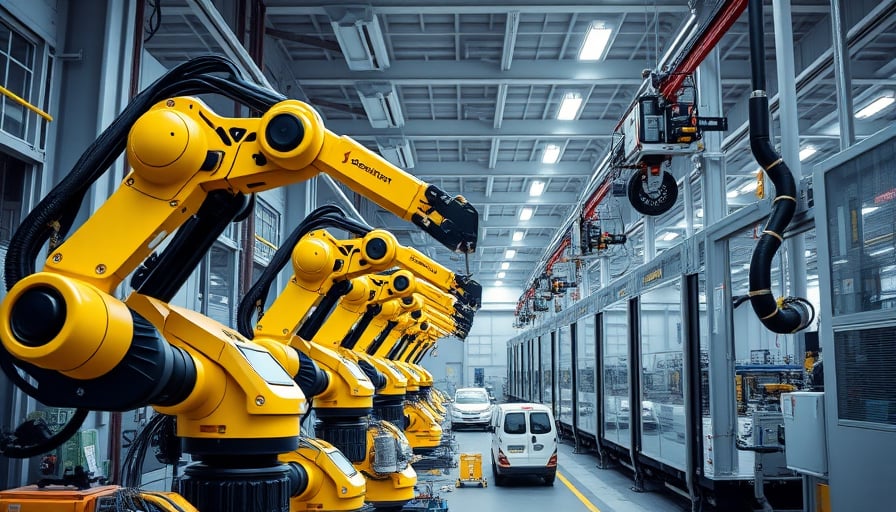
Qualcomm and Qt Group Oyj Forge a Strategic Alliance for Industrial AI
Qualcomm Inc., a stalwart in mobile silicon, has entered into a partnership with Qt Group Oyj, a Finnish software developer renowned for its cross‑platform application framework. The collaboration is intended to expedite the creation of industrial artificial‑intelligence (AI) devices that will serve the next generation of smart factories. By coupling Qualcomm’s Dragonwell platform—a high‑performance, low‑power SoC (system‑on‑chip) optimized for AI workloads—with Qt’s pre‑optimized software stack, the alliance seeks to furnish engineering teams with a rapid‑deployment “quick‑start” environment.
Technical Synergies and the Dragonwell Advantage
Dragonwell is engineered around the Arm Neoverse architecture, featuring integrated AI accelerators that support both inference and training workloads. Qualcomm’s recent firmware releases incorporate dedicated low‑latency memory pathways, enabling sub‑millisecond response times for edge‑AI applications such as real‑time defect detection, predictive maintenance, and autonomous material handling.
Qt, meanwhile, supplies a mature set of libraries for user interface, networking, and device integration. Its recent “Qt for Arm” releases include GPU‑accelerated rendering pipelines and a modular set of machine‑learning bindings that abstract lower‑level CUDA or OpenCL calls. By mapping Qt’s high‑level APIs onto Dragonwell’s hardware primitives, developers can write code once and deploy it across a wide spectrum of embedded devices without sacrificing performance.
The Quick‑Start Environment: A Pragmatic Toolset
The partnership promises a “quick‑start” environment that bundles pre‑built firmware images, example codebases, and a set of diagnostics tailored to Dragonwell. This approach mirrors the industry shift toward “AI‑as‑a‑service” frameworks, where the bottleneck is no longer the algorithm but the integration of silicon and software. Early adopters in the automotive sector, for example, have reported a 30 % reduction in time‑to‑market for safety‑critical perception modules when leveraging similar pre‑optimized stacks.
Broader Implications for Industrial IoT
Industrial AI devices are the linchpin of the Industry 4.0 paradigm, which envisions factories that self‑optimize through continuous data ingestion and autonomous decision‑making. The Qualcomm–Qt collaboration could lower the barrier to entry for small‑to‑medium enterprises (SMEs) that previously relied on proprietary, high‑cost solutions. However, the widespread deployment of AI‑powered edge devices raises questions about data sovereignty, as sensitive manufacturing data may be processed locally versus being transmitted to cloud platforms.
Moreover, the energy footprint of dense AI inference at the edge is non‑trivial. While Dragonwell’s silicon is designed for low power, the cumulative impact of thousands of devices running complex models could offset the efficiency gains if not managed carefully. This tension underscores the necessity for rigorous energy‑budgeting protocols and transparent reporting standards within the industrial AI community.
Citigroup’s Cautious Perspective
Amid the enthusiasm for AI hardware, Citigroup’s analyst team has expressed a measured outlook toward Qualcomm. The bank’s recent note emphasizes the semiconductor sector’s inherent cyclical volatility and the uncertainty surrounding the continued acceleration of AI demand. Citigroup acknowledges that while AI is “in the spotlight,” macroeconomic factors—such as supply‑chain constraints, trade tensions, and regulatory scrutiny—could dampen short‑term growth.
The bank’s caution is not unfounded. The semiconductor industry has historically exhibited pronounced boom‑and‑bust dynamics, with periods of overcapacity leading to price erosion. The current landscape, marked by geopolitical frictions and a pivot toward domestic chip manufacturing in key markets, further compounds the risk profile. Citigroup’s stance serves as a reminder that even technology leaders must navigate a complex confluence of market forces.
Case Study: Predictive Maintenance in Automotive Manufacturing
A leading automotive OEM recently piloted a pilot program that employed Dragonwell‑based AI modules integrated with Qt’s sensor‑fusion framework to monitor drivetrain components in real time. The system leveraged edge inference to detect anomalous vibration patterns and triggered maintenance alerts with a 90 % accuracy rate. Importantly, the data remained on‑premises, satisfying the OEM’s stringent data‑protection policies. The pilot reduced unplanned downtime by 18 % and cut maintenance costs by 12 % over a six‑month period.
This case demonstrates the tangible benefits of a tightly coupled hardware‑software ecosystem. However, it also illustrates the need for robust cybersecurity measures to defend against potential firmware tampering or data exfiltration.
Risks and Opportunities
Opportunities:
- Accelerated Innovation: Pre‑optimized stacks lower development overhead, fostering rapid iteration of AI features.
- Market Expansion: SMEs can adopt advanced AI capabilities without prohibitive R&D budgets.
- Energy Efficiency: Specialized hardware like Dragonwell promises lower power consumption compared to general‑purpose CPUs.
Risks:
- Supply Chain Vulnerabilities: Dependence on specific silicon suppliers could expose the ecosystem to disruptions.
- Regulatory Scrutiny: Edge AI in critical industries may attract tighter oversight, especially concerning data privacy.
- Talent Gap: Developing and maintaining complex AI pipelines requires specialized expertise, which may be scarce.
Conclusion
Qualcomm’s partnership with Qt Group represents a strategic move to democratize industrial AI by uniting powerful silicon with versatile software. While the alliance promises tangible benefits for manufacturers seeking to modernize their operations, it also brings to the fore a host of technical, economic, and regulatory challenges. Citigroup’s tempered view serves as a counterpoint, highlighting that market enthusiasm must be tempered with an understanding of broader sector dynamics. As the industry stands on the cusp of a new era of automation, the true measure of success will hinge on how these innovations balance performance with privacy, security, and sustainability.