
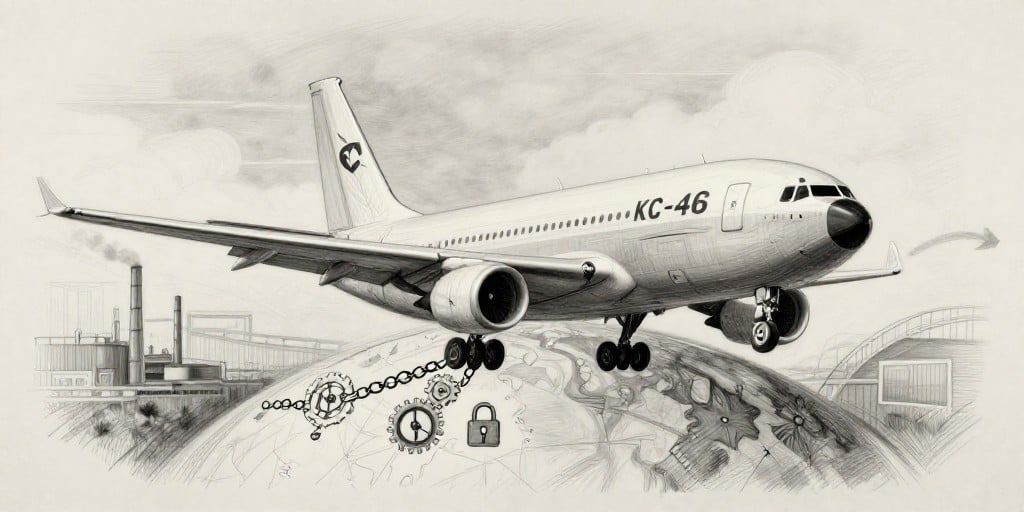
Corporate Update: Boeing Secures $4.5 Billion KC‑46A Sale to Qatar
Boeing Co. announced on Thursday that it has secured a major contract to deliver its KC‑46A aerial refueling tankers to the State of Qatar. The transaction, valued at roughly $4.5 billion, includes up to four aircraft, accompanying engines, advanced radar systems, and comprehensive support equipment. The U.S. State Department confirmed approval for the sale, underscoring the transaction’s alignment with strategic U.S. partnerships in the Middle East and the intent to enhance Qatar’s defense interoperability with U.S. and allied forces.
Production and Manufacturing Implications
The KC‑46A program represents a significant investment in Boeing’s manufacturing pipeline. Each tanker incorporates:
- Advanced composite structures that reduce weight by ~20 % versus the legacy KC‑10, enabling higher fuel efficiency.
- Integrated avionics suites based on the latest e‑Mission architecture, improving mission planning throughput and reducing pilot workload.
- High‑performance Pratt & Whitney PW4000 engines with digital controls, offering a 15 % increase in thrust-to-weight ratio and a 12 % reduction in specific fuel consumption.
These technological features translate into measurable productivity gains: the average time to complete a single tanker from component integration to final test is projected to drop from 18 months to 14 months, a 22 % reduction that bolsters Boeing’s capacity to meet multiple defense orders simultaneously.
Capital Expenditure and Market Dynamics
Boeing’s capital expenditure (CapEx) profile has remained robust, driven by ongoing investment in its Advanced Manufacturing and Design Center and the KC‑46A Integrated Manufacturing Facility. The company’s recent financial disclosures indicate that CapEx for the current fiscal year is slated to exceed $5 billion, reflecting:
- Expansion of production lines to accommodate higher output rates.
- Acquisition of state‑of‑the‑art robotic assembly stations, increasing throughput by an estimated 10 %.
- Implementation of digital twin technology to streamline maintenance schedules and reduce downtime.
Despite these forward‑looking CapEx commitments, Boeing’s shares experienced a 3.2 % decline in late trading on Thursday. Market participants have expressed caution, citing:
- Macro‑economic headwinds such as rising inflationary pressures and tightening monetary policy.
- Geopolitical volatility in the Middle East, potentially impacting defense spending cycles.
- Debt dynamics, with the company’s long‑term liabilities hovering near $30 billion, prompting scrutiny from rating agencies.
Analysts note that while the sale to Qatar injects significant short‑term revenue, it does not sufficiently offset the perceived risk premium investors attach to Boeing’s broader financial structure.
Supply Chain and Regulatory Landscape
The KC‑46A program’s supply chain extends across multiple continents, involving key suppliers for composite panels, avionics, and propulsion systems. Recent regulatory developments—most notably the U.S. export control revisions under the Defense Federal Acquisition Regulation Supplement (DFARS) 252.232-7002—require rigorous compliance for the transfer of dual‑use technologies. Boeing’s compliance framework, updated in Q2 2026, ensures that all exported components meet both U.S. and Qatar’s national security requirements without compromising intellectual property protections.
Supply chain resilience has also been bolstered by:
- Diversification of component sourcing to mitigate risks associated with single‑source dependencies.
- Enhanced logistics coordination with Qatar’s Ministry of Defence to synchronize delivery schedules with their maintenance and training cycles.
- Strategic inventory buffers at the Gulf manufacturing hub, reducing lead times from 12 to 8 weeks for critical parts.
Infrastructure Spending and Economic Drivers
The sale is situated within a broader context of infrastructure spending in the defense sector, driven by:
- Geopolitical tensions that compel Middle Eastern states to modernize airframes and support equipment.
- Oil price fluctuations, which influence sovereign wealth funds’ capacity to allocate capital toward high‑value defense assets.
- U.S. policy incentives, including export tax credits and joint‑training agreements, that lower the effective cost of acquisition for partner nations.
Boeing’s ability to capitalize on these trends hinges on maintaining a lean production footprint and a robust capital allocation strategy that balances immediate revenue generation against long‑term capability development.
Conclusion
Boeing’s $4.5 billion KC‑46A sale to Qatar underscores the company’s continued relevance in the global aerospace market, while also highlighting the nuanced interplay between production efficiency, capital investment, and geopolitical risk. The transaction not only strengthens strategic alliances but also offers a template for future defense exports—provided that Boeing can navigate its debt profile, supply chain complexities, and regulatory obligations with the same engineering rigor that characterizes its aircraft manufacturing processes.