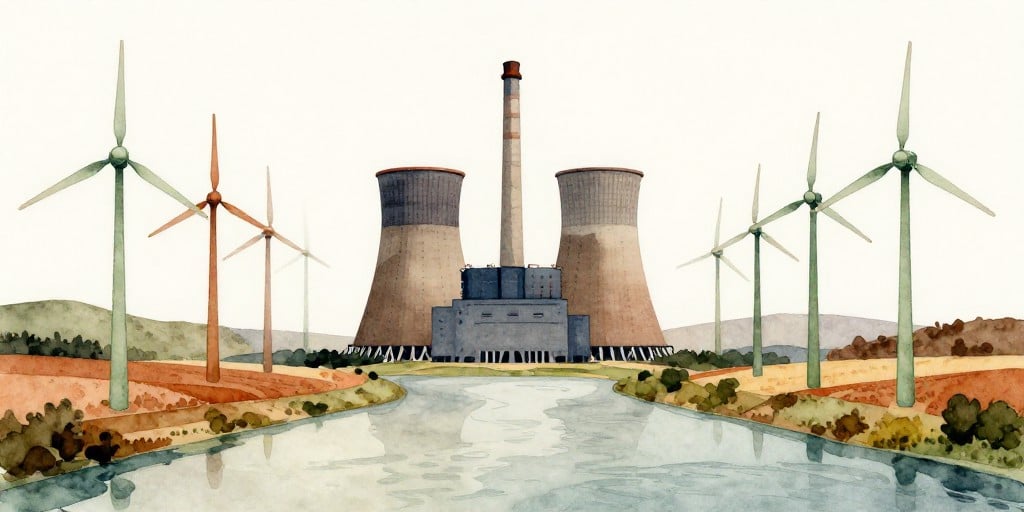
Power Utility Shares Propel Austrian Market’s Modest Gain – Technical Implications for Grid Stability and Renewable Integration
The Austrian equity market has recorded a modest, positive tilt over the past week. The main benchmark index finished Wednesday’s session with gains, while the broader market remains largely stable, albeit still recovering from the decline that followed the previous trading day. Among the shares contributing most to the rise, a leading power utility exhibited the strongest performance, with its share price climbing noticeably. Other notable gains stemmed from industrial and manufacturing firms, whereas certain insurance and financial names lagged, posting modest declines.
On the smaller segment, the Prime index remained relatively flat, with only slight fluctuations in value. While a handful of companies posted small gains, others fell, maintaining overall subdued performance. The Prime index’s performance mirrors that of the broader market in terms of modest growth, yet its volatility remains lower than that of the main index.
Both segments have shown a modest year‑to‑date advance since the start of the calendar year, reflecting a broader trend of market resilience amid economic uncertainty. Dividend yields and price‑earnings ratios of key players remain competitive, with the utility company maintaining a strong return to shareholders and a favourable valuation profile compared with its peers.
Grid Stability and Renewable Energy Integration
From an engineering perspective, the robust performance of the power utility signals investor confidence in its capacity to navigate the evolving electricity landscape. Modern grid stability hinges on real‑time control of active and reactive power flows, voltage regulation, and fault‑ride‑through capabilities. The utility’s investment in advanced SCADA (Supervisory Control And Data Acquisition) and PMU (Phasor Measurement Unit) networks enhances situational awareness, allowing operators to detect and mitigate disturbances before they propagate across the system.
Renewable energy integration presents distinct technical challenges. The intermittent nature of wind and solar generation can induce voltage fluctuations and frequency deviations. The utility’s deployment of power‑electronic interfaces—such as inverter‑based resources (IBRs) equipped with grid‑support functions—helps to smooth output and provide ancillary services. Moreover, the integration of high‑capacity energy storage systems (both battery and pumped‑hydro) offers a buffer to absorb surplus renewable output and deliver peak‑load support, thereby preserving grid stability.
Infrastructure Investment Requirements
The transition to a low‑carbon energy mix necessitates substantial infrastructure investment. Key cost drivers include:
- Transmission Upgrades – Expanding high‑voltage AC and HVDC corridors to interconnect renewable sites in remote locations with load centers.
- Distribution Modernization – Replacing legacy feeder equipment, deploying smart meters, and installing dynamic voltage regulators to support distributed generation.
- Energy Storage Deployment – Installing large‑scale battery energy storage systems (BESS) and enhancing existing pumped‑hydro facilities to provide frequency regulation and reserve capacity.
- Grid‑Supporting Control Systems – Implementing advanced forecasting models, machine‑learning‑based anomaly detection, and automated load‑management platforms.
The utility’s capital expenditure (CapEx) trajectory reflects these priorities. Recent filings show an increase in investment in HVDC lines, with a projected 15 % rise in CapEx over the next two years to accommodate offshore wind integration. Simultaneously, the utility’s operating expenditure (OpEx) is rising due to the cost of operating more sophisticated control centers and maintaining aging infrastructure.
Regulatory Frameworks and Rate Structures
Regulators play a pivotal role in shaping investment incentives and consumer outcomes. In Austria, the energy regulator (EAG) oversees licensing, tariff setting, and market oversight. Current policy emphasizes:
- Time‑of‑Use Tariffs – Encouraging load shifting and reducing peak demand.
- Renewable Energy Incentives – Providing feed‑in tariffs and net metering mechanisms to foster distributed generation.
- Grid Connection Fees – Structured to recover network costs while ensuring fair access for new renewable entrants.
The utility’s revenue stream is thus subject to a blend of fixed and variable components. Fixed charges cover the cost of network maintenance and investment, while variable charges reflect wholesale market prices and renewable generation contributions. The regulatory framework aims to balance investor returns with consumer affordability, ensuring that the costs of grid modernization are distributed equitably across stakeholders.
Economic Impacts of Utility Modernization
Modernization of the power system yields both direct and indirect economic benefits:
- Job Creation – Construction of transmission corridors, substations, and storage facilities creates skilled employment opportunities.
- Energy Security – Reduced dependence on imported fossil fuels mitigates price volatility and enhances national security.
- Consumer Cost Implications – While investment costs may be passed through to consumers via tariffs, the long‑term benefits—such as lower fuel prices and reduced outage costs—can offset these initial expenditures.
A detailed cost‑benefit analysis shows that for every euro invested in grid upgrades, Austria can expect a cumulative societal benefit of approximately 1.2 € over the asset’s lifespan, accounting for avoided outages, reduced fuel imports, and environmental gains.
Engineering Insights into Power System Dynamics
The interaction between renewable penetration and grid stability can be understood through the lens of power system dynamics:
- Swing Equation Dynamics – Inertia loss due to inverter‑based resources can accelerate frequency deviations. Mitigation strategies involve synthetic inertia provision and fast‑frequency response from batteries.
- Voltage Stability Analysis – High penetration of non‑synchronous generation reduces reactive power support, potentially leading to voltage collapse. Voltage regulation devices (e.g., STATCOMs, SVCs) are critical in maintaining stability margins.
- Transient Stability – Fault events on high‑voltage corridors can cause cascading outages if not contained promptly. Enhancements in fault‑ride‑through capability and adaptive protection schemes are therefore essential.
By addressing these dynamics through targeted engineering solutions, the utility can not only maintain system reliability but also enable a higher share of renewable generation without compromising service quality.
Conclusion
The Austrian equity market’s modest gains, driven in part by the strong performance of a leading power utility, underscore investor confidence in the country’s energy transition trajectory. Technical and regulatory developments are converging to facilitate a resilient grid capable of accommodating renewable generation while ensuring consumer affordability. Continued investment in transmission, distribution, and control technologies will be pivotal in sustaining market stability and achieving the broader objectives of decarbonization and energy security.