
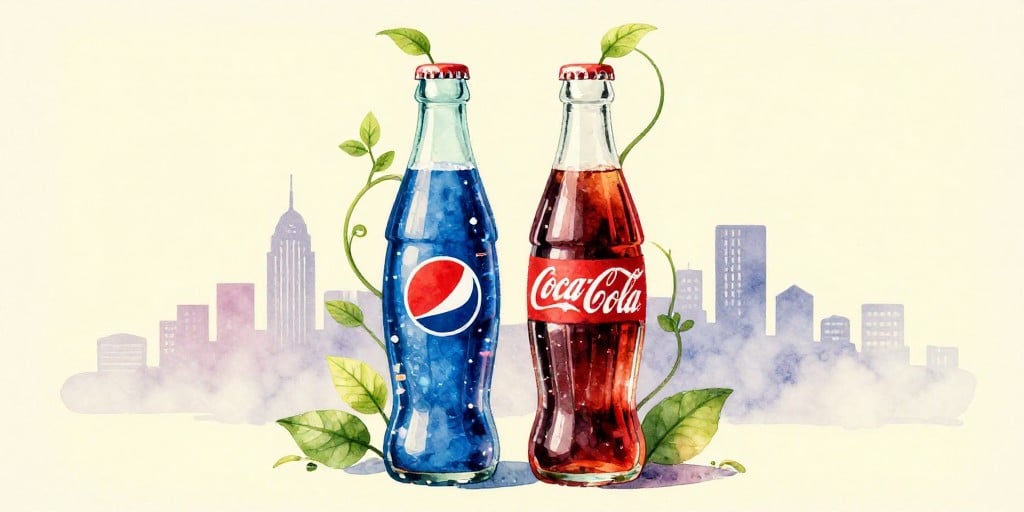
PepsiCo Inc. and Coca‑Cola: A Comparative Lens on Consumer Trends and Market Opportunity
PepsiCo Inc. announced its second‑quarter 2026 earnings on 12 August, a disclosure that immediately drew the attention of analysts and investors who were gauging the company’s performance against that of its chief rival, Coca‑Cola. The quarterly report highlighted a rise in revenue and earnings that exceeded market expectations, yet management underscored persistent softness in the North American beverage segment. Declining consumer spending in the United States has dampened beverage volumes, whereas international markets continue to provide a solid growth cushion. PepsiCo maintained its 2026 outlook for organic revenue growth in the lower single‑digit range and projected adjusted earnings growth modestly higher than its prior guidance. The company reiterated its commitment to returning substantial capital to shareholders through dividends and share repurchases, reinforcing its appeal as a stable income investment.
In contrast, Coca‑Cola’s results for the same period exhibited stronger momentum: double‑digit earnings growth, an expanded operating margin, and a revised upward guidance for the full year. Analysts noted Coca‑Cola’s ability to lift unit volumes globally and the continued success of its flagship products as key drivers of the improved outlook. The juxtaposition of the two companies’ guidance and recent performance has led some market watchers to favor Coca‑Cola for near‑term upside, while others view PepsiCo’s diversified portfolio of beverages and convenient foods as a longer‑term advantage that may offset current North American headwinds.
Digital Transformation Meets Physical Retail
Both companies are navigating a landscape where digital channels increasingly complement, rather than replace, traditional retail. The proliferation of e‑commerce and mobile ordering platforms has accelerated the “omni‑channel” model, allowing consumers to purchase beverages and packaged foods online for home delivery or curbside pickup. This shift is particularly pronounced among Gen Z and Millennials, who prioritize convenience and digital engagement. PepsiCo’s strategic investments in direct‑to‑consumer initiatives—such as branded subscription services and partnerships with food‑delivery platforms—illustrate how the firm is adapting its distribution model to meet evolving consumer habits.
Coca‑Cola, meanwhile, has leveraged its extensive global supply chain to power a robust digital presence. The company’s “Coca‑Cola Digital Hub” integrates data analytics, AI‑driven demand forecasting, and real‑time inventory management to optimize product availability across both brick‑and‑mortar stores and online marketplaces. By aligning digital capabilities with physical retail, Coca‑Cola has maintained a resilient sales mix even amid fluctuating in‑store traffic.
Demographic Shifts and Generational Spending Patterns
The North American market is experiencing a generational shift in spending behavior. Younger consumers are more inclined toward health‑conscious and experiential products, while older cohorts continue to value value‑driven, familiar brands. PepsiCo’s focus on functional beverages, lower‑sugar options, and protein‑rich products reflects an anticipatory response to these trends. However, the translation of these innovations into stronger operating results will likely be gradual, given the need for market acceptance and scale.
Conversely, Coca‑Cola’s portfolio, anchored by flagship beverages that have achieved near‑universal brand recognition, enjoys a more immediate uptake across demographic segments. The company’s ability to drive unit volume growth globally—particularly in emerging markets where disposable income is rising—positions it favorably against demographic volatility.
Evolution of Consumer Experience
Modern consumers expect more than just a product; they seek immersive brand experiences that resonate with their lifestyles. PepsiCo’s investment in experiential marketing—such as pop‑up tasting events, virtual reality brand activations, and collaborations with influencers—illustrates an effort to create memorable touchpoints. These initiatives not only enhance brand affinity but also generate data that can refine product development and targeted promotions.
Coca‑Cola, on the other hand, has capitalized on its long‑standing heritage by integrating cultural narratives into its marketing strategy. Campaigns that celebrate local traditions, sports events, and social causes foster a sense of community among consumers, reinforcing loyalty across age groups.
Forward‑Looking Analysis: Societal Changes as Market Opportunities
Digital‑Physical Synergy – Companies that seamlessly integrate online ordering with in‑store experiences can capture higher margins and customer data. PepsiCo’s ongoing digital platform upgrades and Coca‑Cola’s robust supply‑chain analytics set a benchmark for competitors.
Health‑Conscious Innovation – The demand for functional, low‑sugar, and protein‑enriched beverages is projected to grow steadily. PepsiCo’s pipeline of such products offers a long‑term competitive edge, especially as it expands into international markets where health trends are rapidly gaining traction.
Experience‑Driven Brand Loyalty – Immersive marketing and community engagement can differentiate brands in a crowded marketplace. PepsiCo’s experiential initiatives, if scaled effectively, could translate into incremental sales and higher lifetime value for younger consumers.
Capital Allocation and Investor Sentiment – PepsiCo’s steadfast capital return program reassures income‑seeking investors, whereas Coca‑Cola’s upward guidance may attract growth‑oriented capital. The divergence in shareholder value creation strategies provides a nuanced decision framework for investors weighing stability against upside potential.
In sum, the comparative performance of PepsiCo and Coca‑Cola underscores the importance of aligning business strategy with evolving consumer lifestyles, generational spending habits, and digital transformation imperatives. While Coca‑Cola currently enjoys near‑term upside due to its robust global volume growth and operating margin expansion, PepsiCo’s diversified portfolio and strategic investments position it for sustained long‑term growth as societal trends continue to shift toward healthier, experience‑centric consumption.