
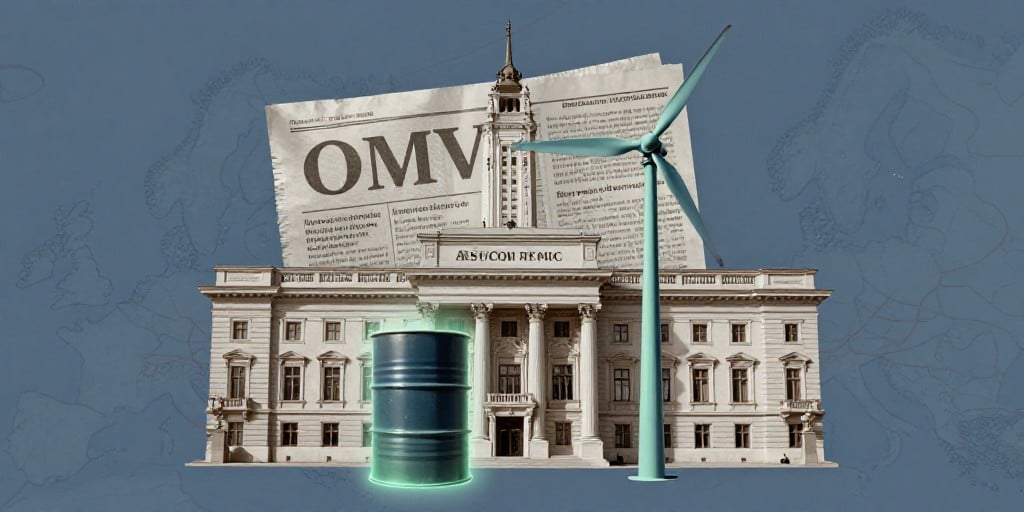
Energy‑Sector Performance and Market Dynamics at the Vienna Stock Exchange
The Vienna Stock Exchange concluded Thursday with modest gains, reflecting a cautious yet optimistic stance among investors. The benchmark index advanced slightly as market participants weighed a range of factors, from geopolitical developments to evolving commodity fundamentals. Central to the day’s activity was the oil and gas group OMV, whose shares rose in response to a favourable interim report, underscoring the interplay between corporate earnings and global energy markets.
OMV’s Interim Report: A Catalyst for Market Confidence
OMV’s interim figures revealed a tangible rebound in profitability across its core operating lines—oil, gas, and chemicals—largely attributable to heightened commodity prices. The company’s margin expansion in these segments has attracted the attention of major banking analysts. Erste Group and RBC Capital Markets both highlighted the improved operating earnings outlook, while Barclays lifted its profit projection for the reporting period.
These corporate metrics dovetail with broader supply‑demand dynamics: a tightening global oil market, driven in part by geopolitical tensions in the Middle East, has pushed crude prices higher. Simultaneously, advances in extraction technologies—such as horizontal drilling and hydraulic fracturing—have moderated supply growth, sustaining upward price pressures. The resulting environment has created a favourable backdrop for energy producers like OMV, whose cost structures benefit from economies of scale and efficient production techniques.
Market Reactions to Sector‑Specific Performance
While OMV enjoyed a modest share price uptick, an oil‑field equipment supplier experienced a slight decline, reflecting the sector’s mixed earnings picture. This divergence highlights the importance of distinguishing between upstream production companies and downstream equipment manufacturers when assessing market sentiment. Equipment suppliers often face tighter margin compression due to volatile capital expenditures and a cyclical demand for drilling services, whereas producers benefit more directly from commodity price swings.
Geopolitical Context and Commodity Price Sensitivity
The day’s performance was framed by the anticipation of a trading update on OMV’s second‑quarter results, scheduled for later that evening. Investors remain vigilant to the possibility of further price volatility amid escalating tensions in the Middle East. Historically, such geopolitical events have a pronounced effect on crude prices, which in turn influence the profitability of integrated energy companies.
Current commodity price data shows that Brent crude has risen by approximately 4 % over the past month, while U.S. WTI prices have followed a similar trajectory. The upward trend is underpinned by constrained supply from OPEC+ and robust demand in emerging economies. Analysts project that unless new supply disruptions emerge, commodity prices could sustain their current levels for the remainder of the year, providing a supportive environment for energy producers.
Technological Innovations and the Energy Transition
Beyond traditional hydrocarbon markets, the sector is witnessing rapid innovation in renewable energy production and storage. Advances in lithium‑ion battery technology have reduced storage costs by over 30 % in the last three years, enabling more consistent integration of intermittent renewable sources. In parallel, developments in green hydrogen production—particularly electrolyzer efficiency gains—are positioning hydrogen as a potential bridge fuel.
Regulatory frameworks continue to play a decisive role. The European Union’s NextGenerationEU recovery plan, combined with the European Green Deal, has accelerated investment in renewable infrastructure and set ambitious decarbonization targets. These policies are encouraging a shift in corporate capital allocation from conventional oil and gas assets to renewable energy projects, thereby influencing long‑term valuation metrics for energy companies.
Balancing Short‑Term Trading and Long‑Term Transition
Short‑term trading factors—such as commodity price fluctuations and geopolitical events—remain pivotal drivers of market movements. However, the long‑term trajectory is increasingly shaped by the energy transition. Firms that effectively integrate renewable technologies and adapt to evolving regulatory landscapes are likely to outperform peers that rely solely on traditional hydrocarbons.
In the context of OMV, while the company’s current operating earnings are buoyed by commodity prices, its strategic investments in renewable energy and carbon‑capture projects will be essential for sustaining growth in the coming decade. Market observers have generally maintained a neutral stance on OMV’s valuation, indicating that investors view the company’s transition strategy as a long‑term stabilizer rather than an immediate growth catalyst.
Conclusion
The Vienna Stock Exchange’s modest gains on Thursday reflect a complex interplay of factors: favourable interim results for OMV, heightened crude prices driven by geopolitical tensions, and a broader shift toward renewable energy innovation. While short‑term market dynamics are heavily influenced by commodity price volatility, the sustained transition toward cleaner energy sources and supportive regulatory frameworks will likely dictate the long‑term performance of energy sector firms.