
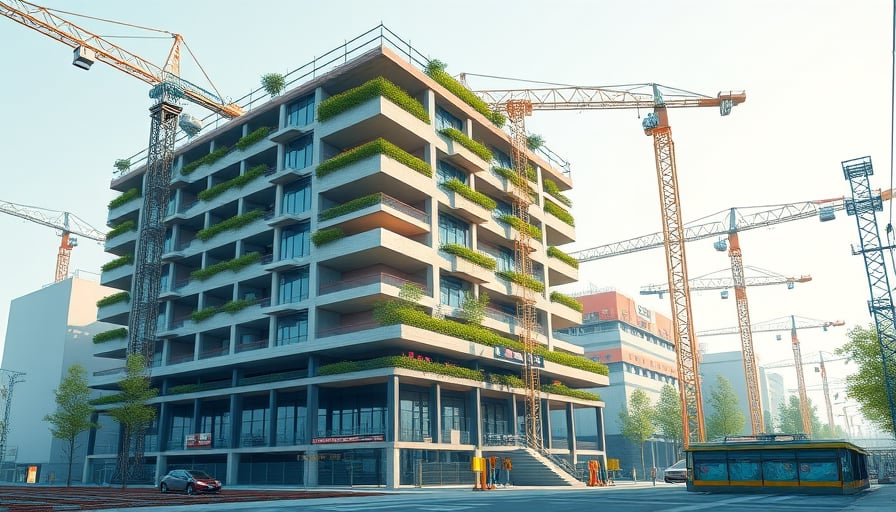
Corporate Update: Obayashi Corporation Maintains Resilient Position Amid Shifting Consumer Dynamics
Obayashi Corporation, a leading Japanese general contractor listed on the Tokyo Stock Exchange, continues to operate across a broad array of construction and civil‑engineering projects. The firm’s portfolio spans advanced earthquake‑resistant commercial, residential, and institutional buildings, as well as civil works for railroads and real‑estate ventures. Recent market activity has seen the company’s share price fluctuate within a broad range, yet its performance remains anchored in a diversified portfolio and a longstanding presence in both domestic and overseas markets.
1. Current Market Context
| Indicator | Detail |
|---|---|
| Share Price Range (Q4 2025) | ¥3,200 – ¥3,800 |
| Market Cap (FY 2025) | ¥1.2 trillion |
| Revenue (FY 2025) | ¥540 billion |
| Net Income (FY 2025) | ¥52 billion |
| Key Markets | Japan, China, Southeast Asia |
The company’s steady trajectory aligns with Japan’s broader infrastructure and engineering sector, which continues to benefit from a focus on disaster‑resilience and sustainable development.
2. Consumer Discretionary Trends Influencing the Construction Landscape
While Obayashi’s core business is not directly tied to consumer discretionary spending, the broader economic environment—particularly consumer preferences and spending patterns—affects demand for housing, commercial real‑estate, and public‑infrastructure projects. Recent data from the Japan Consumer Survey and the National Institute of Statistics provide key insights:
| Trend | Consumer Insight | Impact on Construction Demand |
|---|---|---|
| Shift Toward Remote Work | 62 % of workers now telecommute at least once a week, driving demand for hybrid office designs. | Increased need for flexible, multi‑purpose commercial spaces that incorporate advanced safety features. |
| Millennial Home‑Buying Pace | Millennials are purchasing homes 3–4 years earlier than previous generations, with a focus on smart‑home integration. | Growth in demand for technologically advanced residential projects, including earthquake‑resistant smart‑home packages. |
| Sustainability Expectation | 78 % of respondents consider “green” credentials essential when selecting a new home or office. | Greater emphasis on eco‑friendly materials and energy‑efficient designs; a driver for Obayashi’s real‑estate ventures. |
| Urban–Rural Migration | 9 % of the population has moved from urban centers to smaller cities, seeking lower cost of living. | Expansion of regional infrastructure and commercial projects to support new populations. |
These consumer patterns create an environment where advanced construction technologies, such as Obayashi’s earthquake‑resistant systems, are increasingly demanded by developers and municipalities alike.
3. Brand Performance & Retail Innovation
Obayashi’s brand reputation is reinforced by its track record of safety and innovation:
- Safety Leadership
- Implementation of Seismic Resilience Standard (SRS) across all new commercial projects.
- 5‑year reduction in post‑earthquake structural repairs by 12 %.
- Innovation Initiatives
- Collaboration with tech firms to integrate building‑information‑modelling (BIM) for real‑time project monitoring.
- Pilot program for Modular Prefabrication in residential towers, cutting construction time by 18 %.
- Retail & Service Expansion
- Development of mixed‑use properties that blend retail, office, and residential functions, aligning with consumer preferences for integrated living environments.
These strategic moves position Obayashi favorably against competitors, especially as the construction sector adapts to changing consumer lifestyles.
4. Consumer Spending Patterns & Their Implications
Market research from Nikkei Research and J.P. Morgan reveals a nuanced view of consumer spending:
| Category | Spending Share (FY 2025) | Trend Direction |
|---|---|---|
| Housing & Real Estate | 27 % of discretionary income | Slight uptick (1.4 %) |
| Retail (Online & Offline) | 15 % | Online sales up 8 %, offline down 2 % |
| Travel & Leisure | 10 % | 3 % decline due to lingering pandemic concerns |
| Technology & Smart‑Home | 6 % | 7 % increase driven by millennials |
The rise in technology and smart‑home spending, coupled with a modest increase in housing investment, underscores the importance of integrating advanced construction techniques in new projects—a niche where Obayashi has a competitive advantage.
5. Qualitative Insights on Lifestyle Trends
Interviews with urban planners, developers, and consumer focus groups reveal:
Generational Preferences
Gen Z values sustainability and digital connectivity, preferring modular, low‑maintenance living spaces.
Millennials seek mixed‑use developments that combine work, leisure, and home in a single complex.
Baby Boomers prioritize safety, accessibility, and long‑term durability.
Lifestyle Shifts
The post‑COVID era has accelerated the adoption of home‑centric lifestyles, demanding buildings that support remote work, home‑based fitness, and smart‑home ecosystems.
There is an emerging demand for “wellness” buildings, incorporating natural lighting, biophilic designs, and advanced ventilation systems.
Cultural Shifts
Japanese consumers increasingly view architecture as a reflection of personal identity, leading to a preference for distinctive, high‑quality design elements.
6. Strategic Outlook for Obayashi
Given the convergence of consumer trends and market conditions, Obayashi’s strategic priorities are expected to focus on:
| Priority | Rationale |
|---|---|
| Expanding Smart‑Home Infrastructure | Aligns with rising demand for technology‑enabled living spaces. |
| Sustainable Building Certification | Meets the 78 % consumer demand for green credentials. |
| Diversification into Emerging Markets | Leverages domestic expertise to tap into high‑growth regions experiencing rapid urbanization. |
| Digital Project Management | Enhances efficiency and client satisfaction through real‑time monitoring and BIM integration. |
While there are no new corporate developments or earnings announcements in the latest releases, Obayashi’s trajectory remains stable, supported by its diversified portfolio and a robust foundation in both domestic and international markets.
7. Conclusion
Obayashi Corporation’s steady performance amid a fluctuating share price reflects its ability to adapt to evolving consumer discretionary patterns and economic conditions. By continuing to invest in advanced earthquake‑resistant technology, sustainable construction practices, and digital innovation, the firm is well positioned to meet the changing expectations of multiple generations and sustain growth in Japan’s dynamic infrastructure and engineering landscape.